All Posts By

Robert

Dear Parents and Godparents

By | Cleric Comments | No Comments

Dear Parents and Godparents,

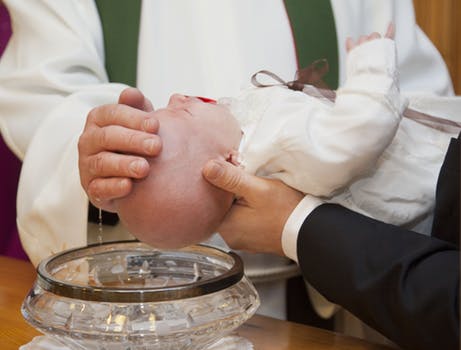
Congratulations on being asked by other parents to be involved with the baptism of one of their critters.  The institution of godparents probably extends back to times of greater mortality, when parents wanted to ensure that should they die, their children would be raised in a godly tradition.  Even today, being a godparent implies that the parents of a child see something in your life that they want instilled in their child as they grow.  In the course of the ceremony you will be asked questions, both affirmations and renunciations.  The service can be found in the Book of Common Prayer, pages 299 through 314.  The link to the online version is here: http://www.bcponline.org


The practice of baptizing infants and children has come under heavy criticism, as it suggests that there is some magical property in the rite that transcends understanding.  To some extent the 1979 Prayer Book is guilty of making this claim.  Other Christians suggest that baptism is appropriate only for older people who are capable of understanding what it is that is being said and promised.  I believe that it is in fact appropriate to baptize infants and young children as long as it is understood what baptism is and isn’t.  Let me explain.


Baptism is not magic.  There are many people who are lost spiritually who were baptized.  Further, there are many redeemed who were never baptized; the thief on the cross being a prime example.  So what are we doing here?  Baptism is two things.  First of all, it is a celebration of the fact that without our knowledge or consent, Jesus Christ died on behalf of a sinful humanity, and all people, in every place and age, are justified by virtue of his substitutionary death.  Humanity will never be judged for its sins; they’ve been atoned for by the blood of Christ on the cross.  Just as an infant is unaware of this fact, so we are unaware that our sins are atoned for and will never be debited to our account.  Secondly, baptism is a public declaration, with by an individual or parents and sponsors, that we recognize the death of Christ to be germane to our lives, and that just as he died, we, too, need to die to self, be buried and come up a new person.  We need to cede our will to Jesus, and the symbol of giving up our will is to allow ourselves to be buried, in water as it’s cleaner than dirt, so that the old man with his selfish will, might be done away with.  We come up in newness of life, free to obey Jesus as Lord and embark on a new adventure of living with Him.  To the extent that kids are being baptized, it’s up to the parents and sponsors to bring them up to know that just because they want something, doesn’t mean it’s good or they should get it.  It takes a lifetime sometimes to get the point across that our will should not, must not, be paramount, and that the faster we sign the death warrant to our own wills the better off we’ll be.  Thus, parents and sponsors are the tools God uses to get the point across to kids that “It’s not about you.”  To the extent that you can help them control their will, you’ve been God’s surrogate, and everybody, God, them, society and you, will be the better for it.


Although it’s beyond the scope of a discussion of baptism, I should point out that the way people get into spiritual trouble is not for being sinners per se, but for being fruitless.  Jesus died for our sins, he is our savior.  He lives to impart new power to us, he is our Lord.  Or should be.  Check out that attached paper for more.  

This brief monograph captures the salient points of Christian doctrine.  I would appreciate it if, before the ceremony, you read, mark, learn and inwardly digest it.  It’s all based on Scripture, and conforms to the thinking of the great Christian luminaries across the ages.  I would ask that you be prepared to answer the following questions:


What, if anything, is new to you?

Is there anything you don’t understand?

Is there anything you understand but don’t agree with?

Is there any Scriptural basis for your disagreement?  Any historical precedent for your viewpoint?

Do you still want to be a sponsor?  Some kids are pretty docile, while others can be a handful.

Please feel free to contact me with any reactions you have to this letter or this article.  As the Scriptures say, it’s better to not vow, than to vow and break it.  Thank you for your willingness to get involved in the life of a child.  I look forward to having a beer and hearing the answers to these questions.

Why I’m Not a Five Point Calvinist

By | Cleric Listens | No Comments

T – Total Depravity

The first point of orthodox Calvinism is that man is totally depraved.  I would argue that he’s right to the extent that our will is depraved, and apart from the indwelling Holy Spirit, nothing good can be accomplished by man.  Pelagius’ argument was that man could in fact do right apart from the aid of the Holy Spirit, and in this he’s totally wrong.  However, as Richard Hooker and Romans chapter 7 point out, although we are powerless to do right, we are not powerless to know and aspire to do right.  Says the Apostle Paul, “For I have the desire to do what is good, but I cannot carry it out.  For what I do is not the good I want to do; no, the evil I do not want to do – this I keep on doing.”  Thus we see that by the Biblical record, as well as the witness of discerning Christians, we are partially, not totally, depraved.  A distinction must be made between our moral perception and our moral action.  Thus it can be concluded that our conscience is intact until “seared as with a hot iron,” as Paul says.  One down, four to go.


U – Unconditional Election

Perhaps the biggest error of Calvinist soteriology is to be found in the doctrine of double election or predestination for the individual.  In a typical Greek or Western reading of the Scriptures, which is always an error, Calvin concludes that God elects some for salvation to show his mercy, and some for damnation to show his justice.  This is a complete misunderstanding of the terms election and predestination as used by the Biblical authors.  A careful reading of those authors reveals that these terms are used almost exclusively when the audience in question is composed to a large degree of Gentile converts to Christianity.  What was the first problem confronted by the early Church?  As early as Acts chapter 6 we have a conflict arising between the Christians of Jewish and Greek background revolving around the relative status of the two groups.  Specifically, the question was just how Jewish Gentile converts had to become.  Did they have to adopt Jewish cultural and religious customs, or not?  This was the topic of discussion at the very first ecumenical council held in Jerusalem and recorded in Acts chapter 15.  The Biblical authors used the concepts of election and predestination to assure their Gentile audience that from before time and forever, in the eternal counsels of God, their need of a Savior was anticipated and planned for, no less than was the Jews’.  Thus, even though they were looked down upon by their Jewish brethren, the Gentile converts were coequal in God’s eyes, and were full members of the Church along with those of Jewish heritage.  These terms have nothing to do with individuals; they have to do with groups or categories of people.  This is in keeping with Jesus’ own use of the term “elect,” that it refers to all those people who respond to God’s grace with obedience to himself as Lord and a consequent humility toward one’s fellow man.

Calvin can be somewhat excused for arguing for unconditional election, in that he was arguing for God’s sovereignty in opposition to the Roman dogma of the church and pope’s possession of the keys to heaven.  He overstated his case in order to counteract over a millennium of ecclesiastical overreaching and doctrinal error.  I understand his intent and zeal, but his followers and he were in total error when it comes to understanding these terms in the context of their authorship and audience.


L – Limited Atonement

How can it be that Jesus died for the sins of the whole world, yet by his own admission, not all are saved?  If there is one question that separates Christians, it is this: how do you explain how grace is limited to some and not available to all?  Romans state that it’s a matter of which church you’re a member of; their church being the only valid one.  Calvinists say it’s a matter of God’s caprice; see above.  Baptists and fundies say it’s a matter of not having too much fun; it’s the sin you avoid.  Dispensationalists say it’s a matter of knowing times and dates, as per Tim LaHaye.  To resolve this dilemma one must read the Bible; all of it.  Paul, and the author of the letter to the Hebrews, make a distinction between justification and salvation, an important difference.  Paul’s passages are found in Romans 5:9,10, Romans 10:9,10, and I Timothy 4:10.  See also Hebrews 9:28.  That is, we are justified or forgiven because of the death of Christ, which Scripture affirms as being for the “whole world.”  There was a judgment passed on sin, and it took place on Good Friday.  I posit that as of that day, and indeed for all time, as God is outside of time, all humanity stood justified or forgiven for all sin.  Our sins will never be brought up to condemn us, as they are covered by the sinless blood of Jesus.  As of Good Friday, all humanity, of all races and religions and in all times and places, have been placed “in Christ” from a legal or forensic perspective.  This is not a universalistic statement, however, because in addition to being justified by Christ’s death, Paul says we must be saved by his life.  Thus we conclude that there are two judgments, not one.  The second judgment, which is described in Matthew 25 and Revelation 20, doesn’t involve sin at all, but rather the good we did not do, having already been justified.  Like in the parable of the wedding feast where someone is invited but chooses to refuse the wedding garments freely offered to him by the host, we can be justified and in Christ legally, but if Christ is not in us effectually through his risen life, we are not saved from this second and final judgment.  God’s will is that there be a complete and unlimited interpenetration of his Son and the individual believer; we in him legally, he in us effectually.

This explains how grace is limited.  It is not limited in the sense of Christ’s sacrifice.  It’s only limited by us in terms of our willingness to cede our will to the risen Christ in the person of the Holy Spirit and let him bear positive fruit through us.  For Calvin to say that the blood of Christ is somehow limited in its efficacy is to criticize God and his plan of redemption.  Any limits it encounters are the result of our deliberate refusal to cooperate with his plan which is both accessible to people yet honoring of their will.  Jesus is Savior of all, but not Lord of all.  To be saved is to have him as both.


I – Irresistible Grace

The idea here is that those who are chosen for salvation can do nothing to frustrate God’s sovereign choice of them for redemption.  Just as the damned cannot change their fate, neither can the saved.  This argument is a corollary to unconditional election, similarly stating that God’s sovereign election of a person to salvation leaves no room for human resistance.  While the doctrine of unconditional election focuses on God’s sovereign role, this doctrine focuses on man’s role, or lack of same.  It is inserted into the Calvinist creed to do two things; first, to make a cute word like TULIP, as it’s somewhat redundant, and secondly, to support prior statement of God’s sovereign rule.  Should the former doctrine prove untenable or overreaching, then this corollary will of necessity fall.  See prior arguments.


P – Perseverance of the Saints

Of the “five pillars” of Calvinism, this notion has the least warrant in Holy Scripture.  This doctrine states that “once saved, always saved” and all believers who are truly redeemed shall have “eternal security.”  Despite the fact that this rumination is explicitly refuted by Matthew 12:43-45, Hebrews 6:4-12, 2 Peter 1:10, and 2 Peter 2:20-22, it is nevertheless one of the most widely promoted falsehoods of Calvinist doctrine.  It precludes the possibility and necessity of any sort of human response to God’s grace in Jesus Christ.  Further, it would fulfill Arminius’ critique that this would make God the author of evil.

Just as Luther came up with 95 things that seemed debatable about indulgences, I offer these points to put classical Calvinist thinking in some sort of Biblical and rational context.  They all arise from the fundamental error of taking a document inspired by a Jewish God, and written by Jewish authors for a predominantly Jewish audience, being largely figurative, integrative, and synthetic, and reading it from a literal, individualistic, and analytical Greek or Western point of view.  Such an approach violates every tenet of proper exegesis, and results in a gross distortion of the propositional truth contained therein.  The fruit of Calvinist thinking is bitter indeed.  It is repulsive to the mind, enervating to the heart, and destructive to the spread of the Gospel.  As Will Durant writes,

… we shall always find it hard to love the man who darkened the human soul with the most absurd and blasphemous conception of God in all the long and honored history of nonsense.”


Why Do I Feel Guilty?

By | Cleric Listens | No Comments

We live in a moral universe.

If we didn’t there would be no such thing as guilt; nothing would matter.

But because we live in a such a universe, thoughts and actions count.

The cost of meaning is the possibility of failure.

The reason we feel guilty is because we are guilty.

We do not belong to ourselves, we belong to somebody else.

When a moral inventory is taken, we fall short, hence our guilt.

There will be an accounting at some point.

What is most peoples’ reaction to this fact?

They run around, trying to find something that they do well and others do poorly to emphasize.

And they blame shift.

“The woman you gave me, gave me to eat, and I ate.”

It’s your fault, it’s her fault, but it’s not my fault.

The only solution?  To confess your guilt, and give it to somebody who has no guilt of their own.

Who is that?  Jesus of Nazareth.  He has already taken your guilt, placed it in his own account, and paid for it.

This was done 2,000 years ago, but many don’t realize it.  When you do, it’s the most wonderful realization in the world.

What Does God Want?

By | Cleric Listens | No Comments

The one point the Church needs to be clearest on appears to be the point on which it is the most vague: what does God want?  And nor is it vague by intention; denominations strive to be precise on this matter, it’s just that they disagree.  An impartial observer who wanted to investigate the claims of Christ would have no trouble finding sincerity on the part of his followers, just consistency.  So how about we take a step back and see if there cannot be some sort of simplification and distillation of the Biblical record to answer that most important question: what does God want?


The Biblical record doesn’t comprise more than two chapters before trouble develops between God and his creature, man.  It is said that as a result of the Fall, there is enmity between God and man; God is mad at us, and we are mad at God.  The first sign of this enmity was that when God was looking for man during his walk in the cool of the day, man was ashamed and hid himself.  Thus, the prevailing reaction most people have to God, even to this day, is the desire to flee and hide.


Now the Bible is clear as well that God would undertake steps to deal with his enmity towards us first through the Law and then through a Son, the Messiah.  The life and ministry of Jesus of Nazareth was focused on his sacrificial death on the Cross on Good Friday.  He came not to teach, but to die, that his Father’s enmity toward the human race might be expiated through a substitutionary atonement.  Having submitted to this sacrificial death, during which all the accumulated sins of humanity were placed on him, Jesus declared all humanity justified; forensically guiltless and rehabilitated in his Father’s eyes.  Once again, God walks in his creation, looking to have fellowship with his sons and daughters, you and me.


This scenario leaves one important point untouched, however, and that is the enmity we feel towards God.  We still feel the shame of nakedness in front of God, and even though the Gospel declares our relationship restored, we will have none of it.  We continue to run from him and hide whenever he approaches.  This sense of nakedness before God, the resulting shame and tendency toward flight are thus the keys to answering the question: “What does God want?”  Clearly, what he wants is for us to realize that we’ve already been justified and to stop running away.  Thus, what he wants is not a positive contribution, a “work” in the sense of a Pelagian effort that springs from our own virtue, but a negative, the cessation of something that springs from our own false perception.


Now you may well say, “I don’t run from God.  He doesn’t scare me.”  Yet think of the ways we do run.  We hear him in the Garden no less than Adam, as we watch friends and neighbors change for the better when they encounter Christ.  And those very friends tell us of a God who has already forgiven us, and who does not judge us for our sins.  Yet what do we say in reply?  We drag up all our offenses against God and man, and act as if they are still in between us.  We postpone our divine encounter until we can stop them on our own, something that will never happen.  Or we deny that we’ve done wrong at all, saying that these things are fine and of no consequence to God or ourselves.  Both these responses are wrong.  The Biblical record says that we are justified by Christ’s death, but we are saved by his life.  We will not be judged for our sins; they have been atoned for on Good Friday.  What we will be judged for, however, is fruitlessness.  Having already been forgiven by God, do we stop running, walk with him, and let the Spirit that animated his Son dwell in us as well so that fruit might be born in a lost and broken world?


So we see that it is possible to be clear on this question of what God really wants.  And it’s not something we do, a work, but something we stop doing, a rest.  A rest from justifying ourselves by denying moral law, or from striving to make ourselves moral without the aid of the Spirit of Jesus.  We are born as responsible moral agents, and at the age of majority are challenged by the Gospel to see how we will react.  Will we deny the Biblical record and claim we have no sin, or the ability to stop sinning on our own?  Or will we simply say, “I am not at enmity with God any more.  If he’s not mad at me, then I’m not mad at him.  When I hear him walking in my life, I will not run, I will not hide, because I’m no longer naked.  I’m clothed with the righteousness of Christ, and I trust that the Spirit will not bring me ruin but success.


The Number 2

By | Cleric Listens | No Comments

Much is made of Biblical numerology, and not without reason; the numbers 3, 7, 12 and 40 seem to recur with purpose and regularity throughout the Scriptures.  I would argue, however, that one cannot understand the Bible and the God who caused it to be written without an appreciation for the number 2.  Let me explain.


The first thing you notice about the Bible is its inherent redundancy.  It seems as though God does everything twice!  Look.  Old testament, new testament; two.  These equate with the two covenants, first with Abraham, then with Jesus.  Two temples, the one made of stone, then the flesh and bones of Jesus.  Each sacrament has its own prior adumbrations as well, first the water of the Red Sea, which points to baptism, and then the Passover lamb, which finds its perfection in the Cross and the Eucharist.  Even the bad stuff seems to have a precursor, with the destruction of the temple and deportation of the Jews, a foretaste of the final judgment of humanity.


In each case we see the same pattern.  There is an imperfect, temporary, physical presentation, which presages a later, perfect, permanent, spiritual reality.  It is as if God wants to prepare us for the latter, so that we might have both warning and hope, and be thoroughly prepared.  Two.  Twice.  As Joseph says in Genesis 41:32, “The reason the dream was given to Pharaoh in two forms is that the matter has been firmly decided by God, and God will do it soon.”


Then, within the words of the Bible itself, we find Hebrew poetry.  It is characterized not by rhyme, but by repetition, or parallelism.  Being the only form of poetry that translates without loss, we find that God always says things twice.  Two, again.  Whether it be warning or promise, God wants us to know that  the matter has been firmly decided, and he will do it soon.


The bilateral symmetry of the cosmos is further demonstrated when we leave the form of the Scriptures and start to dwell upon the theology they reveal.  There is the kingdom of God, and there is creation.  Spiritual and physical.  There are two actors, God and man.  God and man are doing swell at the beginning, but are soon at enmity.  Man has two problems: God’s mad at him, and he’s mad at God.  This produces two moral dilemmas on man’s part: guilt and powerlessness.  These two problems lead in turn to two judgments, the first over sin on Good Friday, and the second over fruitlessness at the end of time, as per Matthew 25 and Revelation 20.  God’s solutions, needless to say, are also two in number: the aforementioned Good Friday and Pentecost.  For God’s enmity with man and our resultant guilt we have the death of the sinless Son of God, to cover our sins with his blood, and place us, legally, in his position of rectitude.  Having thus been justified from God’s perspective, we also need ministry from our perspective.  To eradicate the enmity we feel toward God, we need an infusion from without.  This is the role of the Holy Spirit, who comes in and fills the void left when our spirit was attenuated in the Fall.  Although we can’t take credit for this new life, it is nevertheless up to us to cease striving and rebelling, and to let the Spirit have his way with us, that our behavior might conform to and reflect our legal status.  We have been placed in Christ forensically, but Christ is to be placed in us effectually as well.


Two solutions, and guess what, two sacraments.  Just as we are justified once, so are we to celebrate that fact through the one baptism commanded by Christ.  And here we see the desirability of child baptism, for what is it except for the celebration of something done for us by another, with no agency or effort on our part?  Just as an infant child is incapable of willful effort one way or the other, and may even be asleep, he stands justified by the act of Christ’s death on the cross 2,000 years ago.  Just as that action is perfect and needs no repetition, so too our baptism is a one-time act that need not and should never be repeated.  Then, what of our powerlessness?  Even the greatest of saints knows the experience of needing a new infusion of power from above.  As the Scriptures record, the apostles themselves were “filled with the Holy Spirit” time and again.  So for the on-going drama of life, we need a sacrament that is repeatable, and which corresponds with our constant need of divine help.  Thus, communion is a request that the Spirit of Jesus dwell within us, no less than the bread and wine do, in a literal, deliberate sense.  Two actors, two problems, two solutions, and two sacraments, two points of contact with divine power.  Here’s a graphic representation of my point:

Moral Actor Problem Judgment Solution Christ’s Role Sacrament
God Enmity with Man On Sin Death on the Cross Savior Baptism
Man Enmity with God On Fruitlessness Pentecost Lord Eucharist / Confirmation


So what can we conclude from all this?  Both theoretical lessons and practical applications.  Regarding theory, I would, of course, make two points.  First, God is a God of simplicity.  He suits his solutions to the situation with an elegant economy that suggests his only goal is to reach us and help us succeed.  Secondly, we should beware of any belief or practice that stands alone.  If there is not a spiritual, perfect counterpart to our thought or action, we should be warned that we might in fact be infatuated with a prior, physical, transitory adumbration, and not the perfect, final, permanent reality.  This is why God saw fit to destroy the Jewish temple after the body of Christ had rendered it obsolete and a snare.


In terms of practical application, I would invoke the cliché that says there are only two kinds of people in the world.  How so?  There are two thieves crucified with Jesus!  They represent the only two responses that the death and life of Jesus can command.  The first is flippant and incredulous, “Aren’t you the Christ?  Save yourself and us!”  He personifies those in every age who hear the Gospel and choose to reserve the right to determine moral authority unto themselves.  The second is the first man’s opposite in every way.  “Don’t you fear God, since you are under the same sentence?  We are punished justly, for we are getting what our deeds deserve.  But this man has done nothing wrong.  Jesus, remember me when you come into your kingdom.”  This man is honest about himself, and believing regarding Jesus.  He has ceded his role as moral arbiter, and has in fact repudiated that right.  Between the two men, we have the sum total of human response to the Gospel.  The computer age has shown that the most effective and efficient way to compute, store and transmit data is through the use of bits; ones or zeros.  Either positive or nothing.  There or not there.  Analogue is fine for wrist watches and home audio, but when it comes down to ultimate reliability and parsimony, we are squarely in the digital age.  As with information, so with theology.  As Jesus says, you’re either for or against him, there’s no third way.  The question is not whether or not you’re a thief; any religion can tell you that you are.  The question is which thief are you?


So don’t make things more complicated than they really are, and never accuse God of not telling you what’s coming and what’s really important!  He’s done it all, if we’re simple enough to count to two.

Event 1                                                        Event 2

Old Covenant – Genesis 15                      New Covenant – Mt 26 etc.

Law                                                              Grace

Passover Lamb                                          Jesus

Red Sea                                                       Baptism

Jonah in fish 3 days                                 Jesus in Earth 3 days

Circumcision to enter promised land  Repentance to enter KOG

Babel to confuse speech                         Tongues to restore communication

Elijah                                                         John the Baptist

Israel                                                         Church

Noah and a promise- Genesis 8:21     Isaiah 54:9 and a promise

Manna                                                      Feeding of the multitudes


Redemption: Justification and Salvation Both

By | Cleric Listens | No Comments

Being a retired priest, I have the luxury of watching the Church from a safe distance and gaining some perspective on her travails.  What I see makes me sometimes wish I did not have said luxury and perspective, as what presents itself is troubling, and getting no better with time.  Although people are forever trying new packaging and forms for Christian life and worship, I get the sense that the problem lies not in the presentation, but rather in the substance, of our message.  Like Stephen on his way to getting stoned, let’s quickly review sacred history up to the present time, and see how we got into this mess.


Christianity in the West was a single franchise monopoly until the 16th century.  Yes, the Eastern Church broke off, and there have always been Middle Eastern variants of Christianity that should be recognized, but in the West, it was Rome or nothing until Martin and John got involved.  What ensued over the next 100 years, almost to the year, was a contest of hearts, minds and pens that still defies easy analysis LO these many years later.  Rome insisted that human tradition can and should be used to clarify Scripture in the formation of doctrine.  The good part of this is that their very imaginative interpretations of Holy Writ have allowed them to continue to talk about behavior and authority up to the present day.  They may not be right, but at least they maintain a semblance of order in their house.  And, it’s a big house.  As Stalin observed, “Quantity has a quality all of its own.”  The bad part is that they’ve had to cover for some pretty bad decisions in the past, like the celibate priesthood, and they are now paying a very real price for their approach to Scripture.


Lest we Protestants gloat over Rome’s troubles, however, we have many of our own.  No, we don’t embrace Pelagius in our soteriology; our God is sovereign and cannot be manipulated by human agency.  But then again, you ask a Protestant why behavior and authority matter, and if the person you’re asking is honest to his own Reformed traditions, they won’t be able to tell you.  The result?  The mainline Protestant denominations, each and every one, are beset by those who, in the words of Oswald Chambers, are saying, “Christ died for me, I go Scot free.”  The fights about sexual mores and political imperatives have driven the life, and the people, out of these churches in a comprehensive fashion.  If you want to witness fiscal, moral and theological irrelevance, just attend a mainline Protestant church.


So those of us with a little time on our hands have traditionally opted for one of two choices: wring our hands and give up, or takes sides and enter a fray that has yet to impress the non-Christian world as being at all important.  Being a little younger than most retirees, I was involved in a serious auto accident, I’ve chosen a third course, and that is to go back and see if there isn’t something the antagonists are missing that really is wrong with our message at its very core.  Forget packaging, forget names; what are we really saying about God and the human condition, and is it right?


I was able to confirm my suspicions and crystallize my own response after a visit to the home of a fellow cleric.  This man is a little more senior than I, and he views my efforts at theologizing with a combination of avuncular amusement and genuine horror.  I had commented that Paul makes a distinction between justification and salvation, and added that I felt this point was lost on most commentators.  The priest in question leapt from his chair and thrust a copy of N.T. Wright’s Justification: God’s Plan and Paul’s Vision into my hands.  I am not the only one, he seemed to be saying.  After reading the book, I can understand why he thought it was apropos.  Bishop Wright does in fact point out that Paul draws a distinction between the two concepts, and goes on to define justification in a most satisfactory way.  Where I would depart from his painstakingly thorough and labored analysis, however, is the way he defines salvation.  It’s only through an understanding of this second idea, and how it differs from justification, that really allows us to understand the mechanism of redemption.


I’m not focusing on this seemingly minute point in order to join the ranks of theologians and churchmen over the ages who feel that parsing words more finely somehow reveals more truth and insight into the mind of God.  Nor am I, in Wright’s own words, offering the scorpion of scholarly infighting instead of the fish of the Gospel.  After my injury I don’t have the will or energy to do that, which may be just why God allowed me to be in that car in the first place.  What I propose instead is to apply the same scrutiny to Paul’s writing that Antoine de St. Exupery applied to his biplane, when he observed that “Perfection is achieved not when there’s nothing more to add, but when there’s nothing more to take away.”


Suffice it to say that most commentators either gloss over the verses where Paul contrasts justification and salvation, or conclude that they refer to the same thing from different perspectives.  Rather than do what others do in this regard, I propose we look at two verses that hold them in stark contrast, and see if we can discern what Paul may be trying to say.  In Romans 5:9,10 we read:


“Since we have now been justified by his blood, how much more shall we be saved from God’s wrath through him!  For if, when we were God’s enemies, we were reconciled to him through the death of his Son, how much more, having been reconciled, shall we be saved through his life!”


Further, in Romans 10:9,10 we find:


“That if you confess with your mouth, ‘Jesus is Lord,’ and believe in your heart that God raised him from the dead, you will be saved.  For it is with your heart that you believe and are justified, and it is with your mouth that you confess and are saved.”


Now the first temptation is to say that Paul is simply indulging in that time-honored practice of Hebrew parallelism, where one statement is repeated in a different manner to have poetic impact.  Resist the temptation.  Give him more credit.  Let us assume that he wrote what he wrote for a reason, and wasn’t being redundant for the sake of literary form.  What I propose is that Paul is separating two things that must be kept separate, or else we will lose insight into how God redeems mankind.


First, Paul says that something happened on one day, Good Friday, that he calls justification, where all humanity was declared innocent in God’s eyes, and placed in Jesus’ legal position of righteousness.  The Rt. Rev. Dr. Wright is adamant on this definition of justification, and I agree.  To Paul it means being found by the divine court to be in a position of righteousness and legal probity exactly like that of Jesus Christ.  We’re not any different, but our legal standing is updated to reflect Christ’s righteousness, not our own. Donald Bloesch seems to agree:


“Something happened for our salvation in the death and resurrection of Jesus Christ independent of our belief or response.  Reconciliation and redemption are an accomplished fact, an objective reality that is not affected by the subjective attitude of man…The atonement of Jesus Christ signifies a transformation of the human situation, and not simply the possibility of a future salvation.”


Now I would clean up Donald’s soteriological nomenclature somewhat, but my point abides: on Good Friday Christ died for all humanity, independent of time, our awareness, or our ability to respond.  All are placed “in Christ,” whether they know it or not, and are justified.  As Scripture boldly proclaims, Christ died for the sins of the whole world.  There is nothing limited or imperfect about the shed blood of the sinless Son of God.  Is that the last word on man’s redemption?  No, but it is the first word.  God is no longer at enmity with us.


The second word God speaks is that of salvation, to Paul an entirely different kettle of fish.  It is, according to John the Baptist, Jesus, John the apostle, and of course Paul, deliverance from a coming wrath reserved for those do not value, but rather squander, their justification.  It’s not too much to say that whereas both Rome and Geneva say people are lost until they are saved, variously through ritual observance or divine election, a careful reading of Paul suggests that we’re in fact saved until we’re lost; a very different thing!  And Paul’s not the only one saying this.  What we read in many parables, in Hebrews chapters 4 and 6, and throughout that entire, pesky, book of James, is that we can indeed fall out of a position of favor with God.  Further, Jesus himself says in John 15:2 that the branches that are cut off and burned are those originally “in me.”  Although it is treading on the inner counsels of God, I would venture that at the age of majority, people become subject to the temptation to declare themselves moral free agents, and become subject to this coming, second judgment.  Jews and Christians both have sensed this reality, and have commemorated the occasion with rites to confirm a right decision.  What each is saying is, “We are no longer at enmity with God, and therefore trust him to control our lives.”  This, as both experience and the Bible suggest, is anything but universal.


Looking at redemption as a two-phase project makes perfect sense.  There are two actors, God and man.  God and man are doing swell at the beginning, but are soon at enmity.  Man has two problems: God’s mad at him, and he’s mad at God.  This produces two moral dilemmas on man’s part: guilt and powerlessness.  God’s solutions, needless to say, are also two in number: Good Friday and Pentecost.  For God’s enmity with man and our resultant guilt we have the death of the sinless Son of God, to cover our sins with his blood, and place us, legally, in his position of rectitude.  Having thus been justified from God’s perspective, we also need ministry from ours.  To eradicate the enmity we feel toward God, we need an infusion from without.  This is the role of the Holy Spirit, who comes in and fills the void left when our spirit was attenuated in the Fall.  Although we can’t take credit for this new life, it is nevertheless up to us to cease striving and rebelling, and to let the Spirit have his way with us, that our behavior might conform to and reflect our legal status.


Two solutions, and guess what, two sacraments.  Just as we are justified once, so are we to celebrate that fact through the one baptism commanded by Christ.  And here we see the desirability of child baptism, for what is it except for the celebration of something done for us by another, with no agency or effort on our part?  Just as an infant child is incapable of willful effort one way or the other, and may even be asleep, he stands justified by the act of Christ’s death on the cross 2,000 years ago.  Just as that action is perfect and needs no repetition, so too our baptism is a one-time act that need not and should never be repeated.  Then, what of our powerlessness?  Even the greatest of saints knows the experience of needing a new infusion of power from above.  As the Scriptures record, the apostles themselves were “filled with the Holy Spirit” time and again.  So for the on-going drama of life, we need a sacrament that is repeatable, and which corresponds with our constant need of divine help.  Thus, communion is a request that the Spirit of Jesus dwell within us, no less than the bread and wine do, in a literal, deliberate sense.  Two actors, two problems, two solutions, and two sacraments, two points of contact with divine power.

So what can we conclude from all this?  Both theoretical lessons and practical applications.  Regarding theory, I would, of course, make two points.  First, God is a God of simplicity.  He suits his solutions to the situation with an elegant economy that suggests his only goal is to reach us and help us succeed.  Secondly, we should beware of any belief or practice that stands alone.  If there is not a spiritual, perfect counterpart to our thought or action, we should be warned that we might in fact be infatuated with a prior, physical, transitory adumbration, and not the perfect, final, permanent reality.  This is why God saw fit to destroy the Jewish temple after the body of Christ had rendered it obsolete and a snare.


In terms of practical application, I would invoke the cliché that says there are only two kinds of people in the world.  How so?  There are two thieves crucified with Jesus!  They represent the only two responses that the death and life of Jesus can command.  The first is flippant and incredulous, “Aren’t you the Christ?  Save yourself and us!”  He personifies those in every age who hear the Gospel and choose to reserve the right to determine moral authority unto themselves.  The second is the first man’s opposite in every way.  “Don’t you fear God, since you are under the same sentence?  We are punished justly, for we are getting what our deeds deserve.  But this man has done nothing wrong.  Jesus, remember me when you come into your kingdom.”  This man is honest about himself, and credulous regarding Jesus.  He has ceded his role as moral arbiter, and has in fact repudiated that right as he formerly exercised it.  Between the two men, we have the sum total of human response to the Gospel.  The computer age has shown that the most effective and efficient way to compute, store and transmit data is through the use of bits; 1’s or zeros.  Either positive or nothing.  There or not there.  Analogue is fine for wrist watches, speedometers and home audio, but when it comes down to ultimate reliability and parsimony, we are squarely in the digital age.  As with information, so with theology.  As Jesus says, you’re either for or against him, there’s no third way.  The question is not whether or not you’re a thief; any religion can tell you that you are.  The question is which thief are you?


At this point those in the Reformed tradition throw up their hands and say the only explanation for the success of some and the failure of others must be predestination and divine election.  In doing so, however, they show themselves to be more faithful to the traditions of John Calvin and the Synod of Dort than they do to Scripture, which they pretend to revere.  Aren’t most references to election and predestination spoken, whether by Paul or Peter, to gentile audiences, in order to stress God’s knowledge of their need and their inclusion in the person of a Jewish Messiah?  And are they not references to categories of people, and not as we in the West in the tradition of Aristotle like to think, to individuals?  Election and predestination, as used in the Bible, refer to God’s preordained plan of redemption, and the fact that some would submit to that plan, while others would not.  Never does it refer to God’s arbitrary choice of some for salvation and some for damnation as individuals.  Have not those in the Reformed tradition demanded allegiance to John Calvin over and above the Bible?  No less an authority than Will Durant characterizes Calvin as having “darkened the human soul with the most absurd and blasphemous conception of God in all the long and honored history of nonsense.”


So what is God’s solution to the problem of our lack of power?  Like our moral guilt, our lack of power is solved by Jesus Christ.  Not by his death, but rather, as Paul says, by his life.  Whether this refers to the life conferred upon Christ after his death or that same life poured out upon the Church as of the Ascension and Pentecost is immaterial.  What is germane is that God intends to make us righteous in behavioral fact as well as legally.  The only way to do this is to offer the Spirit, who can come into the heart of the Christian, to become the motive force for a new existence, based upon Christ and not our sinful selves.  Thus, not only are we in Christ as of Good Friday, Christ is also potentially in us as of Pentecost.  This mutual interpenetration is what God intends for all his children; anything else is an abridgement of the divine plan for redemption.


Unlike justification, salvation can be resisted, not because it requires a work, but the cessation of a work: our relinquishment of our will, of control over our lives.  We have a role to play, but unlike Pelagius’ approach, that role is negative and cannot be credited as emanating from our own power or nature.  All credit goes to the Spirit who does these wonders in us, but that same Spirit does not brook competition, and will not persist if we make too many inroads into his hegemony.  All talk of “eternal security” and “once saved, always saved” does not stand up to the light of Scripture.  Not only are these concepts not Biblical, they are actively harmful to the mission of the Church.  The only unforgivable sin, we are told, is blaspheming the Holy Spirit.  The Holy Spirit wrote the Bible, and to argue with its contents, whether by word or deed, is to frustrate the redemption bought by the Father at such great cost.  To claim otherwise is to mislead people regarding both our human situation and the heart of God.


Let me see if I can make this more clear with a table:


Phase of Redemption Divine Event Corresponding Sacrament Christ’s Role Our Role Relative Position Duration Moral Position
Justification Good Friday Baptism Savior Passive We in Christ One Time God no longer at enmity with us
Salvation Easter/Pentecost Holy Communion/

Confirmation

Lord Negative Christ in us On-Going We no longer at enmity with God


Note the many advantages to making, or discovering, this Pauline distinction:


  1. First of all, you’re suddenly faithful to the entire Biblical revelation.  You don’t have to say you’re in favor of this portion of Scripture over another.  You can read it all, believe it all, and obey it all with none of the selectivity that characterizes today’s Church.  We’re saved by grace through faith, but faith takes on new virility.  It’s not intellectual assent to a theoretical proposition, it’s submission to a superior authority, as illustrated by the Roman centurion in Matthew 8.  God does it all, but there is a role for us, albeit a negative one.  Behavior counts, because although you can’t be saved through works, you can, as David Chilton says, be damned by them.
  2. Secondly, there’s a pastoral advantage.  For the first time, you can engage in logical talk with people, Christians and non-, about the universal experience of the vicious circle of repentance, failure, guilt and back-sliding in moral endeavor.  There’s a reason all aspire to morality, and an equally good reason why we all fail.  Failure need not lead us to reject morality, as so many do, but rather to shift the basis for our moral inspiration away from ourselves to the life of Jesus in us.
  3. Thirdly, all this is good for God’s reputation.  He doesn’t deal with problems is a fragmentary of incomplete way.  God deals not just in legality, but also in reality.  He doesn’t demand of us what he doesn’t make possible through the death and life of his own Son, both.
  4. Finally, such thinking can clean up any discrepancy between Roman and Protestant, to say nothing of the fragmented nature of the latter body.  Rome can hereby escape from the clutches of Pelagius, a much-needed change, and place the responsibility for redemption where it belongs: with Christ.  Geneva, too, can breathe easier.  Divine election and predestination are no longer the deformed individual phenomena we’ve always assumed in the West, and Protestants can talk about authority and behavior for the first time in almost 500 years.


Perhaps all this confusion comes from the titles we give Jesus.  As Savior, he justifies and cleanses us from sin.  As Lord, he saves from the coming wrath.  It sounds backwards, but this is the way it makes sense.  Perhaps the confusion is also due to the arrogance of our times.  How could Paul, simple Jew that he was, outsmart us with all our scholarship and philosophical sophistication?  It could be that those very things that we are so proud of are what are keeping us from hearing what he was actually trying to say to us.  Whether Roman or Protestant, we add our own traditions, heroes and shibboleths until the power and simplicity of the Gospel are lost.  Until our reading becomes as careful as Paul’s writing, we’ll be condemned to centuries of acrimonious debate while a waiting world looks on, unimpressed.  Maybe if theologians contemplated biplanes as opposed to jumbo jets, the Church would be able to take flight as God intends.


Reduced to its essence, the job of the Church is to understand this mechanism of redemption, and to share that knowledge with a rebellious and hurting world.  To the extent that we are imperfect in our understanding ourselves, we will necessarily be unable to fulfill that commission.  As Francois de Malherbe said to his preacher after a particularly poor sermon, “Improve your style, monsieur!  You have disgusted me with the joys of heaven.”  Just so.


John Calvin and the Mendoza Line

By | Cleric Laughs | No Comments

Mario Mendoza was a major league baseball player whose defensive skills overshadowed his meager offensive ability.  Although Mr. Mendoza was a lifetime .215 hitter, it is generally agreed that the Mendoza Line, set at .200, is the lower limit below which a player’s presence in the big leagues cannot be justified, no matter how good his defense.


One of my major problems with religion in general and theology in particular is that people tend to suspend logical thought in favor of “feelings” and “what I’ve always been told.”  It occurs to me that when it comes to judging the contributions of historical figures, we need to introduce some objective standard by which they can be judged.  Why not adopt a Mendoza Line for theology, where if a figure is not batting better than .200, we don’t condone their presence on the field of theological reflection?


Take John Calvin, for instance.  The contributions made by John to the overthrow of medieval Roman Catholicism cannot be overrated or underappreciated.  By arguing for God’s sovereignty at the expense of all attempts to co-opt it, Calvin helped repudiate the notion that participation in indulgences, masses, pilgrimages and the like could somehow sway God and purchase salvation.  For this we should be grateful.  His followers, as is often the case after the death of a principal, have taken his already alarming ideas to even more distressing levels.  The Synod of Dort, in 1618-9, gave rise to the five articles of Calvinism, captured by the acrostic TULIP.  T stands for the total depravity of man, U for unconditional election, L for limited atonement, I for the irresistibility of grace, and P for the perseverance of the saints.  Together the five have become the Shibboleth of the Protestant churches, and anyone who questions them is excoriated as “Arminian.”


So, briefly, how is Calvin, or at least “Calvinism,” doing?


Total depravity I get, sort of.  This is the idea that, as Paul says, “I know that nothing good lives in me…”  (Romans 7:18a)  Pelagius was rightly ostracized for saying that although the Holy Spirit helps, it is still possible for us to obey God and his law through our own will power.  Anybody who has tried to obey will quickly realize that what we need is not repair but replacement.  If it is good, it has to be from God, for as Jesus says, “There is only One who is good.”  ( Matthew 19:17)  To the extent that I do anything good, it is not I who do it, but Christ who lives in me.  (Galatians 2:20)  On the other hand, we can still know good, even though we can’t do it.  Paul said, “For in my inner being, I I delight in God’s law;” and “For what I do is not the good I want to do…”  So we can have knowledge, we can have proper intent, but in execution we fall short.  So a distinction needs to be made, as Richard Hooker did, between conscience, which is not fallen, and ability, which is.  Not total depravity, but partial depravity.  So far, half a point.


Now, about unconditional election.  This is the notion that individuals are chosen for salvation, without regard to the will or actions of that person.  Now in hindsight, you might have a point, where is can be said that a God who is outside of time can “know” what the future holds, but that is terminological inexactitude, to quote Churchill.  We are bound by the fourth dimension, and it is useless, if not outright dangerous, to venture into the mind of God in terms of what he “knows.”  The fact is, election is a poorly understood term in the Bible, and particularly for those who hail from the Western or Greek school of thought.  Where in the Bible does election refer to an individual?  Even when Paul uses Jacob and Esau as examples, they are but exemplars of those who submit to a wider divine plan of salvation and those who do not. (Romans 9:13)  When do Paul and Peter rev up the talk about election and predestination, if not when talking to Gentiles about the “mystery of God,” his plan to include Jew and Gentile in one people?  They are arguing that salvation is not something that is limited on the basis of genetics, but that is open to all who, like Jacob, submit to God’s plan for justifying and sanctifying a sinful and rebellious humanity.  So on this count, Calvin whiffs.  He’s now one for two.


Now, let’s look at perhaps the most pernicious tenet of all, that of limited atonement.  This is the idea that the cross of Christ is limited in its power to justify some individuals, but not all.  What treachery!  Where in the Bible does it say that Jesus only died for some?  I thought it said he died for the sins of the whole world (1 John 2:2,) and that it is God’s will that ALL men come to know the truth and find salvation. (1 Timothy 2:3)  The basis for this appalling conclusion is the wrong notion of how God saves.  Paul, to his eternal credit, makes a distinction between justification and salvation. (Romans 5:9.10, I Timothy 4:10b)  All, says Paul, are justified by the cross.  That is, there is nothing limited about atonement.  What is limited, and this is where people get confused, is the latter event, that of salvation.  We are not lost until we’re saved, we’re justified until we’re lost.  God nowhere condemns on account of original sin, or sins he “foresees.”  What happens is that if those who are justified by the cross of Christ continue to live according to the flesh and do not take advantage of the necessary life of the Spirit, they are disqualified from the salvation from the “coming wrath” to which Paul refers in his letters. (Romans, Ephesians, Colossians, 1 Thessalonians)  Although it looks like the atonement of the cross is limited, it is not.  There is no limit to the power of the blood of Christ!  What is limited is the willingness of people to be honest with God about their own limitations (See Total Depravity of Man) and ask for help in the person of the Holy Spirit.  We are not “saved” because of anything we do, we are “saved” when we stop doing something: protesting our innocence and challenging God’s moral rectitude.  Another swing and a miss for Calvin.


So, number four, irresistibility of grace.  This is the flip side of unconditional election, and as such, suffers from the same theological and logical defects.  Here we have the belief that a person, chosen by God and therefore elect, cannot resist the ministry of the Holy Spirit and sin.  Hogwash!  I do this every day, and know in detail how easy this is to do!  The Holy Spirit is a person, and a gentleman at that.  He doesn’t insist on getting his way.  Like any discreet guest, he offers his help, and if refused with any consistency, he simply decamps until such time as our attitude changes and we re-extend an invitation to him.  What Paul argues in the whole of his testimony is that it is possible, indeed common, for people, even Christians, to resist God’s grace.  Is this not what the Jews who killed Stephen were guilty of, and do not James and Peter both urge us to resist the enemy?  Does our will, as polluted as it is, not count for something?  Is God totally arbitrary, or does he not seek after men and women after his own heart, like David, who kept God’s commands and (often) did what was right?  Again, in the final analysis, I suppose it’s possible to say that after a person dies, God’s grace prevailed in a life and has had His way.  Fine.  But the testimony of Scripture and the example of human experience suggests that man has one problem and one problem only, that he tends to resist God’s grace to be in actuality what he is, since Good Friday, legally.  Another strikeout for John, and there’s still another matter to consider.


The final contention of the Synod of Dort was that the saints would persevere.  This is also a modification of an earlier tenet, that of the irresistibility of grace.  Put another way, we have the contention that “once saved, always saved.”  Although this is a specious argument whose popularity is widespread, it is patently untrue.  To repeat, our problem is not that something goes wrong with our justification by the blood of Christ.  This is a standing fact that is, in the words of Donald Bloesch, “independent of our belief or response.”  The problem arises when we, like the seed that falls on the path or in suspect soil, fail to allow the Holy Spirit to come in and do through us what we cannot do on our own.  Thus, we fail to abide where the blood of Christ has put us, and are cut off and burned as unfruitful vines.  We recommit Adam’s sin of deciding for ourselves what is right and wrong, and thereby disobey the injunction of the Bible that we be honest and ask for help.  Blaspheming the Holy Spirit is the only unforgiveable sin, as it consists of resisting the testimony of God, the Bible, which was written by the Holy Spirit.  Do saints fail to persevere?  All the time.  In a very real way, all are saints at birth, and the masses who fail to abide in Christ do not lose their salvation as much as they lose the benefits of justification; a very different thing.


So Calvin has been coming to the plate for almost 500 years, and four and a half out of five times he has failed to get on base.  No walks, even.  Let’s go back to Mario Mendoza.  Here’s a man who was great on defense, but couldn’t hit a lick.  He became the personification of offensive ineptitude, and has given his name to the measure of that unfortunate reality.  If we ditch a player because of this offensive liability in baseball, shouldn’t we also have a standard in theology?  According to this brief and cursory analysis of Calvinism, he’s at the Mendoza Line, batting one half out of five!  Although we appreciate his defense against Rome, we can’t put up with his misleading and hurtful performance at the plate.  What he offers is worse than what he got rid of.  Time to trade for a better player, one who can give us consistent, reliable production, so that we can get this Christian team on its way to victory.


God is My Friend: A Primer for Children

By | Cleric Listens | No Comments

A friend accepts all people

“… God treats you and me the same.”  Romans 2:11


A friend accepts people as they are

“… while we were still me people, Christ died for US!.”   Romans 5:8

A friend forgets our mistakes

“I will forgive and forget all the wrong things.”  Jeremiah 31:34b


A friend gives us a place to stay

“Make your home in my love.”  John 15:9b


A friend is easy to please

“I won’t lay anything heavy on you.”  Matthew 11:30 TM


A friend knows what makes us happy

“’I know the plans I have for you,’ says God, ‘They are for good and not for bad, to give you a future and a hope.’”  Jeremiah 29:11


A friend doesn’t keep secrets

“I call you friends, and tell you everything that I have heard from our Father.”  John 15:15b JBP


A friend warns of danger

“Not everyone who calls me, ‘Lord, Lord,’ will go to heaven …”  Matthew 7:21a


A friend knows what makes us sad

“… your wrong things keep you from your God,”  Isaiah 59:2


A friend lets us choose

“Do you want to get well?”  John 5:6b NIV


When we cannot do something, a friend will do it for us.

“… I don’t live any more, but Christ lives in me.”  Galatians 2:20a  Beck


A friend is easy to find

“I stand at the door.  I knock.  If you hear me call and open the door, I’ll come right in and sit down to supper with you.”  Revelation 3:20a TM


God is MY friend

“Abraham believed God … and he was called God’s friend.”  James 2:23 NIV

God is Jewish

By | Cleric Listens | No Comments

My daughter recently made the observation that popular Christian authors have a theme they consistently return to in their writings.  She was able to spout off what Tim Keller and John Piper feel is their unique contribution to the Christian agenda, based on having read a number of their works.  “What’s your theme, Dad?”  Although both insufficient and misleading, I immediately replied, “God is Jewish.”  Let me explain.


The first thing to point out is what I do NOT mean.  I do not mean that God cares one whit about the fate of racial and political Israel, any more than cares about his lost children wherever they are found.  Of all the great foreign policy blunders of the 20th century, I am persuaded that failing to listen to T.E. Lawrence and giving the Middle East away to European powers at Versailles ranks first.  A close second would be Great Britain giving Palestine to the U.N. to turn over to Jews to found a new, theocratic state.  Quick reference to Leviticus 26 can explain the fate of the Jewish race from the time of Christ, if, of course, you understand their rejection of Jesus of Nazareth as the Messiah as having any meaning at all.  As far as I can ascertain, all references to Israel in the Bible after the coming of the Messiah refer to the Church, which is Jewish in its roots but ecumenical in its final flowering.  Paul goes to great lengths to portray the breaking down of the racial barrier between Jew and Gentile as the mystery of God, for which all creation has been waiting.  To this day, Jews remain hostile to the Christian Gospel, and formally reject it as a perversion of the revelation over which they claim sole custody.  So I am no Zionist, and contend that crimes committed in the name of God are even more onerous than those committed for more base reasons.


What I do mean by saying God is Jewish, is that the Bible, in both testaments, is a document that is singularly Jewish in terms of its authorship, its intended audience, its literary style and its philosophy.  This means the Western or Greek reader must take this Eastern background into account when reading the Scriptures or he’s simply not going to understand what he’s reading.  First of all, he is going to come to wrong conclusions.  He’s going to think it’s saying things that it is not.  Secondly, he is going to miss things that he should be getting, points that the author thought he had presented clearly.  Further, I submit that this East/West mismatch has led to the major theological fights in the Christian Church, both Catholic and Reformed, to date.  Until this ingrained bias is recognized and taken into account, Christian thought will be paralyzed and the mission of the Church enervated.


First, the wrong conclusions.  Christian thought was dominated by pagan and Roman Catholic distortions for over 1,000 years.  With the adoption of Christianity as the state religion by Constantine, the old pagan pantheon was replaced by a Christian cast, but the script was not fundamentally altered.  The result was that the Jewish concept of monotheism was completely lost in the translation.  The subsequent hash was then systematized, to the extent that it could be, by Thomas Aquinas in the 13th century.  After having experienced a personal revelation in 1273, Aquinas admitted that “all I have written now appears to be of little value.”  He died before he was able to set matters straight, and the unexpurgated Summa Theologica has become the unquestioned source for all Roman “theology” since.  Because the Roman church was dominated by political and philosophical forces from the start, it’s no wonder that the basic message of a loving triune God was immediately lost.


What’s more surprising, however, is that Protestant theology is just as prone to distortions due to this Eastern or Jewish presentation as Roman theology.  The reformers attempted to sweep away the human accretions of those thousand plus years and get back to Scripture and the original message of the early Church.  Their rallying cry was Sola Scriptura, Scripture Only, and they said that if it couldn’t be found in the Bible, it couldn’t be required of a man.  Just what was the Bible saying, though?  In their zeal to refute Rome and the counterreformation some of the reformers, notably John Calvin, overstated their case.  Will Durant, author of The Story of Civilization, says of Calvin, “…we shall always find it hard to love the man who darkened the human soul with the most absurd and blasphemous conception of God in all the long and honored history of nonsense.”  What would lead Durant, probably the most circumspect man ever who ever lived, to make this statement?  No doubt Calvin’s theory of what has become known as double predestination.  Let’s take a look at what this term refers to.


The concepts of election and predestination are Biblical.  The words elect and election are not found in the NIV in the Old Testament, nor is predestination in any of its forms.  In the New, elect appears six times in the Gospels, always appearing as the words of Jesus, and five times in the Epistles, used four times by Paul and once by Peter.  Election appears three times, used twice by Paul and once by Peter.  Predestination in its various forms appears four times in epistles, always used by Paul.  On the basis of these 18 occurrences, Calvin refuted the Roman doctrine of merited grace and consequent salvation.  What was in question was what I call the agency of salvation; that is, who saves whom?  For Rome, we save ourselves, with the help of the Church, of course, by putting God into our debt by works or merit and supererogation.  The notion that anybody could force God to do anything, and by ascribing debt, no less, was anathema to the reformers.  They, one and all, pointed out that God is sovereign, and man can do nothing to force God’s hand.  Further, no good thing resides in us, as Paul so eloquently put it, and we can do nothing to earn our salvation.  While all this is true, Calvin and his followers went further and said that God simply chooses some for salvation, to show his mercy, and some to damnation, to show his justice.  We are elected to salvation or perdition by God’s fiat, and that is that.  The fate of the individual is beyond their control, as man is powerless to resist God’s will.


Not all Protestant reformers bought into double predestination.  Jacobus Arminius, for example, went to great lengths to point out that for God to elect some to sin and damnation, he would have to be the author of sin.  Calvin’s followers took care of this valid objection, however, by making sure that the Arminians were excluded and the Calvinist faction prevailed at the Synod of Dort in 1618-9.  Since the closing of that ecumenical synod, Christian thought has stagnated into a pattern of sniping between Roman and reformed, and has never been able to come up with anything suggesting a synthetic solution to the problem of what these 18 Biblical references actually mean.  Could it be that the Church has painted itself into a theological corner simply by the way it has read these few passages?  I think so.


First of all, who is being elected or predestined here? Calvin assumed that it was individuals who were chosen for heaven or hell.  A casual reading of the Bible will show that in the beginning, God’s preferred unit of address is not the individual, but the family, the tribe, the nation, or the even the civilization. When Achan, Korah, Dathan, and Abiram were punished, their whole families were collected and suffered the same fate as those who actually sinned.  This is no doubt because none of us acts in a vacuum, and what we say and do is both cause and consequence of our communal life.  Although this policy was eventually rolled back and tempered by first Moses and then Ezekiel, the Bible stresses that sin and virtue are corporate qualities that for the most part persist from generation to generation.  God says he will punish “the children for the sin of their fathers to the third and fourth generation of those who hate me.”  To say that God does not take our upbringing into account when judging us, for good or ill, is to impugn his integrity.  This was Arminius’ argument.  God ultimately judges the individual, but he also has strong opinions about culture and ideology that aid and abet the individual in behaving the way they do.  So to say that God picks and chooses individuals is only correct when you realize that those individuals are members of a larger group or type.  It appears to me that this assumption of individual address is an interpolation due to Greek or Western philosophy, and is contrary to the intent of the Jewish authors of the Scriptures.


This leads to a second question, and that is, how does God decide what group you are in?  Although a crude reading of the Scriptures will say that it’s all based on genealogy, which is its own version of fiat, as the Biblical narrative progresses it becomes clear that blood is quickly superseded by behavior.  This can explain why references to predestination and election are restricted to the New Testament, are so few in number, and appear only when speaking to or about non-Jews.  The letters to the Romans and Ephesians were written to non-Jews, and the pastoral epistles of Paul were addressed to Timothy and Titus, both of whom were involved in ministries to the Gentiles.  Timothy was half Greek himself, being from Lystra in Asia Minor.  Peter, too, wrote to those scattered throughout the Gentile world, not to the Jews of Judea.  Thus, it makes sense that this concept of preordained election was meant to assure Gentile Christians that from before time and forever, God would know of their need for a Savior, and they would be included in his plan to unite Jew and Gentile in one man, Paul’s fundamental mystery of God.  When Jesus refers to the elect, he too is implying that those chosen for salvation are a subset of his hearers, whether Jew or Gentile.  Viewed this way, election and predestination are not threats to winnow individuals arbitrarily, but rather promises that at no time did God intend salvation to continue on a racial or political basis.


How did a promise get turned into a threat that would be used to browbeat reformed Christians to the extent that they were no more assured of pardon than their Roman brethren?  By imposing a Western, individualistic reading on an Eastern, tribal concept.  That’s how.


Another major problem that has stymied Biblical scholarship and ministry since the Reformation has been the tendency to read the Bible in a literalistic manner.  Archbishop Ussher of Ireland was the first to formally suggest that the world was between four and five thousand years old according to the various genealogies mentioned in the Scriptures.  The world, he said, was created in six twenty four hour days, literally.  The only problem with this approach is that it doesn’t take into account the Jewish tendency to write not for analytical purposes, but for synthetic.  Put another way, science may be the fruit of Western thought, but philosophy is the Eastern root.  I quote Will Durant again:


“Science wishes to resolve the whole into parts, the organism into organs, the obscure into the known.  It does not inquire into the values and ideal possibilities of things, nor into their total and final significance; it is content to show their present actuality and operation, it narrows its gaze resolutely to the nature and process of things as they are…But the philosopher is not content to describe the fact: he wishes to ascertain its relation to experience in general, and thereby to get at its meaning and its worth; he combines things in interpretive synthesis; he tries to put together, better than before, that great universe-watch which the inquisitive scientist has analytically taken apart…Science gives us knowledge, but only philosophy can give us wisdom.”


It’s not as though Greeks and Jews have a different view of truth, but they do have a different view of what’s important.  Take the creation narrative of Genesis.  To the Greek it gives a faulty account of the construction of our planet because it says it took place quickly.  Therefore, the entire account is dismissed as so much superstition and nonsense.  Not so fast, says the Jew.  The account tells you about agency, order, priority, purpose and man’s place in the cosmos, if you will enrich your understanding of language.  The Hebrew word for day, yom, is translated in the NIV Bible using over forty different words, only one of which is day.  It can mean period, phase, duration, many different things, but all pertaining to the passage of a finite period of time.  Think of all the ink, to say nothing of blood, spilled because of this misunderstanding not so much of language, but of thought.


In addition to causing trouble when reading how things got started, a literal gestalt will wreck havoc when reading about how things will end.  The nonsense of John Darby and his Dispensationalism comes from a desire to read an Eastern eschatology with a Western bent.  Whenever the Bible touches on what’s happening in the future or in heaven, concrete concepts fail, and literary liberties must be taken.  When Matthew, Mark, and Luke speak of the heavenly bodies being shaken at the coming of the Son of Man, does this mean a literal falling of the planets?  I assume it means that those things of which we are most sure, the rising and setting of the sun, for one, might as well be suspended, for all will be lost.  This squares with the fact that this figure of speech was used many times in the Bible for other nations and tribes that were being written off by God.  By its very nature, the Bible has become a medium of communication across time and cultures, and as such is subject to eisegesis, where foreign meanings can be injected into it if so desired.  This puts an added burden on the Bible interpreter, that he be aware of the peculiarities of the time and place of its composition as well as those of his own audience.


In addition to the danger of misunderstanding what is there, there is the danger of missing what the author was actually trying to convey.  Perhaps the most distinctive literary device of the Jew is the use of repetition.  Hebrew poetry is characterized not by rhyme, but by repetition or parallelism.  This is useful, as it translates, while rhyme does not.  Further, it conveys something about God and his mode of communicating with us that we miss if we think it’s just a poetic device.  Might not a loving God, like a concerned parent, deign to say things twice, whether warning or promise?  In his interpretation of Pharaoh’s dream, Joseph said that the fact that the dream was presented twice showed that God was resolved to bring this thing to pass and quickly.  Indeed, just about every event of consequence in the Scriptures can be found twice, once performed in history, imperfectly, and perhaps temporarily, and then again spiritually, perfectly, and permanently.  For each event there is a counterpart, that is either prediction, promise, or warning on the one hand, or realization, fulfillment, and final installation on the other.  You’ve got the Old Testament, then the New.  The Law, then the Gospel.  Moses, then Jesus.  The Red Sea, then baptism.  Passover, then the Cross.  Genesis 15, then the Lord’s Supper.  The list goes on and on.  Indeed, the number two can be said to be the numerical concept around which the whole revelation of God revolves.


Western New Testament scholars, however, are slow to appreciate this state of affairs.  Paul makes a distinction between justification and salvation.  To the western scholar, this is just parallelism, or poetry. To the Jew, however, such a distinction deserves our attention.  What Paul is saying, is that man has two problems, guilt and powerlessness.  God has two solutions, the death of Jesus and the life of Jesus.  The Church has two sacraments, baptism and communion.  One, like the death of Christ is unique, the other is repeated, like the continuous drawing we must do from the life of the risen Lord.  Failure to make this distinction has lead to much suffering, as disputes arise about the importance of behavior and the role man may or may not have in his own redemption.  Until you understand the mechanism of salvation, you don’t really know where you stand in the process, or how to help others who come under conviction.  All this imprecision in our thinking and trouble in our mission is due to cultural bias in our reading.


I could go on.  Arminius never said what Pelagius did, that we’re to draw good from within ourselves to merit salvation.  What he did say, and what I believe the Bible says, is that we’re to stop doing something, that is, protesting our innocence and trying to do things ourselves.  The ultimate test of honesty is to say that we are in fact guilty before a holy God.  The ultimate test of humility is to admit we can do nothing about it, and ask Jesus to do it in us.  All of this requires a change of heart, which implies the exercise of the will.  Why did Jesus speak in parables?  Why was he indirect in his explanations?  To the Greek, this is not only confusing, it is somewhat offensive.  Why doesn’t he just come out and say it?  We can assume that Jesus did everything for a reason.  If God were interested in dispensing information alone, he would have been more straightforward in his manner.  Yet God, in keeping with his Jewish nature, wanted to do more.  He wanted to engage the will of his hearer, knowing that the propositions being shared carried with them a challenge to personal independence and authority. In order to have the desired effect, all communication had to engage the will, so that the hearer would be invested in true understanding.  Again, God is a God of import, not of facts alone.  Eastern, not Greek.


This also explains why God did not see fit to leave us a historical record of his self-revelation that is punctilious and comprehensive.  The Scriptures, as it says in the 39 Articles of the Church of England, contain everything necessary to salvation.  They do not contain everything that can be known, and certainly don’t contain everything about God himself.  They do, however, contain enough to persuade the reader of life and death and purpose, if the reader is so disposed.  Those who ask for impeccability or undue comprehensiveness in the divine record are revealing that they are not interested in meeting God, they are interested only in explaining and controlling God’s chosen means of self-disclosure.  God doesn’t dance to our piping because it would be casting pearls before swine and would change nothing for the hard-hearted.


When I took my first Old Testament class in seminary, the professor opened with a correction.  He said, “There’s a vicious rumor circulating that I believe you have to speak Hebrew to go to heaven.  This is not true.  You don’t have to speak Hebrew to go to heaven, but if, once you get there, you want to know what’s going on, I believe you have to speak Hebrew.”  Perhaps this is an overstatement, as good translations from the Hebrew abound.  What we should strive for, however, is an understanding the mindset that goes with the language, which couldn’t be more different that that of the Greek or western mindset most of us have grown up with.  God had a choice when deciding where Jesus would be born.  He could have been born in Macedonia, or anywhere in the western world.  He did not go that route.  Instead he chose the backwater province of Judea, because it had the culture, philosophy and literary tradition that best coincided with a message of ultimate value that requires the participation of the entire hearer, his heart as well as his mind.


So Martha, my contribution is that God is Jewish.  It’s ironic that this should be the case, because many Jews today have become Westernized in their thinking, and have used that thinking to dismiss the claims of Christ.  Better we should all, Jew and Gentile alike, start looking not for reasons to not believe, but for excuses to believe, that we might one and all be delivered from the hell of solitude that a critical, analytic spirit inevitably leads us to.


Digital Theology

By | Cleric Listens | No Comments

I am the son of a computing pioneer.  My father was working at Point Mugu in the early 1950’s when one of the first analog computers ever sold arrived on the loading dock.  Being a Scot, my father took note of the price tag, $65,000 I believe, and decided he needed to find out what this machine was and what it could do.  He was soon able to use the device to simulate the flight of aircraft and the missiles to shoot them down, and later simulated the pulmonary and cardiac systems of the human body when he built one of the first working heart and lung machines in his spare time.  With my mother he founded Simulations Councils, Incorporated, which later became The Society for Computer Simulation.  Suffice it to say that he was so successful in spreading the gospel of computer simulation and its benefits that the Society today is no longer needed nor is it vital.  All branches of human endeavor have adopted computers and simulation as a means of maximizing performance and control while minimizing costs and risks.  With the development of integrated circuits, digital computers have largely replaced analog because of the increased computational power they offer at a much lower cost.  This change has become possible only through the grudging realization that you can represent just about any datum or relationship through bits of 1 or 0, there or not there, present or absent.  It’s not a romantic notion, but it’s true: by reducing all concepts to binary representation, we arrive at the best, cheapest, fastest way to do work and increase our leisure time.


In contrast to this increased dependency upon the black/white, there or not there reality of digital computation, we have the moral world around us.  Francis Schaeffer points out that up until the 19th century, a similar, binary view of the world prevailed.  Things were either in keeping with divine revelation or not; they were right or wrong, divine or demonic, worthwhile or harmful.  With the introduction of Hegel’s dialectic of thesis, antithesis and synthesis, however, we have a world that is increasingly attracted to gray.  There was no right or wrong, only progress towards a more refined synthesis.  What started out as a philosophical commentary was soon applied in every arena, particularly moral theology or ethics.  Gone is the quaint idea that things have implicit moral validity; a binary valuation.  Hegel has allowed us to substitute a kind of analog morality that has had sweeping implications.  Things that were once considered outrageous or inconceivable are now not only tolerated but encouraged as being avant garde or progressive.  It seems that our society is moving in one direction with respect to technology, while it’s moving in the exact opposite direction in terms of philosophy, morality, or perish the thought, theology.


To be fair I should point out that not everybody’s gone to shades of gray regarding moral theology.  Whereas the last almost 500 years have been characterized by a tension between the poles of Roman Catholicism and Protestantism, that enduring conflict has given way to a new battle between liberal and conservative versions of Christianity.  Unthinkable just a short time ago, conservatives of both Roman and Protestant stripes are finding they have more in common with one another than they do with their liberal compatriots.  This could never have happened unless both Roman and Protestant theologians had started to think like Hegel and base their pronouncements upon changing views of what constitutes right.  Just as an analog computer works by comparing relative voltages, modern moral debate is based upon a reference voltage that is fluctuating according to popular sentiment.  The result is that Rome has compromised its moral integrity in the name of legal and financial expedience, and the only sins that abide in Protestantism are those of sexism, racism, and homophobia.


So the question then becomes, in this debate between liberal and conservative, who’s right?  We can play Biblical roulette and proof-text using verses that buttress our preconceived position, but that’s been tried and has produced more acrimony than certainty.  Is it possible to look at the full expanse of the revelation of God as revealed in both Testaments of the Bible and come to an understanding of how God operates, and how he chooses to reveal himself, that will shed some light on this clash of hermeneutics?  I believe it is.


Taken as a whole, the first thing you notice about the Bible is its inherent redundancy in terms of both its form and its content.  In terms of literary form, you have Hebrew poetry and chiastic rhetoric.  The former is characterized not by rhyme, but by repetition, or parallelism.  This repetition can be attributed to three concerns.  The first is that it’s the only form of poetry that translates without loss; it doesn’t depend upon rhyme.  Secondly, it helps convey emphasis.  As Joseph says in Genesis 41:32,


“The reason the dream was given to Pharaoh in two forms is that the matter has been firmly decided by God, and God will do it soon.”


Finally, it is God’s signature, so to speak, in all his dealings with his creation.  Finite humans require a point of moral reference when receiving or asserting truth.  As the author of the Letter to the Hebrews explains,


“Because God wanted to make the unchanging nature of his purpose very clear to the heirs of what was promised, he confirmed it with an oath.  God did this so that, by two unchangeable things in which it is impossible for God to lie, we who have fled to take hold of the hope offered to us may be greatly encouraged.”


A chiasmus is the traditional form of argument or persuasion wherein an argument is marshaled through a series of points, each building upon that which precedes it.  A culmination or conclusions is reached, then the argument is repeated, point by point, in the opposite order.  A five point argument would appear as A,B,C,D,E,D,C,B,A.  This is the form of rhetorical argument Jesus and the apostles were so good at that they confounded the religious teachers who theretofore had been its sole masters.  


A similar preoccupation with repetition is evident with respect to the historical events the Bible records.  Old Testament, New Testament; two.  These equate with the two covenants, first with Abraham, then through Jesus.  Two temples, the one made of stone, then the flesh and bones of Jesus.  Each sacrament has its own prior adumbration as well, first the water of the Red Sea, which presages baptism, and then the Passover lamb, which finds its perfection in the sacrifice of Jesus.  Even the bad stuff seems to have a precursor, with the destruction of the temple and deportation of the Jews as a foretaste of the final judgment of humanity.  Though resembling the literary forms mentioned above, this repetition of events or types is more comprehensive still.  Whereas the former involves repetition of like words or concepts, the latter involves the repetition of events that are similar in intent but different in terms of efficacy.  In every case, there is first an imperfect, temporary, physical presentation, primarily of human authorship or agency.  There is then a later repetition that is of divine agency, that is perfect, permanent, and spiritual.  It’s as if God lets us try it once ourselves to make the point that we can’t do it by ourselves.  He then comes and does it unilaterally and correctly.


The form of Biblical revelation appears to be a reflection of a deeper bilateral symmetry of the cosmos itself.  There are two created orders, one spiritual and one physical.  There are two moral actors, God and man.  The intent was that they were to be in communion, but it was not long before a problem developed between them.  At the outset of trouble we see two perspectives.  God asks, “Who told you  were naked?  Have you eaten from the tree that I commanded you not to eat from?”  Man, showing that the first sign of human sin is blame shifting, responds by saying, “The woman you put here with me – she gave me some fruit from the tree, and I ate it.”  It’s not his fault, it’s the fault of the woman and the God who put her there.  From this point on, man has two problems: God’s at enmity with him, and he’s at enmity with God.  This produces two dilemmas on man’s part: moral guilt and powerlessness to change.  God’s solutions, needless to say, are also two in number: our justification and our salvation.


If there’s one thing that has been consistently overlooked in the Scriptures, it’s this notion that God’s solution to our problems, our redemption, is a two-step process.  I don’t know why this is so hard to see, but apparently it is.  Suffice it to say that most commentators either gloss over the verses where Paul contrasts justification and salvation, or conclude that they refer to the same thing from different perspectives.  I propose we look at two verses that hold them in stark contrast, and see if we can discern what Paul may be trying to say.  In Romans 5:9,10 we read:


“Since we have now been justified by his blood, how much more shall we be saved from God’s wrath through him!  For if, when we were God’s enemies, we were reconciled to him through the death of his Son, how much more, having been reconciled, shall we be saved through his life!”


Further, in Romans 10:9,10 we find:


“That if you confess with your mouth, ‘Jesus is Lord,’ and believe in your heart that God raised him from the dead, you will be saved.  For it is with your heart that you believe and are justified, and it is with your mouth that you confess and are saved.”


Now the first temptation is to say that Paul is simply indulging in that time-honored practice of Hebrew parallelism, where one statement is repeated in a different manner to have poetic impact.  Resist the temptation.  Give him more credit.  Let us assume that he wrote what he wrote for a reason, and wasn’t being redundant for the sake of literary form.  What I propose is that Paul is separating two things that must be kept separate, or else we will lose insight into how God redeems mankind.


First, Paul says that something happened on one day, Good Friday, that he calls justification, where all humanity was declared innocent in God’s eyes, and placed in Jesus’ legal position of righteousness.  To Paul it means being found by the divine court to be in a position of righteousness and legal probity exactly like that of Jesus Christ.  We’re not any different, but our legal standing is updated to reflect Christ’s righteousness, not our own. Donald Bloesch seems to agree:


“Something happened for our salvation in the death and resurrection of Jesus Christ independent of our belief or response.  Reconciliation and redemption are an accomplished fact, an objective reality that is not affected by the subjective attitude of man…The atonement of Jesus Christ signifies a transformation of the human situation, and not simply the possibility of a future salvation.”


Now I would clean up Donald’s soteriological nomenclature somewhat, but my point abides: on Good Friday Christ died for all humanity, independent of time, our awareness, or our ability to respond.  All are placed “in Christ,” whether they know it or not, and are justified.  As Scripture boldly proclaims, Christ died for the sins of the whole world.  There is nothing limited or imperfect about the shed blood of the sinless Son of God.  Is that the last word on man’s redemption?  No, but it is the first word.  God is no longer at enmity with us.  Jesus is our Savior.


The second word God speaks is that of salvation, to Paul an entirely different issue.  It is, according to John the Baptist, Jesus, John the apostle, and of course Paul, deliverance from a coming wrath reserved for those do not realize that their justification carries with it a moral imperative.  It’s not too much to say that whereas both Rome and Geneva say people are lost until they are saved, variously through ritual observance or divine election, a careful reading of Paul suggests that we’re in fact saved until we’re lost; a very different thing!  And Paul’s not the only one saying this.  What we read in many parables, in Hebrews chapters 4 and 6, and throughout that entire pesky book of James, is that we can indeed fall out of a position of favor with God.  The notion of “eternal security” is not only not Biblical, it’s apparently not true.  Jesus himself says in John 15:2 that the branches that are cut off and burned are those originally “in me.”  Although it is treading on the inner counsels of God, I would venture that at the age of majority, people become subject to the temptation to declare themselves moral free agents, and if this fantasy is indulged in, become subject to this coming, second judgment.  Jews and Christians both have sensed this reality, and have commemorated coming of age with rites to confirm a right decision.  What each is saying is, “We are no longer at enmity with God, and therefore trust him to control our lives.  Jesus is now our Lord.”  This, as both experience and the Bible suggest, is anything but universal.


To eradicate the enmity we feel toward God, we need an infusion from without.  This is the role of the Holy Spirit, who comes in and fills the void left when our spirit was attenuated in the Fall.  Although Pentecost is a historical fact no less than Good Friday, each of us must allow a personal Pentecost if its benefits are to be conferred upon us.  No individual can take credit for this new life, but it is nevertheless up to us to cede exclusive control of our volition, and let the Spirit have his way with us.  The goal is that our behavior might conform to and reflect our legal status as being morally righteous.  We have a role to play that, unlike that which Pelagius would encourage, is not positive.  It is negative, the cessation of something pernicious, but one which nevertheless requires our concurrence.  As Oswald Chambers says,


“The disposition of sin is not immorality and wrong-doing, but the disposition of real-realization – I am my own god…The condemnation is not that I am born with a heredity of sin, but if when I realize Jesus Christ came to deliver me from it, I refuse to let Him do so, from that moment I begin to get the seal of damnation.”


Two solutions, and guess what, two sacraments.  Just as we are justified once, so are we to celebrate that fact through the one baptism commanded by Christ.  For the very young, this is a celebration of something done for us by another, with no agency or effort on our part.  Just as an infant child is incapable of willful effort one way or the other, and may even be asleep, he stands justified by the act of Christ’s death on the cross 2,000 years ago.  And as that action is perfect and needs no repetition, so too our baptism is a one-time act that need not and should never be repeated.  Children who are baptized young should be raised in the knowledge of their accomplished justification.  This is the norm.  Older people who come to faith in Christ later in life should view baptism as an opportunity to agree with Paul that “I have been crucified with Christ.”  They are dead to self, and the ceremony symbolizes burial that an entirely new person might come up who is aware of their powerlessness.  Even the greatest of saints knows the experience of needing a new infusion of power from above.  As the Scriptures record, the apostles themselves were “filled with the Holy Spirit” time and again.  So for the on-going drama of life, we need a sacrament that is repeatable, and which corresponds with our constant need of divine help.  Thus, communion is a request that the Spirit of Jesus dwell within us, no less than the bread and wine do, in a literal, deliberate sense.  Two actors, two problems, two solutions introduced by divine act on two days in history,  Good Friday and Pentecost.


So what does this say about the revelation of God’s will for our doctrine and moral conduct?  It reveals that God is squarely in the digital age.  To quote Oswald Chambers again,


“In spiritual relationship we do not grow step by step; we are either there or we are not.  God does not cleanse us more and more from sin, but when we are in the light, walking in the light, we are cleansed from all sin.  It is a question of obedience, and instantly the relationship is perfected.  Turn away for one second out of obedience, and darkness and death are at work at once.”


There are several passages in the Scriptures that suggest some analog computing lingers in the universe, such as when it says that along with differing gifts and degrees of revelation there are differing expectations.  Further, as behavior differs, rewards can follow suit.  For the most part, however, there is right, and there is wrong.  It galls us, who favor systems that we can master without help from another, but it’s just not what the Bible is saying.  The Bible is a book of extremes, of absolutes, just as holiness is absolute.  We need to rehabilitate the notions of black and white.  They are not inclusive, nor are they intended to be.  We’re not the point of reference, God is.  Jesus echoes this absolute dichotomy when he says, “…whoever is not against you is for you, ” and “He who is not with me is against me.”  All attempts to render God’s will with respect to our doctrine, our philosophy or our behavior in shades of gray is to try to dilute that which is absolute.


 It’s a hackneyed cliché to say that there are only two kinds of people in the world, but that appears to be the case with regard to our response to the Gospel.    When Jesus was crucified there were two thieves executed along with him, and they exhibit the two responses we can have to his ministry.  One is the wrong response, and the other is the right response.  Listen to the first thief, who is flippant about his own role in matters and incredulous regarding Jesus’ authority.  “Aren’t you the Christ?  Save yourself and us!”  He personifies those in every age who hear the Gospel and make the mistake of thinking they are alive when in fact they are dead.  This mistake may be manifested in two ways.  On the one hand they can deny guilt by  reserving the right to determine moral authority unto themselves.  In doing so they are saying they don’t need a Savior.  On the other, they can acknowledge guilt, but insist that they have the power within themselves to reform.  They don’t need a Lord.  Both constitute blaspheming the Holy Spirit, either by denying the testimony to our guilt found in the Scriptures He caused to be written, or by refusing Him control of our will.  The Holy Spirit is gentle but he’s determined, and he will not tolerate competition for our will.  He, like anybody with whom we have a relationship, can be frustrated and driven from our presence.  The man who competes with the Spirit will eventually be left alone, bereft, fruitless.  The second thief is the obverse.  “Don’t you fear God, since you are under the same sentence?  We are punished justly, for we are getting what our deeds deserve.  But this man has done nothing wrong.  Jesus, remember me when you come into your kingdom.”  This man is honest about himself, and credulous regarding Jesus.  He has ceded his role as moral arbiter, and has in fact repudiated that right as he formerly exercised it.  In such men the Spirit finds a chance to dwell, and the sure and certain sign of his presence is the fruit he bears.  Between the two men, we have the sum total of human response to the Gospel.  The question is not whether or not you’re a thief; any religion can tell you that you are.  The question is which thief are you?  I binary question.


One of the legacies my father passed on to me was a love of the outdoors.  Scotsmen like to camp because it’s cheap, but in the process an appreciation for the created order took deep root.  As that creation is beautiful and beneficial, so one can conclude that the One who made it is beautiful and well-disposed towards us.  Every aspect of creation, its laws of life and death, are intended to make us mindful of the intelligence and love behind the work.  It has been argued that the presence of DNA in all living organisms proves that all evolved from a common life form.  I would counter that when the Lord goes to the trouble of developing a system that works, that is perfect, he uses it throughout his garden.  As with natural laws, so with moral laws.  The same reasoning can apply to the processing, storage and communication of information, whether secular or sacred.  Nature has validated a binary nomenclature for data processing as best; it’s clear, concise and responds to advances in technology.  I contend that this is a reflection of the fact that the moral universe is itself binary in essence; God has instituted a mechanism of salvation that is itself clear, concise, and responsive to cultural translation.  Our natural tendency is to make things, especially important things, more complicated than they really are.  It should come as a relief and a joy that all we really need to know about life can be comprehended if we can just count to two.