All Posts By

Robert

Christmas Thoughts

By | Cleric Listens | No Comments

This essay is about Christmas.  Really!  But where to start?


When we consider how God speaks to us, we realize there are two ways he does so.  First, there is the extraordinary: pillars of fire, commandments written on stone, or flashes of lightning.  Even the voice of a donkey.  Then there is the more pedestrian way, his written Word.  But this, too, is wildly varied, and we should be struck by how often he speaks to us in poetry.  And when I say poetry, I’m not referring to the rhyming verse we’re familiar with in Western languages, but rather the Eastern variant, which is known as parallelism.  Parallelism is simply saying things twice, but in slightly different ways.  Whereas our poetry repeats sounds, Hebrew poetry repeats thoughts.  No doubt God chose this form of poetry for several reasons, not the least of which is that it translates into all languages without loss.  Further, it tends to bring emphasis to what’s being said, and whenever God speaks, emphasis is always justified.  As was said by Joseph when interpreting Pharaoh’s dream, “The reason the dream was given to Pharaoh in two forms is that the matter has been firmly decided by God, and God will do it soon.”  But more than being an effective literary device, I believe this repetition tells us something about the author, God himself.  For a careful reading of the Bible reveals that not only does God tend to say things twice, he tends to do things twice as well.  Nowhere in the Biblical narrative is this more clear than in the case of the first Christmas in Bethlehem of Judea.


On the one hand, nothing is more unique than the birth of Christ.  Never before, and never since, has God deigned to enter his creation as a human being, even a baby.  I’m fond of saying that those things that are done perfectly need never be repeated, and the birth of Jesus falls into this category.  By any measure the Incarnation was a success, and achieved everything the Father intended that it should accomplish.  By Jesus’ life, death, and resurrection, he has, in the words of Oswald Chambers,


“…switched the whole of the human race back into a right relationship with God.”


But for all the success of the Incarnation, it still had one major weakness, and that was its particularity.  Even after his resurrection, Jesus was limited in his presence to one time, one place, one audience.  If the whole of humanity, the whole of creation were to be redeemed, something more needed to be done.  What we see, to our eternal joy, is that the Father decreed that upon his ascension, Jesus would be empowered to send his own Spirit forth to all humanity.  The plan was that people might do in their individual circumstances what Jesus himself would do were he there.  In allowing this, the full ministry of the risen Lord could be multiplied to the extent that any and everybody who was disposed to obey him as Lord would become his ambassador.


The only catch in this arrangement is that it involves the will of the human recipient.  Our justification doesn’t require our knowledge, approval or participation in any way, for it was accomplished in full on Good Friday; Jesus is Savior of all.  Our reception of God’s Spirit does require our knowledge, approval and participation, however, because it involves our will, our volition.  Specifically, it requires that we cede that will to another, even Jesus Christ.  Because of this glaring difference, Jesus is not Lord of all.  The reason some refuse this interference in their lives is because it is, strictly speaking, unnatural.  Adam and Eve were very deliberate in their decision to rebel, and it’s only by a series of moral choices that we undo the rights and habits they established.  What are those choices?  Essentially, more than doing new things, they are a cessation of things that we’ve always done.  First of all, we have to stop running from God.  Whereas Adam ran because he was naked and ashamed, Paul says we are now clothed with Christ, and thus clothed we can cry “Abba, Father.”  Further, we must stop trying to repay our debt to God as if we ever could.  The evil servant, confronted with his astronomical and unpayable debt, simply asked for more time, and he would pay everything.  This is temporizing, purely and simply.  Finally, to cede our will means that we stop committing Adam’s other sin, and that was deciding for ourselves what is good and evil.  If we would be about Jesus’ business, we must submit to him in all ways, not only in terms of what we don’t do, but also what we do.


About now you’re asking, wasn’t this article about Christmas?  Trust me, I’m getting there.  On the one hand, the birth of Christ was a unique event, never suffering or requiring repetition.  On the other hand, it is a metaphor for what we must undergo if we are to be restored to usefulness in God’s kingdom.  In the words of Oswald Chambers…


“Just as Our Lord came into human history from outside, so He must come into me from outside.  Have I allowed my personal human life to become a ‘Bethlehem’ for the Son of God?”  


The Orthodox church makes much of Mary, calling her theotokos, which means God-bearer.  Rome venerates her as well, viewing her as slightly more accessible and no less powerful than her son, our Lord Jesus.  What Oswald is pointing out is that although nobody can nor need duplicate Mary’s role historically, we must all replicate her role spiritually.  We can, no less than she, carry the person of Jesus in our hearts and minds, making him present here and now no less than he was present in Bethlehem.  


The only complication with this plan is that it requires our cooperation.  Just as Mary said, “I am the Lord’s servant, May it be to me as you have said,” we have to utter the same words of submission.  What unites all Christians is not that we are cleansed from our sins by the death of Christ; all humanity can make that claim.  What is peculiar to Christians is that we have renounced that Satanic independence into which we were born, and have agreed that Jesus should not only be our Savior, but our Lord as well.


Here we see God as the ultimate poet, the ultimate lover of his creation.  He is not content that things should be to his liking in heaven, he also wants them to be to his honor and glory on earth.  So he makes it possible, nay, necessary, that He who dwells in heaven in his primal glory, should also return to earth in the hearts of those who will do his bidding.  And this is the key; he visits those who are predisposed to do what he says were he to speak!  As Oswald Chamber says,


“If anything is a mystery to you and it is coming in between you and God, never look for the explanation in your intellect, look for it in your disposition, it is that which is wrong.”


If we are willing, then God will do repeatedly and spiritually what he did uniquely and historically in the coming of his Son into the world.  Two moral actors, two realms of creation, two Advents; there is a fundamental binary quality to the cosmos.  Separate in spatial and temporal dimensions, yet unified in the spiritual.  This theme of unity overcoming separation is what characterizes God’s activity, and it is possible only through the repetition of the life Jesus brings.  When we encounter repetition in language, it’s poetry.  When we encounter it in our lives, it becomes the heart of God.  Oswald continues:


“I cannot enter into the realm of the Kingdom of God unless I am born from above by a birth totally unlike natural birth.  ‘Ye must be born again.’  This is not a command, it is a foundation fact.  The characteristic of the new birth is that I yield myself so completely to God that Christ is formed in me.”


God: The CliffsNotes

By | Cleric Listens | No Comments

Introduction


When I was in college, CliffsNotes were displayed behind the bookstore counter, covering all the books and topics students would be tested on in the coming semester. Now, far be it from me to consult one of these cheat sheets, but there they were. SOMEBODY must be buying them, having neglected to do their homework on a timely basis. The notion was this: you don’t have to read the whole text, read the CliffsNotes and get what is essential while avoiding what was optional. It strikes me that somebody needs to do this for the average man in the street, who knows nothing about the Bible or all that has been written about it. Where is theology that accords with Antoine de St. Exupery, who when contemplating his biplane observed, “perfection is achieved not when there’s nothing more to add, but when there’s nothing more to take away?”

The purpose of this exercise is to document the critical issue of how God deals with mankind, and what is expected of us by way of response. Folks, that’s all that really matters, and it isn’t that complicated. It’s rumored that Karl Barthe, no stranger to overkill in his own oeuvre, was asked towards the end of his career what he had learned about theology. His answer? He quoted the child’s ditty, “Jesus loves me, this I know, for the Bible tells me so.” Just so. Short of wholesale reductionism like this, let’s see what can be said about God and his dealings with us that is essential, correct, and brief. Our audience, lost and hurting, deserves nothing less.


Question: How Does God Deal with Humanity?


How does God deal with man? In two ways: forensically and effectually. There is a logical priority here, so they should be dealt with in order.


By forensically I mean legally. Because God is moral, and because we’ve been created in his image, we exist in a moral relationship with him. That means that there is a hierarchy in our relationship: he is in a position of authority, and we are in a position of subservience. These are not popular notions, but that doesn’t detract from their veracity. God’s position of moral superiority is inexorable and immutable, and is characterized by a divine sovereignty of volition. God can and does do what he wants, when he wants, and there’s not much we can do about it, not that we should want to.


This is what allows us to talk about what is right and wrong. Things are right or wrong to the extent that they coincide with this divine will. To be right, you must be in accord with divine will. Anything else is to be wrong. Thus, right and wrong are discovered only by revelation; they are received by us as subjects in God’s creation. Want to know right from wrong? Read the Bible. From its stories we can infer all we need to know of God’s moral requirements.


So we find ourselves in a moral relationship with God whether we like it or not. It follows that that relationship can go one of two ways; well or poorly. The Bible is a story about how it went well for a chapter or two, then went poorly, and then, through God’s persistent and patient work, started to go well again. When our representative, Adam, ate of the tree of the knowledge of good and evil, he caused two problems for himself and all his children. First of all, he brought moral guilt upon all humanity. On account of his disobedience, God was now at enmity with man. He was mad at us. The second problem Adam caused was that his actions killed the spirit of man, and we lost our ability to be in touch with God. As Jesus says, God is spirit, and those who would worship him must worship him in spirit and in truth. The symptom of this spiritual death is that we are incapable of doing right, and are only capable of doing wrong. We are weak, we lack power to do anything worthwhile from a moral or divine perspective. When we try to do right, we fail, and we blame God for exposing our error because it stands in stark contrast to his abiding holiness. So not only are we guilty in God’s sight, we are also hobbled in actual fact. We are at enmity with God. We are mad at him.


Now God has a dilemma on his hands. What to do? First of all, he can start over with a better cast of characters. This is what he did in the flood, when he decided that only Noah had anything on the ball. Yet in the end, starting over changed nothing, and that approach was forever abandoned; God gave us the rainbow. Secondly, God could simply go over the rules again, and hope that the trouble was caused by an information deficit. This is the story of the Old Testament. On the off chance that the Jews simply needed some guidance and encouragement, he gave the Law through Moses and correction through the Prophets. Needless to say, nothing changed here either. Even though the Jews had all the information they needed, and rituals that addressed their moral quandary, they continued to evince the guilt and powerlessness common to man as a result of the Fall.


Our problems with God have consequences in our relationships with the rest of Creation as well; we fight one another, the created order, and ourselves. Sickness, death, estrangement, violence; all are symptoms of a prior schism with our Creator.


Finally, God can undertake reform on his own, unilaterally. If man’s the problem, by leaving him out of the process perhaps an effective remedy can be found. This is the story of the New Testament. Here we have God getting to the root problems of moral guilt and powerlessness, not patching things up with a band-aid. The way he does this is through his Son, Jesus of Nazareth. As Paul says in Romans 5:9,10, he justifies us by the death of Christ, and he saves us by his life. Redemption involves not one but both of these activities.


In order to solve the problem of our moral guilt, God came up with a plan called the substitutionary atonement. It’s based on the principle that when a law is broken, the guilty party must pay with their life. As Scripture says, “without the shedding of blood, there is no forgiveness.” It works in this manner: God selects somebody who is without sin, who is not guilty, and assigns to them the guilt or responsibility for the crime that has been committed. The punishment that is due the guilty party is put on this innocent party. The grace or freedom that was due the innocent party is then transferred to the guilty party. A great exchange takes place, whereby the innocent pays the price owed by the guilty, and the guilty are accorded the liberty due the innocent. Hardly fair for the innocent, but who are we to complain? The only problem with this plan is that nobody on earth could be found to function as an innocent sacrifice. All people, imbued with sin, fail on the first requirement that the victim be themselves innocent. For this plan to work, somebody had to be found who was not subject to the hereditary sin that bedevils all mankind. This is where Jesus of Nazareth comes in. Not having a human father, he doesn’t have the heredity of sin the rest of us do. He, alone, of all people born on this earth, qualifies to function as the scapegoat in this plan of redemption. Just as God provided a ram for Abraham so he didn’t have to sacrifice Isaac, God provides his own son to take our place as the intended sacrifice. As Abraham said to Isaac, “God himself will provide the lamb for the burnt offering, my son.” By offering himself in our place, Jesus upholds the perfect holiness of God, while enabling sinners to have communion with God once again.


This tells us something about God’s nature. He is willing to pay the price for humanity to be redeemed through his own suffering. This magnanimity is why we worship God.


Viewed this way, we understand the cosmic significance of certain events in history. Specifically, we see that as of Good Friday, judgment has been passed on human sin for all people, in all places, and for all time. There is no limit to the power of the blood of Jesus. As Scripture says, he died for the sins of the whole world. As Jesus further says, all sins and blasphemies uttered against the Son of Man will be forgiven. We will never be judged for the wrong we do, our sins of commission. No longer need we be ashamed for our nakedness, as Adam was, for we are now clothed with Christ, to use Paul’s expression. In a very real sense, God is no longer at enmity with us; he is no longer mad at us. The curtain separating God from man is torn in two, and we can boldly enter God’s presence as children.


Good Christian ministry stresses the effectiveness of God’s actions on Good Friday. As of then, our sins are washed away. It is important for people to know this. This is why we baptize infants who are oblivious to their spiritual condition. All people, infant and adult, stand justified by that one-time, unrepeatable, forensic transaction whereby the Father judged sin in the person of his Son without reference to our knowledge or participation.


Easter, therefore, is derivative in its importance. It is significant not just because Jesus is found to be alive, but because of WHY he’s alive. The Law prescribed death as a punishment for moral transgression. When Jesus died for our sins, the Law was satisfied. Having been satisfied for all time and eternity, it ceased to exist; it was fulfilled. When it ceased to exist, the penalty it prescribed, death, was also vitiated. The resurrection of Jesus Christ proves that the whole of mankind is now rehabilitated in God’s eyes. We are in Christ, as both relational metaphor and legal reality.


One problem solved, one to go. If divine intervention on our behalf stopped with Good Friday, we would be abandoned to an endless cycle of spiritual tumult. Moral effort would lead to failure, failure to guilt, guilt to confession, confession to forgiveness, forgiveness to renewed effort and subsequent failure. God, in his love, for us, knows that we need not only legal forgiveness but also effectual help. We need to be changed in reality as well as exonerated legally. To do this, he again turns to his son Jesus. He forgives us through his death, but to use Paul’s terminology in Romans 5:9,10, he saves us through his life.


Paul makes a clear distinction between these two activities, justification and salvation, as does the author of the Letter to the Hebrews. This distinction is also implicit in all of the parables and in the words of John the Baptist. What we gather from Scripture is that in addition to the judgment passed on sin on Good Friday, there will also be a judgment leveled on fruitlessness at the consummation of the age. Matthew 25 portrays this as a separation of the sheep from the goats, and the distinguishing criterion will not be sin committed, but rather righteousness squandered. Nobody is judged for wrongs done, but all will be judged for the good not performed. John the Baptist refers to this when he says that the axe is already laid to the root of the tree that does not bear fruit. Jesus, in his parable of the wedding garments, states that all are invited to the wedding feast, both good and bad (universal justification,) but the guest who is found to be without wedding garments is cast out, for he does not have the fruit that is expected of those who would put themselves in the Spirit’s service.


Many attribute the Pauline distinction between justification and salvation to Hebrew parallelism. This is wrong. Until the reality of TWO judgments for different problems is realized, Christian soteriology makes no sense. Once you do make the distinction, then everything falls into place. The idea of salvation is that we have been put in Christ’s position legally, but our nature is unchanged. Only when the Spirit of Christ enters us effectually does that essential nature change, and we can have the power to do right. In addition to being in Christ, we need Christ in us. This is the normative expectation of the Bible story, yet it’s not widely understood by Christians. Many act like Mary Magdalene, who recognized Jesus after his resurrection. In her enthusiasm she clings to him, not wanting to let him go. Yet Jesus chastises her, saying that to cling would be wrong, as he must return to the Father to complete his redemptive work. Should he not ascend, he would not be accorded the authority to shed his Spirit abroad over all humanity as happened on Pentecost. Uninformed Christians, many of whom appreciate their justification, nevertheless do not know that God has done more for them than merely forgive them. He has also made it possible to recover their spiritual capacity lost at the Fall and be a successful spiritual creature once again.


The experience of trying to live without a personal Pentecost is called back-sliding, and results in that spiritual treadmill described earlier. People who have this experience usually do one of two things. Either they persist in trying to please God with their own efforts and become neurotic, unattractive religious humbugs, or they can give up and reject Christian morality as impossible, and become religious liberals.


Question: What Does God Expect from Us?


The experience of spiritual renewal being described here has been given many names: being born again, baptized in the Holy Spirit, filled with the Holy Spirit, regenerated, being saved or being converted. They all attempt to describe the same reality, that the individual, born a two part person with a body and a soul, is as of salvation a three part person, with the addition of the Holy Spirit of the risen Lord Jesus entering into their being. The details of the experience vary as gifts of the Spirit vary, and it is a mistake to make some aspects of the experience normative for all. What is normative, however, is that the conscious mind will have a new awareness of God’s moral authority, as well as a new capacity for obedience to that authority. Evangelical denominations tend to associate this experience with adult baptism, while churches with historical consciousness tend to associate it with Confirmation. Because individual experiences vary, some conclude that this whole process of personal regeneration is optional. This is a grave mistake, and lies at the root of the incapacity of the Christian Church we see today. Again, the Bible suggests the following bilateral symmetry:


Actor Man’s Problem Attitude as of the Fall Solution Historic Event Extent Our Position Relative to Christ Associated Sacrament 2

Judgments

Role of Christ Event in Theological Terms
God Guilt Enmity with Man Blood of Christ Good Friday Universal Us in Christ legally Baptism On Sin Savior Justification
Man Power-

lessness

Enmity with God Life of Christ Pentecost Particular Christ in us effectually Eucharist On Fruitless-ness Lord Salvation


We see that two actors have two perspectives that lead to two problems requiring two solutions, both involving the Son of God. One solution does not involve our participation, just our appreciation. The other solution, because it impinges on our will or volition, DOES involve our participation. To the extent that we accept the idea that we must cede our will to God, all will go well. To the extent that we take umbrage at God’s requirements, we will not be allowed to participate in God’s salvation. Thus, the seemingly random experience of spiritual regeneration is not due to God’s caprice or “election,” but rather our willingness to acknowledge our position of moral servitude. To be more specific, God links the outpouring of the Holy Spirit to our attitude towards that document written by that same Spirit, the Bible. If we go to God and say, “I want your spiritual blessings in the here and now, but I’m going to argue with what the Spirit has caused to be written in the past,” then I’m pretty sure God’s going to withhold further spiritual revelation until that attitude changes. He doesn’t, as Jesus said, cast his pearls before swine. This reality makes it hard for people-first types to get anywhere with God. If we cling to our liberal notions about freedom of the will in all its permutations, we will find ourselves bereft of true revelation.


Here it’s appropriate to address the attention paid by many Christians, notably Protestants, to the terms election and predestination. Reading the Bible from a Western, or Greek perspective, these terms seem to suggest that God chooses some for salvation and others for damnation without regard to individual volition or behavior. Although this conclusion does uphold God’s sovereignty, it does violence to his character as a loving Creator. It is helpful to note several things about how the Bible uses these terms. First of all, it can be argued that they are used exclusively when addressing Gentile readers, or speaking of God’s treatment of Gentiles. Rather than argue that God is arbitrary, the terms suggest that God, in his eternal counsels, knew of the spiritual needs of Gentiles and in his love included them in his plan of redemption. Until the coming of Christ, the revelation of God was limited to Jews. With the coming of Jesus, however, that revelation was opened up to Gentiles as well, in what Paul calls the “mystery of God.” By using the terms foreknowledge, choice and election, the Biblical authors are assuring their Gentile readers that they, too, are objects of God’s love and eligible for inclusion in his plan of redemption. Further, these terms should be understood in the light of Eastern or Jewish intent. Typically, Easterners do not think in terms of individuals, but rather in terms of families, tribes, nations or other groups; types if you will. What these terms really state is that ALL those who submit to God’s plan of redemption, without regard to race, are eligible for eternal felicities. The idea of double predestination, wherein God damns some arbitrarily as individuals is a pernicious and false reading of Scripture. The term predestination never refers to assigning some to heaven and some to hell, but rather to stipulating that benefits will accrue to believers in this life, and not just in the life to come. We are predestined, for example, to conformance to the nature of Christ or adoption as sons, while we yet live. This is not to suggest that God’s plan of redemption cannot be frustrated. God does allow us to damn ourselves. In the words of Oswald Chambers, “The condemnation is not that I am born with a heredity of sin, but if when I realize Jesus Christ came to deliver me from it, I refuse to let Him do so, from that moment I begin to get the seal of damnation.”


Christians are forever fighting about whether or not we can “lose our salvation.” Certain terms, not found in the Scriptures, such as “eternal security,” have been coined to introduce the notion that “once saved, always saved.” These conundra have their root in poor Biblical exegesis. As said before, justification is universal, while salvation is particular. It’s not so much that one “loses” their justification, but that the introduction of a second judgment renders acquittal at the first nugatory. It is entirely possible to experience the joy of forgiveness and moral justification, and eventually be cut off and burned as a fruitless branch. The branches that are burned in John 15:2 were originally, in Jesus’ words, “in me.”


So if God doesn’t save or damn as individuals arbitrarily, what does he look for? Roman Catholics typically have answered ritual fidelity, fundamentalists have responded by saying the avoidance of certain attractive sins, and dispensationalists have said God looks for knowledge. None of these is correct. Technically speaking, God’s not looking for anything positive at all, but rather something negative. He doesn’t want us to do anything, but to stop doing something. He wants us to exhibit two qualities, both of which are negations. First of all, he wants us to be honest; honest about our inability to do anything morally good or correct on our own. He wants us to stop protesting our innocence. Then, he wants us to be humble. Humility is a willingness to accept his intervention and aid. Lacking the power to do any good thing ourselves, as Paul laments in Romans 7, we invite him to come and do in us what we can’t do ourselves, and to give him all the credit for it. God doesn’t want to improve us, he wants to replace us; a very different thing. All this comes back to our perception of God’s moral authority. Do we grant him all authority, or do we reserve moral authority for ourselves?


Perhaps it’s best to go back to the beginning to discover what God is looking for by way of response from us. When Adam ate of the tree in the garden, he saw that he was naked and ashamed, and ran from God. He was mad at God. As of Good Friday, however, we are “clothed with Christ,” and no longer stand naked nor in need of being ashamed. Therefore, what God’s now looking for from us is that we accept this new legal standing, and stop running from him. When he offers us the Spirit of his son Jesus as a gift, we should accept it in trust that it’s a good thing, and not judge, whine or run away as if we believe it to be an evil trick. To run from the Spirit is to commit the one sin that will not be forgiven, which is described as blaspheming the Holy Spirit. When you refuse the offer of a personal Pentecost, or reject the words of the Bible that were written by the Holy Spirit, you recommit Adam’s sin, nail Christ to the cross all over again, and cut yourself off from spiritual power and the possibility of bearing fruit. We may exist, but we are not alive.


Jesus has two titles: Savior and Lord. He is the Savior of all, no matter what you know or acknowledge. He is your Lord only by a matter of moral transaction: will I do what my Lord says?


What we’ve shown so far is that God deals with man in two ways and only two ways. There is no mystery, no fuzziness, no vagueness about his dealings with man. Although our experiences of God differ and he defies being placed in a box according to our wishes, nevertheless God’s plan of redemption is as consistent and immutable as he is. From his dealings with us, we can conclude what he expects from us. Specifically, he doesn’t expect from us things we cannot do ourselves. He doesn’t expect us to be perfect or even good. He doesn’t expect us to come to him with works, but only true, solid sin. He doesn’t expect us to change things we cannot change. What he does expect, as stated before, is honesty and humility. All who submit to God’s plan of redemption are predestined to new life now and elect to participate in the life to come. Those who reject the plan as onerous, too degrading or whatever, are in effect arguing with God and will find themselves deprived of his plan’s benefits. As John 5:22 says, you cannot honor the Father without honoring the Son, and as John 12:48 says, you cannot honor the Son without honoring the Word he speaks as Lord. If a person is not in touch with God, it’s because they have put conditions on their submission to his Word.


Why all this effort of God’s part? For two reasons. First of all, man was destined for holiness, not destruction. God intends to put creation back on the right footing it was on in the beginning. But now it is not based upon something as ephemeral as man’s ability to understand and obey. The new Kingdom of God is based upon resolute and absolute obedience of the Son of God who redeems all by his death and animates all by his Holy Spirit. The second reason the Father goes to all this trouble is that a bride must be found for the Son. Just as Abraham sent his servant back to his homeland to find a bride suitable for his son Isaac, and Isaac for his son Jacob, so, too, the heavenly Father sends his Son to earth to find a suitable bride. One who is chaste, spotless, responsive and obedient. This can only be a bride who has been purified by the blood of the Cross of Good Friday and animated by the Holy Spirit on Pentecost.   Like all good stories, the story of the Gospel of Jesus Christ is at its root a love story. The object of love gets into trouble, but through the perseverance of the lover, all obstacles are overcome, the marriage takes place, and they live happily ever after.


Question: Is All This Doctrine Important?


Now why all this effort to establish doctrine with regard to what’s known as soteriology, the doctrine of how we’re saved? The last time people fought about this was 400 years ago. Weren’t all the salient issues resolved then? Actually, no. And all the vituperation that’s flying around today about what constitutes Christian behavior is a direct result of having either forgotten received truth or having new, unresolved doctrinal issues.


Perhaps the most pernicious result of doctrinal laxity is the notion that there is no role for humans to play in their own redemption. John Calvin and his acolytes went so far as to say that we have no control over our eternal destinies; it’s decided by God, and arbitrarily at that. Therefore, when ethical questions arise, it’s hard for Christians to say what right behavior is, or that there’s a standard for morality at all. The answer to this quandary is to remember that there are two judgments, one for sin and one for fruitfulness. The former is taken care of by God unilaterally on the Cross on Good Friday. In spite of what Calvin said, there is no limited atonement regarding sin. On the other hand, something is expected of us by way of response to that reality, and that is a negation of our freedom so powerfully exercised at the time of the Fall. We are expected to recognize the incompatibility of our moral freedom and the Lordship of Jesus Christ, and to cede that freedom to him as Lord. This is not a pleasant process, and is therefore one that many, indeed most, shy away from. This explains why justification can be universal, but salvation is not; most lack the moral character necessary to stop running from God and let the Holy Spirit have his way with us.


If this is true, the consequences for our approach to pastoral ministry are legion. Everything we do as Christians should be directed towards helping others come to a right conclusion about the deleterious effects of moral free agency, that they might consciously place themselves under the moral authority of the risen Lord.               Listen to what an astute pastoral counselor, Bill Gillham, has said.


“Biblical counseling seeks to lead the believer to the end of his strength – regardless of how productive (or nonproductive [sic]) such ‘strength’ may have proven to be – and into the certainty of Christ’s strength through him! The Holy Spirit, often through the school of adversity, always works against the believer’s dependency upon the flesh. Ultimately his flesh becomes nonproductive [sic] by Supernatural design at which time many seek counseling. The counselor who uses techniques generated by lost men to help such a believer cut his losses is interrupting God’s process of bringing that Christian to the end of his personal resources. The more ‘skilled’ and ‘effective’ the counselor, the more he sets God back to square one, having to begin the breaking process all over again.”


The same note is echoed by Oswald Chambers, who writes:


“One of the severest lessons comes from the stubborn refusal to see that we must not interfere in other people’s lives. It takes a long time to realize the danger of being an amateur providence, that is, interfering with God’s order for others. You see a certain person suffering, and you say – He shall not suffer, and I will see that he does not. You put your hand straight in front of God’s permissive will to prevent it, and God says, – ‘What is that to thee?’ If there is stagnation spiritually, never allow it to go on, but get into God’s presence and find out the reason for it. Possibly you will find it is because you have been interfering in the life of another; proposing things you had no right to propose; advising when you had no right to advise.”


This perspective runs completely counter to what many consider “Christian” behavior and proper “pastoral” care. When we are asked to minister to the homeless, alcoholics, drug users, sexually promiscuous, serial adulterers, or what have you, relief of their immediate suffering may be exactly what God does NOT want you to do. When symptoms of spiritual death are removed, there is little incentive to go to the root problem, which is organic separation from the Holy Spirit. Bad soteriology leads to bad pastoral theology, each and every time. The debates that rack the Church today are unmistakable evidence that theology was neglected yesterday.


Answer


Although I would never have depended upon a CliffsNotes while in college, I do believe there was a disclaimer somewhere in each volume that said something to the effect that reading the Notes was not a substitute for reading the actual work. It was intended, it said, to complement the original work to enhance understanding of what you’ve already read. I echo that, perhaps vain, entreaty, with regard to the Bible. Is this a comprehensive summary of the contents of the entire Bible or the self-revelation of God? Of course not. But just like the CliffsNotes, this summary may just serve to help you pass the only test that counts, the test of your response to the love of God as found in the death and resurrection of our Lord and Savior Jesus Christ. That’s a test for which there is no make-up, no retest, no recovery. But tests are only bad when you’re not prepared. If you’re prepared, they’re a chance to show what you know: that God is love, and has already done all that is needed to solve our two problems of moral guilt and powerlessness. That, if you ask me, is pretty good news.


CliffsNotes is a registered trademark of Houghton Mifflin Harcourt, and is used without permission.

500 Years and Counting: Is This The Best We Can Do?

By | Cleric Listens | No Comments

Introduction


The Oxford Dictionary of the Christian Church defines soteriology as “the section of Christian theology which treats of the saving work of Christ for the world.”  I would dilate on that definition by adding, “It’s also the section of theology where there is the least agreement with the worst consequences.”  Freud once famously remarked, “The great question that has never been answered, and which I have not yet been able to answer, despite my thirty years of research into the feminine soul, is ‘What does a woman want?'”  In a similar vein, I would rejoin, “The great question that has never been answered, and which the Church has not yet been able to answer, despite its 2,000 years of research into the mind of God, is ‘What does God want?'”  Important as it is to know what women want, it’s even more important to know what God wants.  Yet if the last 500 years are any indication, there are many obstacles to figuring this out.


The Problem


The first obstacle appears to be that the Protestant Church thinks the answer to this question was discovered 400 years ago in Holland.  The Synod of Dort, in the aforementioned country, pitted the adherents of John Calvin against those of Jacobus Arminius.  What the Calvinists proposed was that God followed a policy of double predestination when dealing with his children.  Some he elected or predestined to salvation in order to show his mercy.  Others, however, he preterated or damned to perdition to manifest his justice.  Arminius, though dead by the time of the council, had already gone on record as objecting to this model, based on the argument that for God to mandate rebellion in his eternal councils, he would be making himself the author of sin.  Despite the validity of this argument, the followers of Calvin prevailed and double predestination became the law of the land for most Protestant traditions.  To be sure, Calvin and his sycophants can be excused for arguing for God’s sovereignty, considering the prevailing Roman doctrine that man can manipulate God through sacramental observance.  Nevertheless, by saying that the individual cannot have anything to do with their election or preteration, Calvin undermined the power and appeal of the Gospel.  If God’s decisions are arbitrary, the most we can do is search for “signs of election” in our own lives, and steer clear of those around us who do not have such signs.  Christians are left in doubt, appeals for morality are labeled Pelagian, evangelism is stultified, and Church schism is ensured.  Although fellowship with the East had been abandoned centuries before, and Rome had responded to the Reformation with the Council of Trent, the Protestant Church had now painted itself into a theological corner out of which is could not logically emerge.  Those who objected to this harsh double predestination either reverted to Rome, traveled to the East, or simply ignored the issue.  The last time the Protestant Church met in ecumenical council to resolve its problems, the wrong side won.  Welcome to the present day.


The second obstacle to developing a functional soteriology is that double predestination and the corollary of five point Calvinism appear to have the warrant of Scripture.  A brief review of the basic terms of elect, election and predestination will show this to be true.  It is a gross simplification to focus on only these three words, but they do embody the basic ideas Calvin and his adherents used to refute Roman arguments limiting God’s sovereignty on the one hand, and Arminius’ allegedly Pelagian claims on the other.


What are those verses?  The  terms elect, election and predestination appear in the Greek a total of 28 times in the New Testament.  The instances that interest us in terms of context number fifteen for elect or election, and four for predestined; a total of 19 occurrences.   Elect and election are both nouns, referring to the subjects of the process of election and the process itself, respectively.  The former is used six times in the Gospels, three each in Matthew and Mark and are attributed to Jesus himself.  The remaining 13 occurrences are in various epistles of Paul and Peter.


In the Gospels the word translated elect is attributed to Jesus by both Matthew and Mark in what’s known as the Olivet Discourse or the Little Apocalypse (Mt. 24, Mk 13.)  Jesus has been questioned by his disciples about his statement that all the Temple buildings will soon be torn down.  He replies with a deeper explanation about the events that would characterize the Roman invasion to take place in AD 70, in which Titus and his engineers would in fact dismantle the entire city.  Jesus uses the term elect to describe those who would be spared the destruction that would come upon Jerusalem and most of its inhabitants.  The Markan and Matthean accounts are essentially identical, with it being probable that Matthew simply copied Marks prior account.


The words elect or election next appear in Paul’s letter to the Romans (11:7, 9:11, 11:28.)  What could be more clear?  These verses state in plain words that God chooses some people for good things and others for bad. Whether Ishmael, Esau or Pharaoh, each in turn is passed by, at God’s sovereign discretion, in favor of others who are children of promise.  


Elect and election are subsequently used by Paul in the Pastoral Epistles to Timothy (I Ti 5:21, 2 Ti 2:10) and Titus (1:1).  In the first instance he appears to suggest that angels, in addition to people, are subject to election.  This may be what he believes, or is merely a figure of speech to emphasize the obvious validity of what he’s saying.   Apart from this mild departure, Paul uses the term the way Jesus does, to refer to those under the spiritual care of Timothy and Titus who have escaped the delusions of whatever they believed before they became Christians.  Peter continues this usage, by addressing his audience in his first epistle, as elect, chosen by God according to His foreknowledge (1 Pe 1:10.)  His use of the term election departs from this pattern, and I’ll address this in a moment.

The term predestined is only found four times in the New Testament, twice in Romans and twice in Ephesians (Ro 8:29, 8:30, Eph 1:5, 1:11.)  In Romans 8 Paul appears to use the terms foreknew, predestined, and called almost synonymously, and adds the notions of justification and glorification.  What he seems to be getting at is that redemption is a linear process, but one that begins and ends with God, and one that has actual, concrete results.


So these are the 19 times these seminal terms appear in the New Testament.  Again, to the Calvinist, nothing could be more clear, or simple.  So a third obstacle to developing a functional soteriology is that the doctrine of double predestination is simple to promulgate.   Any competing theory would have a hard time matching it for parsimony.  It solves a great number of problems with one response, “God decided it from before time and forever, and you needn’t bother yourself with asking why.”  The acrostic TULIP has been developed to summarize the five simple points of Reformed doctrine.  How much simpler can it get?  It even reduces to a cute word, and one with Dutch associations, no less.


The careful reader of the Scriptures, however, will be troubled by a review of the linguistic evidence for double predestination.  First of all, 19 occurrences in the whole of the Bible are hardly comprehensive.  Secondly, there are many verses that seem to contradict the notion that all is determined by divine fiat and nothing is left to humans by way of volitional response.  What of Paul in Romans 10 saying there is something to believe and something to confess?  What about Peter, while using these very terms urging “make your calling and election sure,” and “exert yourselves to clinch God’s choice and calling of you?”  The author of the Letter to the Hebrews says plainly in chapter 6 that it is possible for those who have been enlightened and filled with the Holy Spirit to fall away.  Paul, in Galatians 5:4, points out that his readers may have “fallen away from grace.”  Is there anything that these 19 passages share in terms of Biblical Introduction that would help explain what they are trying to say, if not a virulent doctrine of double predestination?  A comparison of the texts reveals that there in fact may be a concern shared by the authors that explains this limited but consistent choice of these particular words for a particular purpose.


A Solution


Good exegesis requires that we start with the author.  Who were they, to whom were they writing, and what was the axe they were grinding?  What we see is that Mark, Paul and Peter all had a common interest in evangelism, specifically to the Gentile world.  Mark goes to great lengths to explain Jewish customs, translates Aramaic words, and otherwise evinces an awareness of the needs of a Gentile audience.  Paul, too, calls himself a minister to the Gentiles, and even Peter, the most parochial of the apostles, addresses his first letter to God’s scattered elect outside of Judea.  Though coming from varied backgrounds, they have a common passion for bringing their message to those outside the Jewish world.  Let’s review the manner in which Gentiles were treated by Jews in the early Church to see if it can shed any light on what these authors wrote.


As early as Acts chapter 6 we have problems between Jewish and Gentile Christians encountered in the ministry to widows.  By chapter 10 we have Peter having of vision enjoining the inclusion of Gentiles in the Church, and Cornelius’ household receiving the Holy Spirit.  What is the result of this expansion of God’s grace?  Peter’s criticized by what are described as circumcised believers (Judaizers) who persist in their former practice of not visiting or eating with Gentiles.  And whom does Paul teach in Pisidian Antioch, but “children of Abraham and you God-fearing Gentiles?”  What were the disturbances Paul refers to in these letters other than the genealogies and arguments about the Law that Judaizers were using to bolster their own standing at the expense of Gentile believers?  Does Peter’s speech quell the disturbance?  Not at all.  In Acts 15 we’ve got the same Judaizers saying unless you maintain the customs of Abraham, “you cannot be saved.”   To resolve this issue, the first serious schism in the Christian Church, the first ecumenical council was held in Jerusalem.  This Council produced a letter to the Church in Antioch and any other Gentile believers, stating that all God requires of converts is abstention from sexual immorality and avoidance of dietary practices that are abhorrent to Jews.  Only in light of this early and persistent controversy can we understand the need to address the insecurities of Gentile converts.


Elect in the Gospels


Though Jesus was always careful to point out that he had been sent to the lost sheep of the house of Israel, by the time we get to the Olivet discourse he’s drawing a distinction, much as he does for the woman at the well at Sychar, between the New Covenant and the Old.  Whereas he was sent to the Jews, he is now pointing out that it is not those who are Jewish racially who will benefit from his ministry, but rather those who are Jewish spiritually, those who submit to his authority as arbitrator of a new covenant based on allegiance to himself.  What he is saying is that in the coming dislocations, the Temple and its theological basis, the Law, will not suffice for personal redemption.  Those who survive will be chosen according to a new criterion, that of devotion to himself, not the outdated Temple.  Jesus describes these people as “those who are considered worthy of taking part in that age and in the resurrection from the dead…”(Lk 20:35.)  He does not describe them as “those who are arbitrarily chosen by my father to exhibit his mercy or his justice.”  He does not stretch language to the point of being misleading.  Thus, Jesus is opening the hope of redemption to all people, regardless of race, which had theretofore been restricted to racial Jews.


But what about Matthew?  Didn’t he write to Jews, to prove that Jesus was their Messiah?  Indeed he did.  Literary criticism reveals that Mark is writing for a primarily Gentile audience, while Matthew is writing for Jews.   Yet even though this is true of Matthew, he also said some things to show that Jesus is also the Savior of the Gentile world as well.  He maintained a global, non-racial appeal in his account, for the field is “the world” and the Great Commission is without limitation.  Mark’s concern for the Gentile world can be established from the outset if his audience was in fact the Church in Rome, who needed Jewish customs to be explained and Aramaic terms translated.  If you accept the literary primacy of Mark with its clear attempts to be intelligible to a Gentile audience, Matthew’s inclusion of this passage verbatim can be easily understood.  Both quote Jesus as saying that the elect will be drawn “from the four winds,” and from “one end of the heavens to the other.”


Elect and Election in the Epistles


An even stronger case for believing Paul wanted to bring encouragement to Gentile believers is found in the Pastoral Epistles of 1st and 2nd Timothy and Titus.  Paul is addressing first Timothy, who is half Greek, and then Titus, who is a complete Gentile.  Each has been left by Paul in charge of congregations consisting primarily of Gentiles in Gentile lands, who are facing the first problem to plague the Christian Church, and that is the proliferation of Judaizers.  The situation that Jesus had predicted had come true, in that membership in the Kingdom of God was already passing from a racial basis to a spiritual one, and the Church was having trouble adapting.  In addressing Timothy, who was left in charge of the church at Ephesus, a Gentile city, Paul points out that Timothy’s charges are “the elect” who must strive to “obtain” that which is freely provided in Jesus Christ, salvation.  It would be suitable in this usage to substitute “faithful” in place of “elect.”  Ditto with Paul’s letter to Titus, a Gentile in charge of a Gentile church in Crete, a Gentile island.  Here he greets his protégé with an exhortation to serve his parishioners, the “elect,” who are recipients of God’s promises made “before the beginning of time,” no less than Jews.  This theme of inclusion based on faith and response to the preaching of the Gospel continues in 1st Peter, where Peter identifies himself as an apostle of Jesus Christ who is writing to “God’s elect, strangers in the world, scattered throughout Pontus, Galatia, Cappadocia, Asia and Bithynia, who have been chosen according to the foreknowledge of God the Father…”


Now to Romans, long considered by Calvinists to be the clearest exposition of double predestination in the whole of Scripture.  In order to understand Romans 11, however, you have to first read Romans chapter 9, and to understand Romans 9 you must first have read Romans 1. How does Paul start the epistle off?  The very first thing Paul does in chapter 1, apart from greeting his readers, is to set forth the mechanism by which men are damned, and by contrast, how they might be saved.  No election or preteration here!  What he points out is that worship is paramount.  Wrong worship leads to wrong thinking, a delusion if you will.  That delusion, in turn, leads to godless behavior that is subject, rightly, to God’s wrath.  People are not damned to show God’s justice, they are damned because they engage in wrong worship and subsequent wrong thinking and consequent wrong behavior.  By the time we get to chapter 9, Paul is arguing that it is possible to be a child of Abraham according to the flesh, and thus heir of all God’s promises, yet to persist in wrong worship and as a consequence experience eternal loss.  It is entirely possible, he points out, to be the rightful heir as being the first in line, as Esau was, yet to not be the child of promise as Jacob became.  Jacob and Esau are a metaphor for the spiritual reality that is to follow.  He is arguing that God has the right to change the rules of the game, from that which is arbitrary and ignorant of personal character, race or in this case being primogeniture, and substitute those qualities of honest self evaluation and correct worship.  Pharaoh was not damned because God wanted pull rank, he was damned because he constituted in his very person, as Pharaoh, the essence of wrong worship.  Those who interpret chapter 9 as a manifesto for double predestination are leaving a step out, and that is the step of worship: he hardens those who worship amiss with a delusion, which in turn leads to unrighteous behavior.  This is an eternal law of the Kingdom of God, now true for Jew as well as Gentile.  Paul seems to be saying that while God had indeed been arbitrary before in his choice of Israel, he’s now operating on a rational basis in a way that involves personal choice in worship; a very different thing.   Again, a touchstone of Reformed soteriology?

Remember Paul’s intent.  The argument of Romans, from beginning to end, is that all humanity is unrighteous, and that true righteousness comes from God and is imputed to mankind in a forensic transaction involving the death and subsequent rising to life of Jesus Christ.  The term election occurs in 9:11, the term elect occurs in 11:7, and the term election recurs in 11:28.  Like Jesus, Paul uses the term “elect” to refer to those who, in contrast to the Jews, escaped a hardening of their hearts and maintained God’s favor.  Election, according to Paul, is used in to denote the process by which the elect are determined.  In the first instance, election is contrasted with works and is equated with God’s calling, and in the second it is used to describe God’s promise to the patriarchs which preceded the disobedience of the Jewish nation when confronted with their Messiah.  In keeping with the general argument of the epistle, Paul concludes by saying that all men, Jew and Gentile alike, have been bound over to disobedience at some point or other, so that He might have mercy on them all.  To Paul, then, election means not an arbitrary choosing of some individuals to salvation and others to preteration, but rather God’s provision of a means by which a sinful humanity might be reconciled to himself.  Election, therefore, is constant.  Whether for the patriarchs and their children or for Christians, it is based upon faith in the mercy of the one who calls, not on works.  The fact that the Jews had lost track of this fact and had developed the Law into a system that rewarded religious works is not germane; God still calls even when that call is misunderstood.


In Romans 9, Paul goes into the greatest detail yet in order to confound the claims of Jewish superiority over the Gentiles, which is his major thrust throughout this sublime work.  He’s not saying God is arbitrary, but that Isaac’s children were a metaphor for the Jewish nation (the older,) and the Church, (the younger.)  God’s plan of redemption would deal with groups of people, or types.  Election here refers to a new Covenant, a new system, based not upon race and accidents of birth, but rather upon the content of a person’s character in terms of their response to God’s offer of new life in Jesus Christ.  Jewishness is no longer a matter of genetics, but of faith and behavior.  Election implies its opposite, preterition; just as it is possible to succeed it is also possible to fail.  God is not becoming arbitrary, but rather is stating that from this point forth, those judged acceptable to God will be those who fulfill a new criterion, based not upon race but upon character.  Remember that repentance is not a work, a positive action taken through human initiative.  Rather, it is a gift of God, freely offered to all but not accepted by all.  It is not a work, but the cessation of work; the willingness to accept a righteousness from God apart from any initiative of our own, and a new Spirit from God as well.  Thus, Pharaoh, Esau and Ishmael fall short, not because they’re not chosen, but because they’ve chosen to exploit a path to righteousness that involves their own power, not God’s.  They are not rejected because God is capricious, they are rejected because they tried to operate outside God’s one plan for human redemption that suffers no competition or emendation.  Paul closes chapter 9 by emphasizing that the Jews failed not because they were somehow rejected by God, but because they had rejected God and his perfect plan of redemption first.  This theme of God allowing humans to frustrate His plan of redemption is continued by Peter in his second epistle, where he points out that effort, resolve and personal application are required to make their “calling and election sure.”  Election is no sure thing apart from appropriate response on our part, something the Jews resent but Gentiles welcome.  The former object to the New Covenant because their place of privilege is being taken away from them.  The latter rejoice because what was previously out of reach, inclusion in the Kingdom of God, has now been opened to them through the vehicle of faith.


Predestined in the Epistles


A similar pattern appears when we study the four instances where the term predestined is used in the Scriptures.  Twice in Romans (Gentile audience) and twice in Ephesians (Gentile audience,) Paul uses the term to bring encouragement to his readers.  He leaves no verb unused in his effort to tell his readers that in all ways, they have been targeted by God’s love, communication and provision that they might find themselves full and complete members in the Kingdom of God being built upon the justification and salvation accomplished by Jesus Christ.  What he is saying to his Gentile hearers is essentially this, “In spite of the treatment you receive from Jews and Judaizers in your midst, God has known from before time and forever that you Gentiles would also need a Savior and Lord, no less than the Jews, and that the time has now come from the barrier wall of separation to come down, and for you to accept your citizenship in the new Kingdom of God.”  This is what he means when he uses the terms “foreknew, predestined, called.”  They, no less than Jews, are justified by the blood of Christ and thereby freed from moral guilt, and are also offered the gift of the Holy Spirit, that they might also be saved by the life of Christ from the coming wrath against fruitlessness.  In no detail are they second class citizens.  Same point in Ephesians, where Paul wastes no time in recounting God’s provision for the salvation of Gentiles as well as Jews.  Paul says “We, who were the first to hope in Christ” to refer to Jews, but then immediately adds “…you also were included in Christ.”


An Alternative Soteriology


So if a virulent double predestination is not a legitimate result of this limited but telling exegesis, is there some other explanation that’s more credible?  Remember the attraction of Calvin’s interpretations: they are simple and seem to solve insoluble problems while preserving God’s sovereignty.  To come up with an alternative soteriology that is widely attested to, that reconciles the whole of Scripture, and that is relatively cogent and simple, you have to be on the alert for subtleties of language that Calvin and his adherents missed.  Specifically, you have to make sense of Romans chapters 5 and 10.  What Paul does in both is make a distinction between justification, the imputation of righteousness to a sinful humanity, which is universal, and salvation, the impartation of the life of Christ into the obedient believer that he might bear fruit for the Kingdom.  This latter is particular and by no means universal, because it involves the ceding of the will on the part of each individual.  This distinction, once made, allows for a simple typology of salvation that fulfills our requirements enumerated above.  A graph will help depict what I’m talking about.


Moral Actor Problem Judgment Solution Christ’s Role Sacrament
God Enmity with Man On Sin Death on the Cross Savior Baptism
Man Enmity with God On Fruitlessness Pentecost Lord Eucharist / Confirmation


There are two actors in the moral sphere, God and Man.  There are two problems, God is offended by human sin, and man is running from God.  This results in guilt on the part of man, and powerlessness to do anything about it.  God and man are at enmity with one another.  There are two solutions to these problems, both involving Jesus Christ.  His death on Good Friday removes our moral guilt by covering it with his sinless blood.  This applies to all people, in all times, and in all places.  Justification is universal; we do not participate in it in any way, shape or form.  That’s why we baptize infants; Jesus is Savior of all.  This is a first judgment, on sin.  The second problem is that of our powerlessness.  There is a second judgment, a coming wrath of God, recorded in the Scriptures, in Matthew 18 and 25 and Revelation 20.  This is a judgment on fruitlessness; on those who are forgiven, yet who blaspheme the Holy Spirit so that he cannot dwell in them effectually and bear fruit for righteousness.  These people are content to be in Christ, but do not want Christ in them.  The solution to this second problem is not Jesus’ death, but rather his life, as conferred on Pentecost.  He will come to those who ask, who stop running and cede their will to him as Lord, and bear fruit through them.  The only problem is that this second reality does in involve us, for it requires that we submit to Christ’s authority over ourselves: mind body and spirit.  Those who let him be Lord are the “elect” of these passages.  Those who refuse him as Lord are those who are preterit or lost.  References to God’s foreknowledge and choice are not referring to his attitude with respect to individuals, but rather his decision in his eternal councils that only those in whom Christ is found will be elect, whoever they may be.  The Book of Life contains the names of those in whom the life of Christ dwells.  Categories, classes if you will, not individuals.  Two problems, two solutions, two sacraments, a binary soteriology.  Two is better than five, don’t you think?

It’s difficult to argue from silence, but the lack of emphasis on election and predestination when addressing other churches in Gentile areas can easily be explained.  For one thing, not all churches were beset by Judaizers.  In fact, in the case of the church in Galatia, Paul’s audience was the Judaizers themselves!  Secondly, he still brings encouragement to Gentile Christians without resorting to these words per se.  This is certainly true of his letter to the Phillipians.  The other churches in Corinth, Colossae, and Thessasolica were all beset by behavioral problems Paul needed to address by means of reprimand, not encouragement.


Conclusion


In summary, we see that it would be an error to base one’s soteriology upon a limited number of passages without taking other passages, in the same book no less, into account.  The fruit of what has become orthodox Reformed soteriology is bitter indeed.  First, it defames God.  Jacobus Arminius was right in saying that for double predestination to be true, God would have to be the author of sin.  Secondly, Church health has been hopelessly compromised.  Christians are confused about the product they’re selling, with one communion or denomination saying one thing, while all others say something else.  As C.S. Lewis points out, the doctrine of predestination leads some to arrogance, and others to despair.  Bad soteriology also leads to organizational schism.  Which leads us to our third problem, and that is that theological inquiry has been thwarted.  Reformed soteriology, taken in a literal manner, simply states that God does what he does in his eternal councils and it is beyond questioning or knowing.  Pat excuses have been offered for legitimate questions, with the result that the Church is fractured with no hope of remediation.  Calvinists need to face a reckoning: John Calvin can in fact be wrong.  The Institutes of the Christian Religion is not the Bible, and JC doesn’t stand for John Calvin, it stands for Jesus Christ.  In his commentary on Romans Calvin completely missed the distinction between justification and salvation, ascribing the double verbiage to a desire to emphasize, not distinguish; perhaps parallelism but not discrimination.   Until we take him off of the throne Dort put him on, the Church will continue to be painted into a corner from which it is not able to extricate itself.  If the Reformation seeks to genuinely reform doctrine, it must not only criticize that which went before, it must offer an alternative that is synthetic and acceptable to Christians of all traditions, Eastern, Roman, and Protestant.


Further, if I were a professor of exegesis I would give John Calvin a D for doing much right, but also doing more wrong.  He had two handicaps we should not forget as we read him centuries later.  First of all, he was engaged in a polemic with Rome.  For an antagonist to overstate his case is understandable.  Perhaps if he shot for the moon, he might be happy if he got into low earth orbit.  Secondly, he approached a Hebrew canon with a Greek mindset.  Whereas the Scriptures were written by Jewish authors and inspired by a Jewish God, the western or Greek mind appreciates nothing of this.  In the place of synthesis the Greek seeks analysis, in the place of purpose he searches for process, in the place of meaning he settles for means.  More importantly, the Greek or Western thinker tends to focus on individuals rather than families, tribes, nations or civilizations, as the Easterner does.  The final faux pas is that Calvin failed to take the author’s perceptions of his intended audience into account, which is nothing less than bad exegesis.  As Will Durant says,


“…we shall always find it hard to love the man who darkened the human soul with the most absurd and blasphemous conception of God in all the long and honored history of nonsense.”


The Rev. Robert McLeod is an Episcopal priest, canonically resident in the Diocese of Central Florida.  He is the author of Everything You Know Is Wrong: The Case for a New Reformation, and manages the website RogueCleric.com.  At present he resides in Colorado and attends an Anglican Church under the auspices of the Convocation of Anglicans in North America.  

2011 Attempt on Denali With My Daughter Martha

By | Cleric Climbs | No Comments

One of the ironies of brain injury is that while it can make some things impossible, other activities remain unaffected.  My 2002 auto accident made it so difficult for me to work that I eventually applied for and was granted a disability pension through the national church.  I had tried to continue in my role as priest for a full year, but eventually had to admit it was not good for the parish or me.  I chose to move to Tucson so that I could be outside year round, for it is in nature that I feel capable and at peace.


Each summer for the past five years or so my younger daughter Martha and I have travelled the western United States going to National Parks in order to hike and climb.  We do technical roots with ropes and gear, as well as casual hikes that require nothing more than a bottle of water.  Somehow or other we got the notion, while negotiating the bottom reaches of the Grand Teton in Wyoming, that alpine climbing, as opposed to rock climbing, would be more to Martha’s tastes.  So we decided to start at the top, and attempt Denali, aka Mt. McKinley, the highest mountain in North America.


Now I’ve got some alpine experience under my belt.  I climbed the Matterhorn at age 12, and Mt. Blanc, the highest mountain in western Europe at age 13.  At 16 I climbed Monte Rosa, the highest mountain in Switzerland.  These were snow trudges that compare to some extent with Denali, but are really small jaunts.  Martha and I amassed gear, and more importantly studied the problem this mountain represents to those who would climb it.


The first problem with Denali is that it’s very far north, somewhere around the 65th parallel.  Being a polar peak, by far the highest in the world at that latitude, it has way less atmospheric pressure than mountains even much higher nearer the equator.  The second problem is that it’s near the ocean, and thus has less predictable weather and much more moisture to cause trouble.  Finally, the approach to the summit, which is 15.5 miles long, is mostly along glaciers with deep, hidden crevasses waiting for the unwary.  Martha and I studied the literature, which is voluminous, made our reservations with the Park Service and a flying service, and drove to Alaska at the end of last May.


The idea was to climb Mt. Shasta and Mt. Rainier on the way up, to refresh our alpine skills, or build them from nothing, as the case may be.  We made it about 1/3 of the way up Shasta before we were stormed off the mountain, and didn’t even get to start on Rainier for the same reason.  It was a very wet, snowy winter, and both mountains were pretty much unclimbable that early in the season.  So off to Alaska we drove, arriving at the end of the first week in June.


Typical Denali expeditions take three weeks from glacier landing to takeoff, but good weather let us advance more quickly.  There are five camps on the way up, and they get more difficult to reach than the previous one.  Martha had an attack of altitude sickness at the second camp, that delayed us but didn’t stop us.  We reached Camp 4, Basin Camp, on day 8, which is quite quick by local standards.  On  the one hand this meant that we had plenty of supplies.  On the other, it meant that we weren’t as acclimated as we might be.  On day 9 I climbed alone to Camp 5 at 17,200 feet and set up a borrowed tent and left supplies.  I returned that day and after another night at Camp 4, climbed with Martha to High Camp where we spent two nights and parts of three days.  We were kept in the tent by snow and cold temperatures, and it wasn’t until day three that the weather was stable and good.  The only problems were that the new snow was unstable, and would require several days to become firm, and low temperatures and high winds were discouraging any summit attempts.  In view of this and our weakened state, we descended on day 12 to Basin Camp, and the next day to Base camp and our awaiting airplane.


In retrospect, we realize that Denali doesn’t succumb to quick attempts.  I made the mistake of bringing only dehydrated food, which lacked fat and therefore energy.  By the time we were at High Camp, we were too worn out for the final 3,100 foot push to the top.  Further, I left our warmest clothes at Basin Camp, thinking we had done just fine in our intermediate gear up to that point.  Granted, but the summit push is unlike any other on the mountain, and requires everything to be just right if it is to be completed.  There was a man dead in his tent at 17,200 feet while we were there, who had made the summit and returned in 19 hours, only to die from exhaustion.  Eight people died that season, I believe, making it one of the worst on the mountain.  Three people we met who had climbed Everest said that it was a good warm up for Denali.


So we made it back in one piece, and Martha has given it a second try with a different group of climbers, not her father.  Sad to say she didn’t make it this time either, as she just couldn’t stay warm above Basin Camp.  She got to 16,000 feet, and decided that she needed to turn around.  I’m happy to say she got higher with me.  If I weren’t so darned old, I’d go back again.  Her great quote, “The problem was there was nobody who loved me who would carry all my shit for me.”

Standard Route – Ship Rock – Personal Observations

By | Cleric Climbs | No Comments

If you’re climbing Ship Rock in Navajoland, there are a number of accounts and route descriptions you can avail yourself to.  Problem is, it’s impossible to describe this mountain and the route in terms that are easy to understand, remember, and visualize; it’s just too big and different.  Probably the best is The Frito Banditos Climb Ship Rock.  The pictures in Desert Towers are indispensible.  Nevertheless, here are my recollections that stress those things that I was not prepared for, and which I wish I knew beforehand.


Access:  Lots of ink spilled about the 1970 ban on climbing this mountain.  The closure was due to an accident that seriously injured two climbers, not religious considerations.  It’s true the land belongs to the Navajos, and they are entitled to do what they please with it.  No doubt the pale face has given them the shittiest land they possibly could, never suspecting that climbers would want to go back and enjoy what was deeded away.  I’ve written what I think about acetic religions that proscribe enjoyment of creation elsewhere (see Devil’s Tower Closure Proposed by NPS for Religious Reasons) and I don’t need to kick that dead horse.  We were assured by two Navajo climbers who have themselves broken the prohibition that they would be thrilled to have us give it a try and clean up some of their detritus.  So I’m going to give Indians the right to take money from stupid pale faces in casinos, and I’m not going to rub their noses in my disregarding their ban on climbing Ship Rock.  I’m going to go about my business quietly and hope nobody notices.  I don’t want to see the place deluged with climbers, but those who do feel the call to climb it, I say proceed with due caution and be self-reliant.  Do not call for help, and have back up plans so you can self-rescue in the event of a rope incident or injury.  If you get caught, take your lumps and show respect.


Take Redrock Highway 13 west from Route 491 about 6 miles to the dike that runs north to the rock.  There is an open cattle guard just on the east side, and you drive through this on a dirt road that any passenger car can handle.  Stay on the east side until you approach the peak, and take the last opportunity to turn left or west to cross the ridge.  We camped just to the east of the ridge in a depression where we felt we could not be readily seen.  In the morning we drove north toward the mountain, crossed the ridge, and parked behind a berm about 100 feet from the actual end of the road.  The car was invisible except from directly west, and there are not too many people in that direction.  You then hike about 1/2 mile north, rising as you go, so that you are just past below the Crow, which is black basalt.


P1:  The start of the climb is found at the opening of the Black Bowl, which is on the NW corner of the peak.  The entrance is to the left of the Crow, and to the Right of Spinnaker Tower, and is identifiable as the confluence of two types of rock.  Spinnaker Tower is welded tufa, and the Crow is black basalt.  Climb up between the two, and when you can go no farther, look to your left and there is a recessed cave with cheater rocks piled up at the mouth.  Rope up, and if you are part French, have your partner put a knee on the rocks to give another couple feet of reach.  Using such a technique the pull onto the face is probably 5.8, and with no aid other than the rocks it’s more like 5.10.  You can get a couple of small cams in at your waist that might hold, and then move up and left to easy ground.  Another small headwall that accepts a cam is just below the belay anchors.  100 feet.


P2:  After you bring your partner up P1, you can scramble up the canyon about 50 yards to where you will see a plaque on the right for an early fatality; just what you need for confidence.  At this level, look to your left and go up the staircase of solid rock at perhaps 5.2.  The rock is compact and doesn’t present much in the way of protection, but the ease suggests that it’s not really needed.  Belay anchors are at the top on the right.  100 feet.


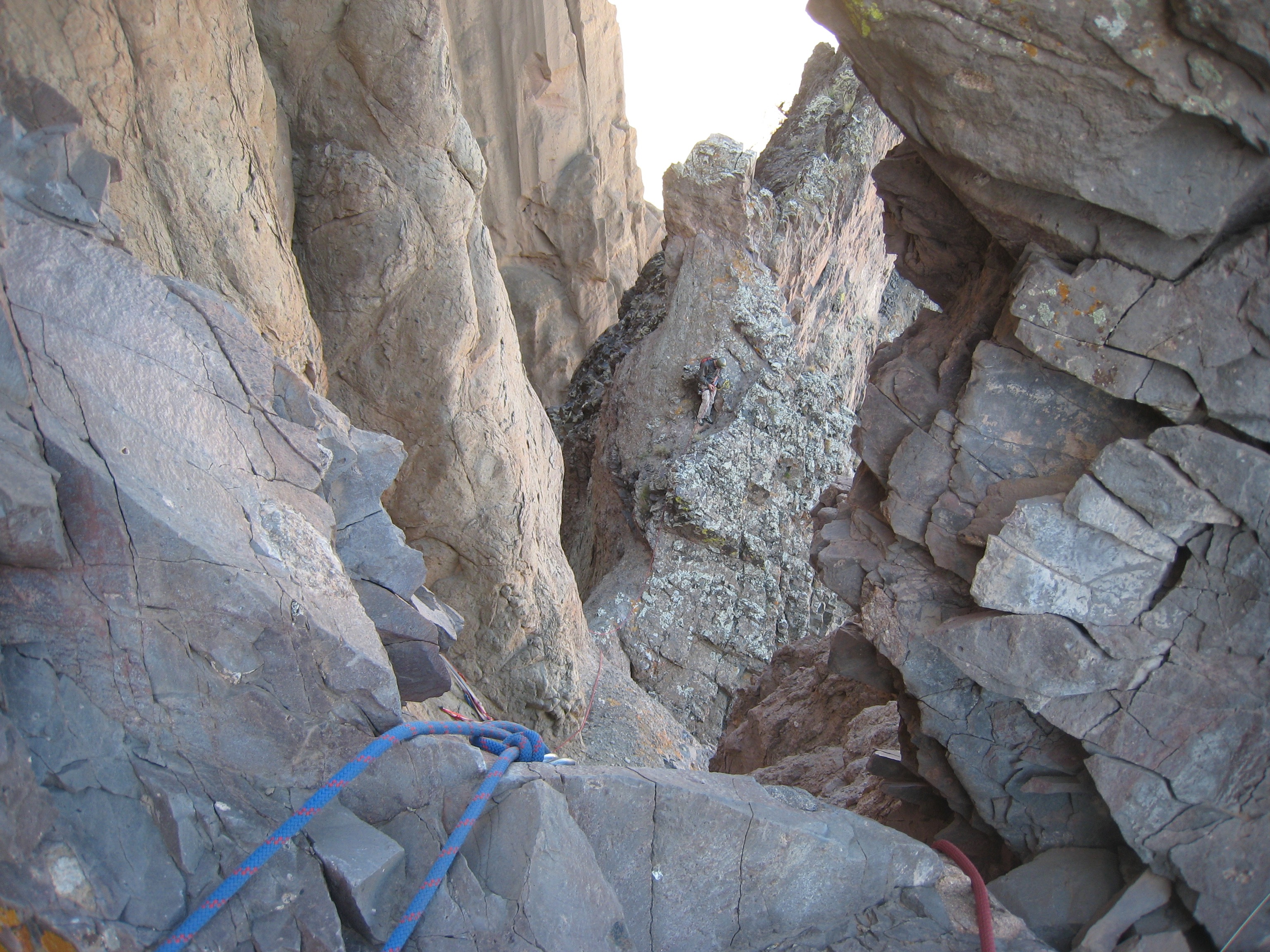
P3:  Coil your ropes and scramble up the bowl, keeping to the left against the wall.  You will curve up and end up going south to the base of the south wall with two parallel cracks ascending to the Sierra Col featuring lighter rock.  You can rope up at any time, but you’re just scrambling and dislodging stones to injure your follower.  Continue up a chossy ramp to the right, and set up a belay when the rock gets steep.  There’s an immediate corner you turn to start back left, or east, ascending toward the Sierra Col.   The crack accepts larger cams, but is of very poor quality.  The climbing is very easy, but there’s danger of pulling hand and foot holds.  At the top of the crack you will be confronted with a choice: belay here from a fixed pin and perhaps a girth hitch around the rock, or continue across the Colorado Col and up to the Sierra.  Because of communication and rope drag, we stopped and belayed just before the first Col.  75 feet.  This is the belay pictured in the photo above.


P4:  The scene here is one of the most appalling specters in climbing.  The Sierra Col is about the size of the back of a horse, with huge drop offs right and left.  On the far wall are two bolts.  The route goes across the Col, to the left, and up to the Colorado Col, about 50 feet distant.  When we were there, there was a descent line rigged from the upper Col to a belay stance just above and around the corner from the lower Col. The move from the two bolts left onto the ramp is very blank, and looks like 5.10 if not worse.  What we did was set up a belay at the fixed pin just before the crossing, have the leader cross, clip the two bolts on the far side with slings, and then use pockets to descend left (past an unused fixed pin) until he could stem and grab holds on the face to the left.  This involved going down about six feet, and the large holds on the far face then allowed an easy and confident way to get back up to the ramp to the upper Col.  Easy climbing with perhaps one piece of gear at the headwall and you’re at the Colorado Col and its belay/rappel anchors.  Perhaps 100 feet total.


Ascent Rap 1:  A short scoot down the ramp into the Rappel Gully deposits you at the most famous set of bolts in America.  At this holy spot the expansion bolt was first used to help climbers.  Now there are at least three 1/4 inch bolts mashed down and perhaps four larger diameter bolts with funky, dated hangers and attendant mank.  Put your ropes (two!) through the rings, and decide if you really want to finish the climb.  If you descend and pull this rope, you can’t get off the mountain without completing the climb.  Make sure you have time before darkness falls, and zip down the rope to the large chock stones in the gulley.


AR 2:  Work your way down the stones, and on the left wall you will find a single bolt rappel anchor, which will, with another two rope rappel, deposit you at another single bolt anchor.


P5:  Clip this anchor, and belay your partner across the face to skier’s right, climber’s left (south.)  There are bolts and pins here and there, and if you follow them, you will ascend to a crappy shelf with a scary reach around to a fixed pin, from which you must be lowered 20 feet to a large ledge where there is a belay anchor.  Rumor has it that by going low you can avoid the scary reach around, but at the expense of having less pro and the prospect of a real swing if you fall.  One account had the party going low, and having to climb a 5.9 crack to get to said ledge, but as we went high, we don’t know.  The traverse was nerve wracking, but no more than 5.8.  Taller climbers will bum out more at the reach around, as it’s a crouching move with a good, but not too solid, handhold.  The pin you lower off of is of dubious quality, but held 200 pounds and some bouncing from us.


P6:  Walk to the far end of the ledge, and as you go, look up and admire the famous Double Overhang the first ascensionists aided with ice screws in 1939.  There is a bizarre belay anchor in the cave at the far end, with one bolt in the tufa and one in a cobble stuck in the tufa.  Reach around the far corner to clip a bolt, and do a single 5.8 move to easier climbing, another bolt, and a belay anchor straight up below the small cliff.


P7:  Some accounts say unrope and walk, but it was pretty steep going.  We climbed roped, but largely unprotected, up the drainage.  The route map in Desert Towers shows the route going to the right and around some features by the north wall, but we went up the fall line, probably to our peril.  The angle eases, and you can walk to the base of the fin separating the South and Main summits.


P8:  There’s a small gulley to your right ascending to the base of the Horn pitch.  You can rope up now, but the moves are easy and if you fall, you just get jammed in the crack.  At the top you set up a belay for the wildest part of the climb.  The route goes up the arête formed by the Ramp up which you’ve climbed and the west face which must descend over 1,000 feet at this point.  The route is marked by bolts and pins, and the moves are stout at the beginning.  All footholds have been knocked off, and so it’s pretty smooth until you can get a left hand over the block and the right in the crack where the protection is.  Move up to the bolt, and then right over very small holds, including two monodoigts!  Scary.  We linked this short pitch with the next, which starts 15 feet past the top of the horn up a ramp to the right.  The crack is marked by three fixed pins.  The moves are rated vintage 5.9, because there’s nothing for the feet and not much for the hands, except a seam between the pins.  It made my French side come out.  Even after you pull yourself up there’s not much to grab on the flat to relieve your suffering, but once the whale beaches, you’re home free.


P9:  A short trip up over easy ground to the right brings you to some large blocks, on top of which there’s a ledge going left.  Rope drag prevents linking this with the last pitch, even though it’s short and easy.


P10:  The final pitch starts at a belay anchor of ancient tat found looped between two rocks at the far south end of the ledge.  The leader proceeds across the sloping rocks and steps left into a crack leading up to the final scramble.  The rappel anchors can be seen through a gap in the blocks to your right as you go, and the sight of them brings both joy and anxiety.  There’s plenty of room just below the summit block.  The register is under a rock at the western extremis of the summit area, just north of the actual summit.  It was placed there in 1962 to replace the original, which had apparently seen its day.  We were party 501, having missed the 500th by four weeks.  I incorrectly noted it as Third Sunday of Easter season, when it was actually the fourth.  The 500th climb had been on Maundy Thursday.


Descent Rap 1:  All descent raps except number 7 are with two 60 meter ropes, minimum.  Look east, and just to the left of the way you came up is a cleft that lets you access the rappel anchors.  There are two bolts high on the east side of the cleft in which you are standing.  When you descend, make SURE you see the next set of anchors off to your right, skier’s left, west, where the sun’s setting etc., before you drop over the sharp roof directly below you which WILL saw your ropes in half if you have to pendulum right to get to the anchors.  One of the reasons we were invited by those Navajo climbers to climb the peak was to retrieve two grievously damaged ropes they had abandoned at this point doing just that.  How they got down I do not know.  When you see the prow below you, make sure you move right to land in the proper spot.


DR 2:  Drop straight down and land on a large, sloping ramp.  All these belays are hanging, and rock pours off the face at the slightest touch.  Partners will hate each other by the time they get down.


DR3:  Make sure your ropes track over the edge of the ramp to your right, not down through the crack separating the ramp from the face.


DR4:  One more hanging rappel stance and you’re on the “ground” at the top of Long’s Couloir.  Turn around and gape at the north side of the Sierra Col.


DR5:  Scramble down the hill until you come to steep ground.  At the left edge of the talus there is a rappel anchor on a block of rock facing north.


DR6:  Anchors on the right hand wall are all you can reach with a double rope rappel, but there’s a lot of resistance when you go to pull the ropes.  Another set of anchors beckons from about 50 away, and are probably accessible without protection, though we didn’t use them.


DR7:  As the canyon narrows, a double bolt anchor with a single sling is found on the north side of the slot.  This can probably be done with a single rope.


DR8:  The last rap is done from anchors hidden from view until you’re about to fall into the void.  A double rope anchor allows you to make it all the way to the precious flat earth at the base.  Your packs and comfortable shoes await you back to skier’s right, about 100 yards away.  Took us 5.5 hours up, including wasting 45 minutes trying the center of the bowl on P2, and 2 hours coming down.  No problems with gendarmes or restless natives.  Had a couple beers to prepare ourselves for the long drive home, and thanked the Lord who calmed the very cold, consistent wind we woke up to.  “What kind of man is this?  Even the winds and waves obey him!”  Matthew 8:27


Devil’s Tower Closure Proposed by NPS on Religious Grounds

By | Cleric Climbs | No Comments

It’s commonly assumed that Christian culture and individual Christians do not have a theological or philosophical interest in the outdoors and mountains in particular. This couldn’t be farther from the truth. There is probably no other religion, for lack of a better term, that has such an appreciation for exploration and scaling heights. Let me explain.

Christianity, as described in the Old and New Testaments, is portrayed as a spiritual development that is closely linked to the created, natural order. In the beginning of creation, after each “day” or step, it is said that what has been created is “good.” Rather than fearing a natural world that is powerful and confusing, the Jew and then the Christian are encouraged that the whole cosmos has been created by a benevolent Creator who wants us to learn, explore, understand and master the world around us.  This has led to most of history’s developments in natural science, philosophy, medicine and political reform. We view ourselves as instruments of our God, who do His will in order to bring about greater order and beauty.  I’m reminded of a joke about a New England farmer.  He’s just worked very hard to clear a field of stones, when his parson comes by, and trying to be “spiritual,” says, “Nice field you and the Lord have.” To which the farmer replies, “Yeh, and you should have seen it when just the Lord had it!”

In keeping with this notion that we are to master and enjoy our surroundings, Christians have a long tradition of mountain climbing. Indeed, Francis Schaeffer points out that the first ascent of a mountain for the purpose of personal edification was undertaken by the writer Petrarch (1304-74). This man found in the ascent an enjoyment of nature as God made it good and proper. In short, it was a religious experience in that he was able to see beyond the creation to the Creator. An Anglican priest was in the party that first climbed the Matterhorn.  George Mallory, who may be the first man to ascend Mt. Everest, was the son of an Anglican clergyman.  Hudson Stuck, the first to climb Denali (Mt. McKinley) was an Episcopal priest and Archdeacon of the Yukon.  Writes Stuck, “Rather there was the feeling that a privileged communion with the high places of the earth had been granted; that not only had we been permitted to lift up our eager eyes to these summits, secret and solitary since the world began, but to enter boldly upon them, to take place, as it were, domestically in their hitherto sealed chambers, to inhabit them, and to cast our eyes down from them, seeing all things as they spread out from the windows of heaven itself.” Note well what these men share.  They all shared the idea that these places are sacred not because they are reserved for some or none, but because they are accessible to all who feel the call to experience them. It is not in their reservation that they are religious, but in their accessibility. In experiencing them, true potential is realized.  The words mount, mountain, mountains, mountainside, mountaintop and mountaintops are found 468 times in the Bible.

In contrast to this view, we have our ascetic religions: Buddhism, Hinduism, Mohammedism, and most animistic beliefs. Although Buddhism is technically not theistic, that is, doesn’t posit the existence of a god, these religions suggest that there are gods or a god who are not well-disposed toward the human experience, and who need to be mollified through self-denial and other ascetic observances. Buddhists in the area of Mt. Kailas practice immuration, where the devote allows himself to be walled into a cave with only a small passageway left into which food, and presumably from which human waste, can be passed. The younger the person who does this, the more positive karma is believed to be attained. Hindu women are expected to throw themselves on the pyre burning the bodies of their deceased husbands, and devotes are lauded when they throw themselves under the wheels of the juggernaut that crushes the life out of them. Mohammedans are told they must not drink alcohol, smoke tobacco, or eat pigs, as this is unclean, but classify women as dogs if they walk between a praying man and Mecca. Because of the lack of self control on the part of Mohammedan men, the women are forced to wear unsuitable and restrictive clothing and to undergo, in many cases, clitoral “circumcision” so as to not become wanton. The Sioux, aboriginal people originally from the Great Lakes region of the central United States who recently migrated to the Great Plains with the domestication of the horse, have a spiritual ritual in which a leader allows himself to be cut along the arms to inflict the most possible pain in order to receive prophetic knowledge.  What all these religions share is a dim view of god.  It has been said, “The Mohammedans have ninety-nine names for God, but among them all they have not ‘our Father.'” If god himself is opposed to our enjoyment of life, then how can we value creation? People who fly airplanes into buildings, or demand that people live in closed caves their whole lives, or crawl 55 miles on their knees, are merely transferring the disdain they feel from their deity to that which he has made. The Apostle Paul writes, “‘Do not handle! Do not taste! Do not touch!’ These are all destined to perish with use, because they are based on human commands and teachings. Such regulations indeed have an appearance of wisdom, with their self-imposed worship, their false humility and their harsh treatment of the body, but they lack any value in restraining sensual indulgence.”

It’s a dangerous thing these days, though common, to forget the profound differences in religious belief, and to allow minority groups to lay claim to places or practices in the name of religion. It seems as though one man’s religion trumps another man’s freedom, simply on the basis of the sincerity and fervency of the believer. In the past, there was not much interaction between peoples of differing religious views, so conflicts were not so prevalent. Today, with better travel and communication, these conflicts are becoming more common and in many ways more serious.  When Winston Churchill was returning to England after attending the Yalta conference during WWII, he invited Ibn Saud to lunch as he passed through Alexandria.  Winston writes, “A number of social problems arose. I had been told that neither smoking nor alcoholic beverages were allowed in the Royal Presence.  As I was the host at luncheon I raised the matter at once, and said to the interpreter that if it was the religion of His Majesty to deprive himself of smoking and alcohol I must point out that my rule of life prescribed as an absolutely sacred rite smoking cigars and also the drinking of alcohol before, after and if need be during all meals and the intervals between them. The King graciously accepted the position.” I tell this story to illustrate the fact that capricious or culturally-defined religious beliefs are potentially mutually exclusive and contradictory.

In view of this reality, it behooves us to see how this matter was handled by our founding fathers in terms of the Constitution. The First Amendment to the Constitution says two things about religious observance.  First of all, it says that the government cannot embark on the “establishment” of a religion. Secondly, it says that the government shall not interfere in the free observance of religion.  These things must be taken together in order to understand the intent of our Constitution. The first thing we should note is that the term “establishment” is not a general term, but a technical term, not used in today’s English. The Church of England was said to be the “established” church, in that it was formally sanctioned by and incorporated into the government of the land. This is the sense in which the word is used in the Constitution. The clause does not say that there is a “separation of Church and state,” as many erroneously believe, nor does it say that the U.S. Government can have nothing to do with religion. It simply means that unlike England, the U.S. will not have a church as part of the government. Secondly, the free exercise clause suggests that the government will indeed get involved in religious matters to the extent that religious observance of its citizens is being impaired.

Thus, the United States is a liberal, capitalist republic. It is liberal in that the government is limited to regulating behavior, not belief. As long as everybody in the U.S. was nominally Christian, this was easy to enforce. I’m sure it was the farthest thing from the founders’ minds that one day people would come to the country and claim that their religious law trumped U.S. Civil Code, yet this is now happening.  As the world becomes more secular in many ways, people are finding themselves at a loss to explain their significance and purpose for living. One of the more popular responses to this existential angst is to look to the past to find what makes us unique. This response is particularly popular in peoples and situations where the current prospects for peace and happiness are distant. What we have now, even in the U.S., is people laying claim to places and practices based on religious interpretations that are mutually exclusive. The dispute over the proper use of places “sacred” to, or of “cultural relevance” to aboriginal Americans is an excellent example of this kind of conflict.

Claims to sacred places are as numerous as the people who make them. In Arizona, we’re told that Baboquivari Peak is the navel of the universe, and is the focus for many creation myths for the local aboriginal peoples. The Peak lies on land owned by the Tohono O’odham people, and they are gracious in letting others hike and climb the peak. All they ask is that care be taken to preserve the environment, and that nothing be done to anger I’itoi. This is perfectly reasonable, and as a result, there are no access issues with the peak. This is remarkable in that aboriginal claims often state that access to sacred sites be limited to either true believers (the Black Box in Mecca, the LDS Temple in Salt Lake City) or nobody at all (Devil’s Tower.)  On the island of Hawaii some aboriginal peoples believe a beetle living on the high mountain tops is sacred, and thus telescopes and other scientific apparati are not welcome there. If I remember correctly, the claimants demand that certain precautions be taken by the University of Hawaii which maintains the site, thus requiring the use of public funds to support their particular religious belief.

So what are we to do when religious views conflict?  Is there some sense in which people are entitled to regulation by fiat, simply because “we were here first.”  What about the right of conquest by the sword, which states unambiguously, that “we were here last.” Is there ever going to be some objective criterion that allows us to evaluate religious claims on the basis of truth or validity, and not historical guilt? A good starting point in resolving the dilemma caused by competing religious views is to realize that just because something is religious, doesn’t mean it’s fair, or right or worthwhile.  There are many religions, and they agree on very little. So the fervency of belief, the appearance of religiosity, longevity and the denial of the flesh are not sufficient grounds for saying that a religion is valid. At some point those in authority are going to have to vet them and say, here is a religion that produces behavior that is consistent with our ideals of a liberal, democratic republic.  Beliefs are beyond our scope, but behavior is not. Does the recognition of these beliefs further social harmony and mutual accommodation, or does it lend itself to further compartmentalization, separation and alienation to the detriment of the larger body?

Although in our ignorance of the true content of world religions we want to give them equal weight, this cannot be done. At some point those in authority are going to have to decide that restrictive, acetic religions cannot enjoy the same civil rights as those that are more benevolent and inclusive. To grant a restrictive religion preference over one that is experiential is to go against both the establishment clause and the free exercise clause of the 1st Amendment, as it pits government power behind the peculiar restrictions of the one, at the expense of the free exercise rights of the other. It sets the Federal Government in the role of establishing a religion, for it uses its enforcement powers to impose religious observance upon all, including the unbelieving and unwilling. For example, to close the Devil’s Tower to rock climbing Christians like me is to deny me the ability to worship my Creator who made this wonderful phenomenon. By touching it, by climbing it, by being scared on it, I connect with the One who made it, gravity, and my own body in a way that cannot be duplicated by any other activity.  Now do I need to do that every day of the year? No. Closures for endangered animals species are allowable if they can be PROVEN to be necessary and effective. If a temporary closure for other groups who lay claim to a place helps them worship in their own way, then fine; we should wait our turn. But severe access limitations so that others can worship from afar is indefensible philosophically, theologically, and most importantly, legally.

I therefore submit these facts to you for your reflection, in full expectation that they will be incorporated in the Long Range Interpretive Plan for the Devil’s Tower. These are not opinions, these are not feelings, these are not religious tenets.  These are facts of history and logic that cannot be contravened without doing gross injustice to the rules of epistemology and common sense.  I look forward to an answer to my specific contributions, as well as news about further developments as you fulfill your responsibilities as a public servant in this great country of ours.  What makes this nation great is that first and foremost, we are a land of law.

Lacking Sponsorship, Bring a Priest – By Ed Warren

By | Cleric Climbs | No Comments

My Denali Speed Ascent

This speed ascent was not a sponsored affair.  As a team of nine professional climbers skied past us with their prototype Dynafit skis, coordinated clothing, and team patches, that fact was made abundantly clear.  In contrast was Robert, my 58-year-old climbing partner and pit crew.  As he stood catching his breath on ‘Ski Hill’ at 9,000 feet on North America’s tallest mountain, he looked the part of circus clown more than badass mountaineer.  He had unzipped his Gore-Tex pants to cool off and they billowed in the slight breeze.  His floppy sunhat, yellow boots, white gloves, and goofy glacier goggles rounded out the endearing outfit.  Looking at him, I was skeptical we would make it to 11,000 feet that day, much less the summit.  

It was Day 2 on the mountain and we were schlepping ridiculously heavy sleds and packs up to ‘11 Camp’ on our first, acclimatization ascent of Denali.  We were on Denali so that I could attempt to break the ascent and round trip speed records, which were set by Chad Kellogg in 2003.  That year, he climbed from the airstrip to the summit in 14 hours and 22 minutes and completed the round-trip effort in 23 hours in 55 minutes.  But before I could challenge this record, our plan was to climb the mountain first – expedition style.  This would allow me to fully acclimatize, a process in which your red blood cells slowly take on more oxygen as the air gets thinner up high.  If I were to push directly from the airstrip at 7200ft to the summit at 20320ft without acclimatizing, I would risk altitude sickness and certainly would not be able move at a record-setting pace.  So there we were, hauling nearly a month’s worth of gear and food up Denali’s lower flanks to climb the mountain once together before I would attempt to do it all over again solo and for speed.  

I met Robert in 2011 in Talkeetna.  Actually, I met his lovely daughter, Martha, first.  I had just gotten off Denali, and after chatting her up, discovered she and her father were flying onto the mountain the next day to attempt an ascent.  Hours later the three of us were having Dinner at the Denali Brewing Company and midway into our first pitcher of Twister Creek IPA, I realized Robert was not a normal person.  He was a former Episcopal priest who had suffered traumatic brain injury in a car wreck that forced his retirement, and now he drank like a fish and swore like a sailor.  He also made clear his intentions to convert me to Christianity and have me marry his daughter.  He was a riot, so I ordered another pitcher of IPA.  

Although neither the theological conversion nor romance ever came to fruition, Robert and I became good friends over the next couple of years.  Because he and Martha did not make it to the summit in 2011, I thought he might be interested in joining me on this trip.  My proposal was that I would help him summit, if he would then help me with logistics for my speed ascent.  He accepted.

He quickly became excited about the record attempt and had more confidence in my ability to break it than I did.  Soon we were outlining our strategy.  I would use the latest equipment designed for the emerging sport of ski mountaineering racing or ‘SkiMo’.  Although well established in Europe, SkiMo is relatively new to the U.S. and, as far as I could tell, few people had tried to use this ultra lightweight gear to lower the speed record.  When Kellogg set the current record, he had only used skis on the lower glacier, and then switched to running shoes and crampons.  When Vern Tejas, who holds the speed record for summiting all the Seven Summits (134 days), attempted the Denali speed record in 2009, he used Nike javelin spikes and overboots.  In contrast, my plan was to stay in my ski gear the entire time.  I would ski up to 11,000 feet then put the skis on my back and crampons on my ski boots.  Modern Alpine Touring ski boots are lightweight and easier to walk in than older models, so I hoped they would not slow me down too much on the upper mountain.  Then, after summiting, I would put my skis back on and ski as much of the mountain as I could.  The hope was that skiing would dramatically cut down on my round-trip time.  

Lastly, I insisted on doing the climb unsupported.  Whereas Chad Kellogg had left caches of gear for himself along the route, I wanted to start and finish with all my gear on my back.  I also would not accept any food or drink from other climbers along the route.  As an alpine climber, maximum self-sufficiency is always the goal.  For safety reasons, however, Robert would accompany me, roped-up, on the lower glacier to mitigate the risk of crevasse fall.  He would then hang out at Camp 1 until I returned, at which point we would rope back up and ski out together to the airstrip.  He would not carry any of my personal gear or give me food or drink.

Before the speed ascent was even an option, however, we had to acclimatize by doing our expedition-style ascent.  So Robert and I, pulling our gravity-happy sleds, finally pulled into ‘11 Camp’ and set up for the night.  Having only been on the mountain two days, we were surprised by how good we were feeling and decided to make a carry to ’14 Camp’ at 14,200ft the next day.  Our quick pace continued and on Day 6 we found ourselves wedging ourselves into my little Nemo Tenshi tent at 17,200 feet, preparing for a summit push the next day.  According to the National Park Service it is most common for groups to take between 15 and 18 days to summit.  That was the timeline I was expecting for our first summit bid, but the weather had been so unusually sunny that we decided to keep pushing until our bodies told us otherwise, and so far they had not.  

On Tuesday, May 28th, Day 7, we left ’17 Camp’ and pushed to the summit in about five hours.  We were one of the fastest groups summiting that day despite our limited acclimatization, which was a real testament to Robert’s toughness and fitness.  Then, after Robert performed a communion on the summit, we decided to split up so I could investigate the ‘Orient Express’ couloir as a possible descent option for my speed climb.  Robert would descend back to ’17 Camp’ with a young Frenchman we had met, while I would head down the Orient.  

Having skied the West Buttress and Messner’s in 2011, I had a good feel for potential descent options, but was not confident in either because of the icy conditions and circuitous route-finding at the base of Messner’s.  Conditions on the mountain were unusually icy and with my super-light-but not-so-powerful Dynafit PDG skis, I was hoping to find the most moderate and straightforward descent.  So, after saying goodbye to Robert on the summit, I skied off the summit and along the narrow summit ridge.   I skied across the Football Field, a large plateau just below the summit, and over to the top of what I hoped was the Orient couloir.  After only a few turns down the upper couloir, I did not feel comfortable, especially with my heavy summit pack.  I transitioned to crampons and down-climbed nearly 3000 feet before putting my skis back on and skiing to ’14 Camp’.  The down-climbing really worked my legs, and when I woke up the next morning I was shocked by how sore I was, which ruled out the Orient as my descent route.  Robert descended from ‘17 Camp’ that day, Wednesday, meeting me at ’14 Camp’, and we decided to head all the way back to the airstrip that evening once the glacier started to cool off.

Descending from ’14 Camp’ back to the airstrip with heavy sleds, especially ones that still contain about 80lbs of food each, is not fun.  The sleds pull sideways on cross-slopes and zip ahead of you on steeps, trying to rip you off your feet.  Skiing while doing this shortens the duration of misery, but adds even more control issues.  The descent lived up to expectations, offering an added dose of unpleasantness when Robert discovered his decades of alpine skiing did not translate well to ski mountaineering in Koflach boots, especially when mounted on a pair of thrift shop skis.  Although he claims to be the champion of some French ski series in 1975, he could barely stay upright on his own, much less control a sled.  This meant I got the honor of holding back both sleds and Robert when he got out of control.  This effort strained my already weary legs and when we limped into basecamp at 3AM, I was convinced I would not be ready to attempt a speed ascent anytime soon.  

After only a couple of hours of sleep, interrupted by airplanes landing and people drunkenly cheering, I was ready to throw in the towel on the whole endeavor.  I had concerns about the safety of going back out on the lower glacier with Robert and his crappy equipment, my legs were sore to the touch, a low pressure weather front was moving in soon, and the prospect of beer and showers was overpowering.  As I lay in my sleeping bag massaging my tender thighs and listening to the roar of planes shuttling people back to society, I even started planning how I could tell the story of my aborted climb.  With all the factors against us, people would understand.  I could save face, right?  I was moments away from suggesting we fly back, when Robert spoke up.  He apologized for bringing shitty gear onto the mountain, but reminded me why we were here.  “Doing this speed ascent is going to mean a lot to you,” he said.  “This why we came here.  We need to give it a shot.”

He was right.  In the frustrations of the moment I had lost perspective.  And although I did not fully realize it at the time, setting the speed record would boost my confidence and help me move past my injuries.  18 months ago I had been ice climbing when I was hit by an avalanche in Wyoming.  I shattered my left ankle, sprained my right, and tore a big chunk out of my right quad.  My partner and I self-rescued, and I crawled most of the 2 miles back to the road.  Since then my recovery had been frustrating.  A second surgery and a chronically weak ankle joint kept me from my most ambitious alpine plans.  In fact, I had not planned on a Denali speed ascent at all – I had planned on some alpine rock and ice climbing on the Ruth Glacier.  But when my ankle had consistently failed to hold up on long ice and rock routes around Colorado the previous winter, I finally called off my Ruth plans.  Out of my limitations, I ultimately found my strengths.  I knew my ankle did pretty well in a ski boot and I also knew I was consistently strong at altitude, so I decided to use my summer off to go for a speed ascent of Denali.

These thoughts focused me and left me with a resolve to see my plans through.  I had been rationalizing my own failure and could see that clearly now.  But Robert’s wise comments and a positive outlook from the ranger on lower glacier conditions, gave me the push I needed to recommit.  I was not going to search for an ‘out’.  I was going to fully throw myself into this and let the results speak for themselves – success or failure.  

With my legs still aching, though, we decided to push back the speed ascent until Saturday morning to get an extra 24 hours of rest.  The weather forecast for Saturday was mixed as a low-pressure system was moving in, but we hoped that the good weather would last long enough for me to squeeze in my second ascent.  Robert spent all day Thursday melting snow for water and organizing gear as I lay prostrate on my sleeping bag, hydrating, eating, and hoping to recover as fast as possible for Saturday.  It killed me to skip a good weather day on Friday as was predicted but attempting to set a record with tired legs seemed pointless.

Robert fell asleep at 9PM and I lay in bed mulling over logistics and decisions that still needed to be made.  As I waited for sleep to come, a question came into my head and stuck there: Are my legs really so tired that I am willing to miss my ideal weather window for a less reliable one?  I knew the answer.  No.  I did not want the weather turning me back – not now that I had recommitted.  If I was going to do this, I wanted my legs or my lungs to hold me back – not the weather.  But should I wake up Robert and tell him that we needed to leave in 6 hours?  I had not even started packing my speed ascent pack.  We only got back to base camp 18 hours ago! The thought of getting ready and trying to squeeze in a few hours of sleep when I was already so tired was daunting, but having just recommitted to this climb, I knew now was not the time for half measures.  Robert stirred in his sleep.  “Robert,” I said, “I think we should go in the morning.”  He paused.  “Ok.  Wake me.”  And that was it.   This was happening. Now.

I got out of my sleeping bag and began sorting through my gear, packing, and making final adjustments.  I still had a lot to do since every ounce mattered for a 13,000 foot elevation gain.  By midnight, everything was ready and I finally crawled into my sleeping bag and, with the peace that comes with confidence in decisions made, fell asleep.

We woke up at 2:30AM.  Robert set about heating up water, while I arranged the last of my things.  The weather was good, my legs felt OK, and the summit, viewable from our tent, beckoned. All the logistics and complications had been cleared away and now it was just my legs, my lungs, and the mountain.  It felt right.

We were almost ready by 4:15AM.  We got a witness, Tyler Jones, a guide from another climbing party, to sign an impromptu affidavit confirming our start time: 4:30AM.   We roped up, put on our skis, and Robert counted down the seconds.  We set off.

Robert skied hard but because of the difference in our gear and experience with skinning, the pace was moderate for me.  It worked out perfectly, though, as it kept me from going out too fast and provided a nice warm up.  We took the most direct route to Camp 1, going through the main thrust of the glacier, which was more broken up with crevasses, but in the early hours felt solid underfoot.  

At 6:15AM we arrived at Camp 1.  This was where we would part ways.  Above Camp 1 there is still crevasse danger but it is much less than the lower glacier, which becomes a hot, soupy mess of sagging snow bridges due the lower elevations and higher temperatures.  We un-roped and said our goodbyes.  In case anything happened to me, I made sure Robert knew how happy I was to be doing exactly what I was at that moment.  He said he would be glad to officiate my funeral.

I chuckled and began skinning up Ski Hill, an undulating rise that does not quit for nearly 2000 vertical feet.  However, with my light skis, flexible boots, and slick skins, I made fast, steady progress and felt great.  With the lack of wind, cloudless predawn skies, and the bulk of Denali looming to the east, I was imbued with that rare sense of confidence that success is in reach.  It was a feeling of power and trust in my abilities.  I no longer felt like an illegitimate amateur, recklessly swinging for the fences.  I felt as though everything had been building to this moment and it was now finally mine for the taking.  I was going to take it.  

There were not many climbers on the route, but the few that I did pass looked at me quizzically.  A solo climber with a small pack, no sled, and a quick, determined pace is an odd sight on such a massive mountain, but no one asked what I was doing.  That was fine as I was focused and eager to make good time.  

By 8:30AM, and only four hours in, I arrived at ‘11 Camp’, having gained 4,000 vertical feet and covered nearly two thirds of the total mileage of the ascent.  I could feel the first signs of strain, but otherwise felt energized and optimistic.  At ‘11 Camp’, I saw the National Park Ranger, Dave, who had checked us in at the Ranger station in Talkeetna only 10 days ago.  We chatted for a bit and I explained what I was doing.  I had not told him about it when we checked in because of how uncertain I had been that I would even get around to the speed ascent.  It felt good to be there, under those circumstances, chatting with him, doing now what I did not have the gumption to even talk about before.  

I refueled with a Clif SHOT Gel and mini Snickers, then put my skis on my pack and aluminum crampons on my ski boots, said goodbye, and set off again.  I started passing more teams, as it was later in the day and more climbers were on the route.  I made good progress up Motorcycle and Squirrel Hill, and, at 9:29AM, was hit with sunlight for the first time as I neared Windy Corner.  Being out of the sun on the lower glacier had been a nice relief from the heat but the golden rays on my face were quite welcome.  At that point, the scale of what I was doing and the effort it was going to require began to truly set in.  I had just climbed 6,000 feet of elevation and had another 7,000 to go.  Surprisingly, my legs felt OK, but my energy was beginning to flag.  Could I really do this at record pace if I my body was already beginning to resist?  I had summited Denali from ‘14 Camp’ before and remembered that as a hard day out.  Could I do that on top of what I had already done plus the added descent?  I hoped so.

I radioed to Robert once fully around Windy Corner.  Each of us had a radio and although nearly 6000 feet above him, there was uninterrupted line-of-sight.  He answered immediately.  I told him my location and condition and said I would try to check in again when I could.  

I pushed on to ’14 Camp’ and strode in at 10:30AM.  I received a warm welcome and looks of surprise from some climbers we knew when they found out I had left the airstrip only 6 hours ago.  They offered me hot drinks and food, but I reluctantly declined in accordance with my plan to be unsupported.  I left my skins at there as I would not need them higher on the mountain and set off towards the fixed lines with shouts of encouragement as I left.

Since my plan was to be as unsupported as possible, I resolved not to use any of the ‘fixed lines’ or protection anywhere on the mountain.  Fixed lines are climbing ropes installed mostly by the National Park Service to aid climbers on the steeper and more dangerous sections of the West Buttress route.  By avoiding them, not only would I be more independent, but I could also quickly pass groups that might be moving slowly.  However, to do this safely, it meant I was bringing the added weight of an ice tool, my Petzl Aztarex.

The push from ’14 Camp’ to the top of the fixed lines was a mental low point.  You gain about 2,000 feet over a short distance of icy snow climbing.  On a normal day, it is relatively interesting snow climbing and a satisfying effort, but for me it was a steep slog that was still a long way from the summit.  And when I crested the ridge at over 16,000 feet, I had a disconcerting view to the north.  Broad clouds with dark underbellies appeared to be lumbering in my direction.  Was this tomorrow’s low-pressure system arriving early?  The weather was not overly menacing but was significant enough to attract the attention of a guy whose entire bivy gear was a kitchen garbage bag and a small pad.  However, the clouds were still a ways off, so I continued on, my pace reinvigorated by an external motivator.

The ridge from the top of the fixed lines to 17k Camp is relatively narrow and frequently crowded and it was no exception that day.  Passing on narrow ridges where other groups are roped-up can be controversial, as you do not want to become entangled in their ropes or cause additional complications.  But with my ice tool, I was mostly able to stay out of their way and when I did have to step by them, they were gracious to let me do so.

The ridge was mostly easy going compared to the steep fixed lines, but my focus had become preoccupied by the long arms of this weather that had moved noticeably closer.  With no one else to talk to, my mind began to play out the worst possible scenarios.  What if I was hit by whiteout high on the mountain? What should be my decision-making point for turning around?  Should I assume the weather is insignificant and press on no matter what?  Denali lore is replete with stories of climbers stranded high on the mountain in whiteouts, often on the featureless Football Field just below the summit.  It ultimately came down to only two options: go home or go faster.  There was no way I was going to throw in the towel with only the suspicious of bad weather, so I went faster.

When I crested the rise before ‘17 Camp’, I was moving well and jogged down the hill into camp at 1:20PM, less than 9 hours after leaving the airstrip.   As I walked among the tents, I saw my friends Steve and Zach who we had hung out with at ‘11 Camp’ on our first ascent.  Although I was tired and happy to rest with friends for a moment, I was optimistic about my strength level.  My previous concern about burning out was subsiding as I felt I now had enough in the tank to get to the top at record pace – but only if the weather could hold.  The clouds were broadening and forming a more formidable front to the north and, despite confidence in myself, fear was growing that this opportunity might vanish before I could seize it.  To make it, I was going to have to push far faster than record pace – I was going to have to beat the weather.

I said goodbye and set off towards the Autobahn at 1:40PM.  As I pushed upwards I could feel the effects of the altitude but kept pressing, feeling guilty about any pause or abatement in my pace.  I reached Denali pass quickly not having to pass any groups because all summit parties had departed long ago.  I sat down on the exposed rocks, wanting to eat and drink but not feeling like doing much of either – a side effect of the hard cardio output and the higher elevation.  It was now obvious that these clouds were eventually going to collide with the peak and although nervous, my resolve was only deepening to push ahead of them.

I turned the corner around Denali pass and was startled to see a group moving slowly upwards only a stone’s throw away.  How could I have caught a summit party already?  Having left the airstrip that morning and climbed 11,000 vertical feet I was not expecting to catch summit parties so soon.  There presence both encouraged and concerned me that others were going to be on the mountain so late in the day.

The fatigue had become all-encompassing but with the dread of whiteout egging me on, I ignored my heaving lungs and frenetically pumping heart and told my legs to keep moving.  Not to stop.

I crested the hill overlooking the Football Field and knew I was going to make it.  The clouds were now touching the mountain but seemed to have stalled, leaving me with beautiful summit conditions – if I could just get there.  

I hustled across the wide plateau, deciding I would drop my summit pack and skis at the base of Pig Hill, the steep final push to the summit ridge.  I had wanted to ski directly off the top but wanted to move as fast as possible as there was no guarantee the clouds would stay at bay, and having no pack would be the fastest way to go.  There were also countless climbers slogging up the face and along the narrow summit ridge, which would make a delicate ski descent even more complicated.

I dropped my pack and pushed upwards.  I could tell I was going into oxygen debt, but was too bullheaded about my pace to heed the over-expenditure.  When I crested the summit ridge, I radioed Robert, “I’m on the summit ridge Robert!” He had been monitoring the radio closely and quickly replied, “Unbelievable! You are on time.  That is great.”  I told him about the cloud cover but that I should be OK then set off along the ridge, hustling past slow moving parties as unobtrusively as I could.  

At 4:59PM, 12 hours and 29 minutes after departing the airstrip, a reached the summit.  I was elated.  I could not believe I had done it.  The fulfillment of such a lofty goal was disorienting and overwhelming and I found myself chuckling and murmuring congratulations to myself.  After a brief rest and getting a witness to testify to my location and time on my helmet cam, I began the descent.

Having dropped my pack on the football field, I did not have my skis or warm clothing and the chill was starting to take effect as I was only wearing a wool shirt and 13 ounce shell jacket.  As my cardio output and rate of breathing unconsciously slowed, I found myself in desperate need of oxygen.  My balance was deteriorating, my vision was getting soft, I continued to get colder, and I felt like there was a crushing weight on my diaphragm.  I knew the only solution was to get to my skis as fast as possible and drop elevation – quickly.

I finally got back to my pack and hustled across the football field.  I bent down to step into my Dynafit bindings, but struggled against the hypoxia.  Finally they were on and I slid forward picking up speed instantly.  I knew I had to lose significant elevation to feel better, so I chattered along as fast as I could without losing control.  I reached Denali pass and looked down across the Autobahn to ’17 Camp’.  This was the last major decision to be made.  Should I down-climb this steep and notorious traverse rather than ski it?  It would probably be the safer option, but getting down quickly had become a top priority.  I decided to ski.  I pushed off and side-slipped the 1000 foot drop, too loopy to trust myself with many real turns, and, when the grade began to subside, I pointed my skis straight and zipped forward along the boot-packed trail moving too fast to do anything but stay upright and rode the breakneck momentum all the way back into 17k Camp.  Just shy of 6:30PM, I stumbled into camp and dropped down at the NPS ranger tent.

Realizing how wooly my head had been during the summit push, I decided to take an extended break and chatted with Rangers Glen, Jacob, and Ali for over 30 minutes.  Before I set off again, I wanted to make sure I rehydrated, ate, and got my wits about me.  As I finally got up to leave, Glen asked, “Uh…do you want to put on your crampons?”

“Oh, wow…” I said, realizing I was about to set off crampon-less.  After strapping my Black Diamond Neves back on, I finally headed out of camp and was pleasantly surprised by how well my legs responded.  They seemed to have missed the hypoxic memo, and as they churned reliably underneath me, the rest of my body seemed to perk up.

I jogged along the narrow ridgeline with my ice tool ready should I trip.  As I got lower on the ridge, I saw my friends from  ’14 Camp’ as they moved up to ’17 Camp’.  They congratulated me warmly, but encouraged me to keep moving quickly to set the round-trip record.  Their encouragement made me realize I had stopped pushing so aggressively– I was just cruising and having fun.  I had pushed so hard on the way up, I just wanted to relax now.  I kept moving, because I knew I was supposed to, but my obsession with pace had vanished entirely.  

I down-climbed around the fixed lines and into a whiteout.  Fortunately, there was no wind and only light snow.  At the base of the fixed lines, I put my skis back on my feet for the last time.  It was a wild feeling as I began looping turns together in the fresh snow and with my little pack. At ‘14 Camp’, I picked up my skins and set off again.  It was genuinely bizarre.  Denali is typified by climbers with massive backpacks and reluctant, ornery sleds.  It is slow, methodical work to make any progress up or down, but here I was, leaving camp only two minutes after arriving and zipping off as if I was out for a pleasant day of backcountry skiing at Cameron Pass, Colorado.

The whiteout conditions only added to the disorientation.  My brain seemed unable to comprehend what I had done and was still doing.  I felt as if I had forgotten something or was in the wrong place.  How could I have started at the airstrip, summited Denali, and now be skiing pleasantly around Windy Corner all in one day?  

The disorientation cleared with clouds.  As I skied down Squirrel Hill I left the whiteout behind and entered a golden vista of late evening rays lighting up the snowy peaks around the lower Kahiltna.  I did not bother to suppress a broad grin as I dropped down Motorcycle Hill, zipped by ’11 Camp’, and rounded the bend towards Ski Hill.  As I skied, I radioed Robert, telling him I was almost to Camp 1.  

My little skis struggled to cut decisively through the heavy wet snow and nerve pain in my feet made me stop frequently, but neither bothered me at this point.  Soon I was plummeting down Ski Hill and zipping across the flat section below.  Robert stood waiting with the rope pre-coiled and ready for me to clip into, but I had no desire to move off so quickly.  I wanted to chat and celebrate for a moment with my friend.  We hugged and he said, “Do you realize you are at 16 hours?”  I smiled and nodded.

Soon we were off and without a pack or sled Robert was able to ski much faster and surely.  We cruised along, maintaining speed on the slight downhill slope but on high alert for any hidden crevasse danger.  It was nearly 9PM and because I had moved much faster than expected, we found ourselves on the Kahiltna at nearly the worst time of day.  But shy of hanging out for a few hours to let the glacier cool down, there was nothing to do but ski fast and hope the sagging snow bridges held.

At one point we came along a particularly unstable-looking snow bridge that had stalled a foreign team.  After making sure they were all right and not seeing a way to end-run it, we tried to ski across it as fast as possible.  Robert went first and instantly sunk down two feet into the soft, sloppy snow.  I instantly put tension on the rope, thinking he was about to go in, but he managed to get out and across.  Then, moving in tandem with Robert, I gained as much speed as possible and managed to plow through and past the deteriorating snow bridge safely, breathing a sigh of relief as I did so.

From there, the glacier conditions improved and I knew we were going to make it back safely.  At the base of Heartbreak Hill and Robert insisted we un-rope so I could go by myself and make better time.  We did so, and moving steadily I climbed the last rise.

At 9:16PM, 16 hours and 46 minutes after leaving the same spot, I slid into basecamp.  

Joey, the NPS ranger manning basecamp, saw me come into camp and officially confirmed my finishing time.  

Soon Robert shuffled in, and as we sat on the edge of our tent platform reminiscing about the day, I said, “I just can’t believe it all worked out – the weather, the logistics, my legs, the gear. I don’t know how it came together so perfectly.”

With a twinkle in his eye, Robert replied, “I do.  I am a Priest, after all.”


My Two By Six Foot World

By | Cleric Climbs | No Comments

Actually, my world is a little smaller than that.  My Thermarest pad is 19 and a half inches by 70, and it’s the practical limits to my world for the indefinite future.  If I weren’t so tired, I’d be freaked out by my circumstances.  My possessions consist of the pad, my sleeping bag in which I’m shivering, a pair of the worst skis ever sold, a lightweight pack, one Summit House dinner, a Whisperlight stove and a Nalgene.  The skis were bought at a Sports Authority in Tucson, Arizona, for $19.95.  They had been shipped there by accident, and the management wanted to get them sold rather than shipped back.  The brand?  Enemy, made in China.  Logo has menacing skulls that are meant to add mojo, I guess.  173’s, they had been selected for this outing because they were wide, light, and cheap.  They were fine with skins going uphill, but turn downhill and go over walking speed and they became veritable roller skates.  Back to where I am.  I take one last look around before I burrow into the bag to get away from the wind and the incessant light of the Kahiltna Glacier.  I’ve pulled about 20 feet off the trail to Camp 1 on Denali’s West Buttress route in order to wait out my partner, who’s abandoned me.  For the time being.


Said partner is Edward Warren.  I first met him at the Roadhouse Inn in Talkeetna two years before.  He had just summited Denali and twice skied from the Football field back to Basin Camp at 14,200 feet.  The second time he got caught in a whiteout, and his spotters couldn’t give him radio instructions to avoid the crevasses that separate the Messner Couloir from camp.  He had missed a turn, descended too low, and found himself on steep ice, hard as boiler plate, just above a crevasse.  He had to gingerly remove his skis, transfer back to crampons, and climb a thousand feet before he could resume his descent.  I haven’t gotten the nerve to watch the video, but apparently he was saying goodbye to his parents who would be presented with the chip from his hero cam mounted on his helmet when his body was recovered from the bottom of the huge crack.  By the time I met him outside the laundromat at the Roadhouse, he had already met my daughter and introduced himself.  His adventures behind him, he was nursing some frostbite on his toes from his constrictive ski boots and was just enjoying being alive.  When I heard he had GPS coordinates for every camp and curve in the route, I invited him to dinner and beers.  The three of us had a wonderful time, even though I pointed out his dietary inconsistencies in that he ordered a veggie burger but also consumed a large quantity of French fries.  He even came to our motel room and helped us sort through our dehydrated food we had lugged up from the lower 48.  We drove from Arizona, partly for the thrill, but mostly to have a free schedule in terms of how long we stayed on the mountain.  It was my impression that many alpine accidents occur because people are in a rush to get somewhere when conditions are not conducive to travel.  Edward had time to blow before his return flight to Wyoming, so I loaned him my Isuzu Trooper to tour the state until he had to get on a plane.  Lord knows I wouldn’t need the car, and there seemed to be a real spark between this guy and my daughter.


Martha and I ended up spending parts of three days and two nights at High Camp, 17,200 feet, but decided to descend because of new snow and the fact that our food just wasn’t cutting it.  All dehydrated, it was light, but totally lacking in fats and lasting energy.  So rather than lose a pound a day, as we then were, and try to posthole in unstable snow with only Conrad Anker on the mountain ahead of us, we came down.  The next two years saw me become friends with Edward independently of his relationship with my daughter.  I travelled to his home in Wyoming twice to help restore a Land Cruiser FJ60 and to complete a remodeling of his house.  We did some technical climbing together at Vedavoo and Lumpy Ridge, where he proved that his injured ankle hurt on the approach more than in the actual climbing.  Edward is known to many as the creator of and star in the Youtube video, Mixed Climbing Accident (http://www.youtube.com/watch?v=1ovr55k6evE), documenting his near death experience in the mountains of Wyoming.  I was honored that he called me right before going into surgery, but I couldn’t help but equate mixed climbing and its attendant objective hazards with consuming too much tequila and expecting to have no consequences.  My pastoral manner has sometimes been criticized.


Edward had big plans for his climbing career, and these had to be extensively modified because of his accident.  He had suffered some pretty good lacerations, but the real problem was that one ankle was completely broken up when his crampon caught on the ice as he fell under the weight of an avalanche dislodged by his partner.  The two were saved when a single BD nut held them both, despite the rope getting desheathed.  So last winter Edward was in a quandary.  He wanted to do something spectacular besides almost getting killed, that would draw attention to his website, Vertical Minded.  Grammatical inconsistencies aside, I understand it to be a cross between Facebook and Amazon, where climbers record their exploits, document equipment requirements, and others are offered a chance to buy said equipment at the best prices.  At one point he was going to climb and ski every mountain over a certain altitude between Alaska and South America, hence the Land Cruiser.  The accident brought an end to anything requiring lots of walking and even technical climbing over rock.  What he found was that the only thing he could really do was ski and hike in ski boots, where the plastic gave him the ankle support he needed to maintain proper alignment in his bones.  So despairing of something new to do to bring attention to his business, he decided to do something old, but faster than anybody else.


After my experience on Denali two years ago, I resolved that if I went back, it would be as the least capable member of the team, and not the most.  Martha was fine on the mountain, but the combination of my responsibility for her and the sequilae of a traumatic brain injury I incurred in 2002 in a car crash made it emotionally impossible to deal with the anxiety a mountain like Denali imposes.  As a woman said whom we met during our climb and who bailed at 16,000 feet, “I can take the pressure of this mountain on any given day, but to feel it day after day was just too much.”  So some time in April, the phone rings, and it’s Edward.  He begins his inducement with the prospect of climbing the mountain in regular siege tactics, with the goal of getting my aged ass to the summit.  Then he drops the real purpose of the call, and that is to enlist me as dead weight on the other end of the rope to help him set a speed record for a round trip ascent.  Of course, I agreed immediately.  Here was a chance to climb with a real, live alpinist, and to perhaps make a little history in the process.  Edward had already done Acconcagua twice, once by the Polish route, and had gone from Basin Camp to the summit of Denali in one push, not once, but effectively twice.   Legs and lungs personified.  And not only would I do the climb, but I volunteered to drive from Arizona to Cheyenne, get his gear, drive to Anchorage, pick him up at the airport, and drive the two of us to Talkeetna.  We’d have a car in town, so we could take as long as was necessary on the bump.


Everything went as planned on the way up; no complaints.  I cast my vanity to the wind and went to the Fort Collins Walmart to buy food for the expedition at lower 48 rates.  I picked up his gear at a self storage facility, as Edward was leaving the Air Force, had sold his house, and was himself on the road visiting family and friends.  Sort of a bucket list in case things went awry on the mountain.  Edward knows me well, so there was a complete checklist of things to bring, all of which were in a neat, but large, pile.  By this time the 1988 Isuzu Trooper was getting full, and I needed to be able to sleep in the back each night.  I planned in an extra three days for the trip, in case I had to rebuild the car on the way up.  I had an extra cam belt, a half set of rocker arms and a full set of exhaust valves, which are the ones that bend when an Isuzu breaks the cam belt.  This I know by experience.  Being in scenic Anchorage early, I went to the local Episcopal church to ask about recognition for the FA with Hudson Stuck 100 years prior.  Hudson was the Archdeacon of the Yukon, and traveled extensively every year throughout Alaska’s interior by dog sled ministering to the various congregations that couldn’t be reached during the summer months.  His two books, 10,000 Miles on a Dog Sled and Ascent of Denali are classics of life in Alaska at the turn of the 20th century.  Hudson was an Episcopal priest, as am I, so I was naturally interested in any observations planned for the centennial of the first ascent.  The Rector of the church I visited was unaware of the momentous nature of the 2013 climbing season, but said that he had seen something on the subject in Diocesan announcements.  A quick perusal of the internet revealed that there was in fact a celebratory ascent planned, which included the Bishop of Alaska climbing the mountain and celebrating the Eucharist on the summit, using Hudson’s own communion kit!  The announcement went on to politicize the climb as a gesture to draw attention to abuses to native Alaskans past and present, saying that this was why Hudson climbed the mountain.  This galled me to some extent, because I had read Ascent of Denali twice, and didn’t recall that he had a political agenda when he made the climb.  I therefore requested the help of the parish to provide me with bread and wine to perform my own service on the summit, along with a 1928 Book of Common Prayer to give me a liturgy similar to the one Hudson would have been familiar with.


Edward arrived on schedule, and we celebrated by finding the best source of beer and pizza we could find.  Edward remarked that this trip to Talkeetna differed dramatically from his own two years prior because then he was trapped in an overloaded van with other large, smelly climbers, and was given only an hour at the local food store to buy all their provisions they would need on the mountain.  The van was seriously overloaded, and boasted purple shag carpet throughout.  Two days later we were on the glacier, ready to start up the hill the next morning.  We had no idea how long we were going to be on the mountain, so we overdid it on food.  We were 68 pounds over our 300 pound limit, but the pilot swore that if we paid the penalty, this would not jeopardize our takeoff or landing.  He was right, and the morning greeted us with perfect conditions.


For those who’ve been on the West Buttress route, there’s nothing particularly aesthetic about the “climbing.”  It’s essentially a long trudge with a heavy pack and sled with fine views and ubiquitous fall danger.  The second day we decided to do a full pull from Camp 1 to Camp 3, at 11,000 feet and at the base of the first steep section.  Edward was dismayed at the competition.  It turned out there were at least two other speed expeditions on the mountain at the time, one from Spain and one from Germany.  Particularly upsetting to him was the way a large entourage of professional guides in matching shells and ski gear blew by us.  Rope after rope of uber-fit guides with the latest in technology, they smiled contemptuously as they glided effortlessly by.  We later learned they were doing half pulls, but the image was seared into Edward’s mind as an indication of just how lame his partner, and hence his quest, was.  Here he was trying to do something faster than anybody else had managed, and his partner was a brain-damaged 58 year-old clergyman whose alpine exploits consisted of guided trips up the Matterhorn at 12 and Mont Blanc at 13.  An unguided trip up Monte Rosa at 16 did nothing to allay his doubts, nor subsequent trips up Shasta and Rainier.  His mood was gloomy as he brought up the rear of our cord.  Our progress was slow but steady, and on the seventh day of climbing we summited, having passed every party who had already set out from High Camp that morning.  Each day the weather report was a marvel: a prediction of continued high pressure for another three days.  The first three days morphed into eight, and I was able to stand on the summit in two layers of clothing, with the legs and sleeves pulled up to bring cooling air to my bare skin.  I conducted a communion service on the summit with Edward watching respectfully, but not participating.  He came from an evangelical Christian family, but had decided that this much-ballyhooed God they spoke of was really a chimera who refused to reveal himself in any meaningful way.  This was the source of the stand-off between Martha and him, that she wanted a Christian husband, and he was not about to make concessions that were anything but genuine.  Each was respectful of the other, and I can’t fault either for their intransigence.  The story goes that Mark Twain feigned Christian conversion to marry the girl of his dreams, and both ended up disillusioned and miserable.  Better to avoid problems beforehand than to solve them later.  So I concluded my service, and started my descent.  Edward was turned loose to ski down to the Football Field, and then try to find a way to descend to Basin Camp on skis.


The dilemma Denali presents to the skier is this.  Come early in the season, and the lower part of the mountain is fit for travel, but the upper reaches are icy.  Come later, and the upper part is softer, but the lower glacier is crisscrossed with crevasses and crumbling ice bridges that both slow and imperil travelers.  This zero-sum game was confirmed again this year when Edward tried to ski down the Orient Express.  Two years before he had almost died coming down Messner’s Couloir, and he hoped that the Express or perhaps the Rescue Gully from 17,000 feet would do the trick.  The rescue gully had proven too icy during a reconnaissance on our way up the peak, and now trying to ski the Orient, he had to take his skis off and proceed laboriously down with crampons and tools to the inevitable bergschrund separating the couloir from the camp.  He tried to roust our friend Andrew Yasso who was guiding for the American Alpine Institute and climbing on our schedule.  He could get nobody in the camp on the radio to tell him which direction to turn, so after much deliberation and crumbling crevasse edges he made it to camp alive.  The day before our summit I had made friends with some Chamonix Guides when I heard them speaking French.  I had lived in Switzerland and France for a year in each country, so I decided to use my French.  What I was really concerned about was the distance between the pickets on the Autobahn, to learn if our 30 meter rope was long enough to protect from picket to picket.  They had assured me that they were only about 20 or 25 meters apart, and weren’t really needed on the way up, just on the way down.  So with Edward gone, I met one of the guides at the base of the Summit Ridge, on his way up solo.  I proposed that we meet at the top of the Autobahn and rope up for the only really dangerous part of the climb.  He readily agreed, and told me he had taken some really good photos of Edward and me on the summit.


These photos that Helias took are the only ones I have of the summit, or indeed of the whole expedition.  We weren’t on the Autobahn for more than a 100 meters when I stopped to take my neck gaiter and wool hat off, out from under my helmet.  When I pulled them over my head, I also pulled off my camera strap, which then fell out from under my shell and bounded down the hill.  Shit.  Our rope was about half the length of the fall it took; it was out of sight over a bulge, and I had a schedule to keep to help Edward with his record attempt.  I soldiered on down to High Camp where I spent a frigid night in Edward’s dated and substandard sleeping bag, while he luxuriated 3,000 feet lower in my -40 degree cocoon from heaven.  The next morning I put the entire camp on my back, minus the emergency provisions Edward had schlepped to the top the day before, and soloed back to Basin Camp.  As I approached the numerous foot wide knife blades on the ridge I would stop to stabilize the shifting load, then scamper across to rocks and safety.  As I descended from the fixed lines above camp, I kept gazing below to see if Edward would have pity on my legs and come out to lighten the load.  No such luck.  He was recovering for the record, and greeted me with the news that I would have all afternoon to recover myself, before we would head back to Base Camp.


My skis, which we had left at 11,000 feet, were short and light, and went up hill just fine.  That evening I stepped into the bindings and tried a short turn.  Terrible.  I couldn’t decide if it was the skis themselves, or the Koflach climbing boots that were letting me down.  I couldn’t believe my eyes.  I had won a regional ski championship in France while attending the University of Grenoble, and ended up nationally ranked by the end of that year.  I was described by a friend who had been Billy Kidd’s teammate in school as the best non-professional skier he had ever seen.  So here I was at the head of the rope, unable to side slip, let alone turn.  All I could manage was a ghastly snow plow that required Edward to slow me down at the other end of the rope.  Further, when I would fall, which I normally never do, I would have to remove my pack to even stand up.  The final indignity was that my carbon ski pole, which had been broken when a douche bag ran into me at the Arizona Snow Bowl years prior, broke anew.  I had repaired it using only the most effective McGyver techniques, but the repeated falls were simply too much for even space age materials.  One time I went down on one of those dark, mottled snow patches indicating an incipient crevasse, and Edward almost sobbed, “We’re all going to die.”  We expected to be back at the bottom at midnight, instead it was a quarter to three.  In the morning I turned to Edward and said, “To the extent that I came here with shitty or unproven gear, I apologize.”  Said he, “I’m glad you said that.”


Now came the toughest part of the whole deal.  All day long planes were landing in perfect weather, dropping climbers off and leaving mostly empty.  When those of our own company went by, the temptation of beer and showers was almost too much to bear.  Edward actually offered to throw the towel in and say that between the physical abuse he had suffered slowing us down the whole way from 11,000 Camp and the forecast of deteriorating weather two days hence, he could not bring himself to risk life and limb in a vainglorious attempt at the record.  The record, to the extent we could get a handle on it, appeared to be held by Chad Kellogg, at 23 hours, 55 minutes.  There was some controversy surrounding the claim, but this appeared to be generated by one person who for some reason found fault with the documentation.  Edward had considered the problems inherent in documenting what was an informal endeavor, and had decided on the following protocols.  First of all, the climb would be totally unsupported by others.  He would not cache anything, and would use only food, clothing and fuel he would carry from the bottom.  Secondly, he would not accept material help in any way from others while climbing.  He would not touch fixed gear, or take so much as a swig of water from others on the climb.  Finally, he would carry a Hero cam on his helmet, and record name and contact information from a guide at the start of the climb, on the summit, and would check back in with camp managers at the bottom, should he return during business hours.  Further, he would carry a GPS programmed to emit a tracking signal every 15 minutes.


That night I was semi-conscious at 10:30 pm when Edward asked if I was awake.  I replied I was, and he said, “In view of the bad forecast for Saturday, how about we leave in the morning?  We could get up at 3:00 and leave by 4:00.  What do you think?”  I’ve always  thought that if you have to suffer, might as well suffer sooner rather than later.  I was actually awakened by a guided group next to us at 2:30, so I set about melting snow and making my signature beverage for Edward of equal parts electrolytes and Tang.  Gas and the fire to light it.  We weren’t ready until 4:15, so a 4:30 departure was decreed.  Edward found a guide with another group who consented to serve as a credible witness to our departure.  I counted down the seconds on my watch, and with Swiss precision, started poling down the hill.  Edward soon dropped a water bottle which necessitated a stop which in turn led to a fall.  By him.  More breakneck snow plowing at the limits of what my equipment would allow got us to the turn at the start of the Kahiltna Glacier proper.  We stopped to put our skins on, then turned uphill.  The week before the track was pristine, with nary a crevasse visible.  There had been two paths, one more direct than the other, but also in danger of having more crevasses as time went on.  The ranger had counseled that we take the less direct but safer path, and indeed we had.  On the way down, however, we had missed the turn and come down the direct route which was now something of a mess.  Hence Edward’s comments about imminent death.  This time going back up it was early morning, and we judged that we could risk the more direct line in the interests of saving time as the snow bridges would be firm.  True to form, we made it, but took careful note of where the turnoff was, so that on the way down, we would take the safer detour.  After all, if Edward succeeded in breaking the record, we would be back at the same place at the absolute worst time of day for crevasses.


Up we went.  For over an hour I never stopped my cadence of left-right-left, going as fast as I could without burning out and having to stop.  When younger I had been the third fasted miler in San Diego, and at 54 had run a marathon in 3:48 without practice.  Still, the plaintive calls came from behind, “Robert, go faster.”  Without stopping I yelled back, “Consider this an opportunity to conserve energy you’ll need later.”  When we finally reached the flats at the base of Ski Hill where Camp 1 is usually pitched, it was only 6 in the morning.  I stopped short of camp, and motioned for Edward to come forward.  The soles of both feet were sopped and just about to burst into blisters from the sweat and constant motion in boots designed for walking.  I asked Edward to unclip.  He said something to the effect that if he died, I should tell people he was nevertheless happy.  I asked if I could say hopeful things about his spiritual state at the funeral.  He said yes, gave me a hug, and hustled off toward the base of the hill.  He hadn’t gone 50 meters before his stopped and had his own camera dilemma.  He couldn’t find the spare chip for his hero cam, and spent 11 minutes poking around and erasing the one he’d already shot before he found the one he wanted.  I turned around and descended to the point where the flat is giving way to a downward slope, so that I would be able to point my tips downhill and move without skins or skating.


Which leads me to the most surreal day I’ve ever had.  Edward’s gone, a mere speck moving up Ski Hill.  I’m in the sleeping bag, radio on and balanced on my chest, trying to get a grip on how I got here.  Happily, the pressure and exertion of the prior week came crashing down, and I was able to slip into a dreamless state of unconsciousness.  I would awake to poke my eyes out and consider the scene.  I was in the very middle of the glacier, right where it bends down and the crevasses start.  I don’t dare get up and move around, because I’m unroped and alone.  From time to time people pass by on the trail, not twenty feet away.  They say nothing, no doubt thinking that I’m dead or crazy, and not wanting to find out which.  Around noon a man approaches with tortillas and a block of cheese.  He’s camped 100 meters uphill in a green tent, and is coming to investigate the corpse.  It’s Helias!  “Robert, c’est toi!”  I marvel at his ubiquity, and am sad to learn that a short foray looking for my camera at the base of the Autobahn had turned up nothing.  It had apparently lodged part way down, or landed in a crevasse.  I had promised Helias and his partner a sumptuous dinner if they would look for it, whether or not they found it.  No such luck, and he again refused my offer of a reward.  I declined the food, as I didn’t have much of an appetite.  In my solitary reverie I had realized that if Edward didn’t come back, my own drama was just beginning.  And he might not.  The bulk of the crevasse danger was passed, but there were still four yawners he would have to cross alone.  Then there was the possibility of an unroped fall while climbing, and ditto while skiing.  A fall while on the Autobahn or on the slopes below 17,000 feet would be fatal.  His equipment was necessarily a compromise, as it was very, very light to allow portage while still delivering a minimum of performance.  By his own admission the time in the Rescue Gully on the way up had revealed his new kit to be insufficient on glare ice, and barely good enough for really steep snow.  Then there was the weather.  It was a Friday, the last day of guaranteed good weather we would have.  Yet summit day was a mixed bag.  From my perch on the glacier, I was enjoying sun and dropping winds.  The mountain, however, was obscured in a patchwork of clouds that had an ominous darkness to them.  Edward had forgotten his bivey sack, which was safely buried in our cache back at Base Camp.  Instead, he had decided to make do with a garbage bag.  His only gear in addition to his skis were a set of lightweight crampons, a stove, a little fuel, gel squirts, some Lara and other candy bars, and my Mountain Hardware down poofy.  If everything went well, I would hear updates on the radio.  If it didn’t, my own adventure would just be beginning.


First of all there would be parents to inform.  That kind of thing can ruin your whole day, and then there would be Martha.  Although she was maintaining a strategic distance from Edward because of their spiritual disagreements, she was nevertheless very fond of him.  I had told her well before our own trip two years earlier that the Lord had told me she would meet her husband on the mountain.  When we met Edward at the Roadhouse Inn, I said, “Martha, we’ve been here ten minutes, and we’ve already met your guy!”  Our time with him before our departure had only confirmed their mutual attraction and compatibility.  When I recovered my car after our climb, Edward had changed the oil and filled the cooler with beer.  Great son-in-law material, I thought.  No sooner had we returned to civilization than the phone rang and Edward extended an invitation to visit him in Cheyenne on our way back to Arizona.  Needless to say, Martha was conflicted.  On the one hand she was thrilled.  Edward was handsome, smart, adventurous, well-educated (Tufts) and had an actual job babysitting nuclear missiles for the Air Force.  On the other hand, the National Geographic she had brought for the trip had an article about involuntary brides in India who enter into arranged marriages at the caprice of their parents.  During the two years in between Denali trips, the prospects for lasting union came and went with the times.  Edward had always said that his spiritual beliefs were subject to review, and that if there were some revelation forthcoming I would be the first to know.  I used all my evangelical arguments and techniques on him, but found him a tough nut.  Not that I wanted to crack him, but I wanted him to have what Martha and I had, as a gift, not a requirement.  I had to admire his consistency and his principles, and neither of us would ever dream of asking him to sacrifice them.


So here I was with my unregenerate erstwhile son-in-law where he had no right to be considering the conditions and his equipment.  If he doesn’t come back, it will be George Mallory all over again, wondering how long you wait before you give in to the inevitable.  At least on this mountain there will be witnesses.  Or will there?  Will he try to ski the whole way and risk another crevasse encounter, or will he down climb and do the slow but safe thing?  I’m semi-comatose, and something like five hours have passed since I made camp.  The radio crackles to life, and I gather Edward’s at Windy Corner.  That means he’s at about 13,000 feet, and although the bulk of the lateral travel is behind him, the real climbing is just starting.  Encouraged that he’s crossed two big crevasses, I return to hibernation.  Just how will I get back down if he falls?  I’ll have to wait until I can’t wait any longer, then ask to join a party descending.  I have a rope, but nobody to attach it to.  I am surprised by a bird that has seen my bright red bag, concluded that it must be empty, as no human would lie in the middle of a glacier, and has landed on it.  I instinctively grab for him, and he makes his escape.  Every once in awhile I have to pee.  I get on my knees, pull the bag down, and whizz into the snow next to the pad.  I admire my handiwork.  Do I write things with my urine, or do I bore a hole to China in one dedicated tunnel, which might lead to a crevasse and cause a collapse?  I think I’m going crazy with the boredom, but there’s always the thrill of what Edward’s up to.  Again, sleep descends and I jolted awake by the radio.  Edward’s voice is clear as he announces he’s on the summit ridge!  Holy Cow.  It’s been only about 10 and a half hours since he left me, and he’s made it to the top.  Something about storm clouds, but it’s garbled.  I float like a leaf.  But now the danger’s really starting, as he’s going to get on his skis, and I’m sure he’s beaten to shit by the climb.


I decide to cook dinner.  Hmmm…..  Mountain House, Oriental something or other.  Suited to what Edward’s now doing, the Orient Express.  Or the Rescue Gully.  I pray he shows wisdom and tact when making the choice.  I’m careful to avoid the now abundant yellow snow when making dinner.  The noise of the stove is intrusive in my little world of numb whiteness.  I perch it on ski poles to keep it from melting into the snow.  Don’t want to spill it, because I’m going to need energy to move fast when and if Edward shows.  Dinner is surprisingly good.  Wish Martha and I had this stuff when we were climbing the mountain; we would have been in an entirely different mind set.  I clean up and become a mummy once again.  The radio disturbs my postprandial relaxation.  Edward’s still alive!  He must be past the tough stuff, and sure enough, he says he’s at the bottom of Motorcycle Hill.  No sooner do I break contact than I realize what this means.  He’s only about five miles and 3,000 feet above me.  On skis, he’s could be here in a matter of minutes.  I jump out of the bag, put my shell back on, and break camp.  This means I roll up my Thermarest.  The skis loom like an executioner’s gallows.  I ask for divine assistance in getting down the mountain.  Although I have a pack, it’s light, and I don’t have a sled.  Those damned gravity magnets allow you to climb Denali, but they strip away all joy in the process.  I put on my gear and shuffle over to the trail.  The rope gets carefully coiled so I can just hand Edward the knot in the end and off we go.  I ask the Lord to make it so that no matter what, I don’t slow Edward down.  I’m starting to get excited.  Edward will probably live.  The last crevasse he has to pass is at the top of Ski Hill, and he’ll be moving so fast he can probably make it across before the snow bridge gives way.  Two years before one of my friends, one of the Hillbillies as they called their expedition, had fallen into this same crack up to his arms.  But Edward is on skis, and would be flying.


Visions of pitchers are dancing in my head as the radio blurts out, “Where the hell are you?”  I’ve moved down the slope a quarter mile from where we parted, and Edward’s pissed.  I give him a general explanation, and it’s not two minutes before he heaves into view, moving with a freshness and power I would never have expected.  Nor do I expect the wry smile that greets me when he pulls up to take the rope.  “Do you realize you’re at sixteen hours?” I ask.  He replies in the affirmative, and off I go, in the lead as the guinea pig of snow bridges.  With the lighter load and the prospect of alcohol, I move like the wind.  No need to make any efforts at braking, the slope is gentle enough that the only problem is keeping our distance constant.  Edward yells something and I feel the rope go tight.  A staggering parallel stop and I hear Edward castigating me about looking out for the turn off to safer terrain.  Of course I’m looking, as my ass is on the line, too.  We take off and there it is, a quarter of a mile away.  We take the turn and face less of a slope and unfortunately, less speed.  I glide where I can and skate where I must.  I use my best downhill racing techniques to keep my bases flat and edges inert.  After what seems like ages we come to a flat section where two Russians are floundering in the snow with a partially submerged sled.  They’re on their way up, and the look of disgust on their faces makes me happy we came earlier in the season.  They motion for us to pass them, but they’re in the middle of the trail, and all around them is the dark slop of snow melting above a crevasse.  Edward’s shouting some nonsense about helping them, but they look okay to me, and I’m thinking about Edward’s record.  Young people today are so damned sensitive, they don’t know that sometimes it’s okay to be selfish.  So off I go into the slop around them, skirting the biggest turd I’ve ever seen in the snow.  Impressive as it is, it is hard to avoid as my skis slide back and forth in the crenellated muck.  I try to think light thoughts as I spastically lurch across the gap.  Edward keeps a tight line to my rear until I reach the other side.  It’s only about 40 feet, but it seems like an eternity.  Finally I’m across, and straining to move away from the danger while offering a belay for my partner.  He’s shouting to move, and without skins, I’m a snowbound Sisyphus.  Finally, he’s across too and we recommence our maniacal skating to the bottom of heartbreak hill.  At its base we reskin and start up the hill.  I’m shouting to Edward to pass me, but he says there’s still crevasse danger, and that I in turn am the one who should hurry up.  When we’re well onto the slope, Edward relents and passes me.  When he gets to the end of the rope, he unclips and takes off on his own.  I take the opportunity to radio the Base Camp manager and warn them that Edward’s coming into camp in the near future.  Edward had made friends with the camp staff and had sheepishly admitted to his ambitions before the attempt.  As it was still working hours, they could serve as witnesses to his time of return.  I then put in a selfish pitch to have them call our plane and see if we could get off the mountain tonight.  Not possible, said she, as the Talkeetna airport closes at 10 pm.  One more night of winter camping, but at least we would be able to revel in lives risked and redeemed, and records broken.  I pushed as hard as I could into camp, to find I was only about 10 minutes slower than the cyborg.  He was relaxing, clearly amused at my physical discomfort.  Warm congratulations, and I break out the Glenfarclas 18 year old scotch I had brought for just this occasion.  His time was 12:29 going up, and 16:46 round trip.


Morning brought great weather, and the chilling news that Talkeetna was socked in, and that Edward had us flying with the only carrier who wasn’t instrument rated.  Fervent prayers carried the day, however, and our plane was the fourth one onto the snow.  Nothing can compare with the sensation that courses through one’s weary bones when the skis on the plane touch the snow for the last time.  The ride back was the usual revelation of the color green seen as if for the first time, and the skill of the pilot as he tuned the fuel mixture and trim of the Beaver.  Back in the hotel, Edward passed out for unexplained reasons, and I went hunting for a gift to commemorate his accomplishment.  I found it in a kitsch shop when the proprietress brought out a 50th Anniversary poster commemorating the FA of the West Buttress route.  These posters sell for $20 at the Ranger station, but this one was special.  It was signed by Bradford Washburn and his wife.  The $200 price was trivial, and I got it for The Man.


Turns out the Bishop of Alaska was more discreet than valiant, and decided to forego the ascent.  Several Episcopal descendants of the first ascent party nevertheless made the climb by the original route, and summited about a month later.  The other speed attempts failed, one by virtue of congestion on the fixed lines, which they intended to use.  As this record was being set, Chad Kellogg was on Everest, attempting to set a new record on that mountain.  Word is that he was stymied by weather.  Chad was killed by rock fall in 2014 while climbing Fitz Roy in Patagonia.  Soon thereafter Edward’s record was “broken” by Kilian Jornet, a professional mountain runner and climber, who was accompanied by three other climbers.  He reported in an American Alpine club publication in 2015 that he left base camp with a liter of water, but that he would “refill” his water bottle at 14,200 feet, though his list of pack items did not include a stove or fuel.  His web site says that he does his climbs completely unaided.  I emailed him to ask him about this apparent inconsistency, but received no answer.

Edward’s teaser on the speed ascent: http://www.youtube.com/watch?v=zuHWUttL3Pc

Edward’s descent in 2011:

http://www.youtube.com/watch?v=GPDDUEJBVwQ

Necessary Reforms in the Christian Church

By | Cleric Plans | No Comments

BEHAVIORAL REFORMATION

The first task before the Church is to come to agreement about what constitutes proper Christian behavior. Until our behavior is consistent with our message, we will not succeed in fulfilling the purposes for which the Church was left on Earth. We have been characterized as the bride of Christ, and Scripture attests that our holy and godly lives will speed the return of Christ (2 Peter 3:12.) To date, our behavior, both individually and collectively, has largely been characterized by three qualities, none of them good.

1) Indolence. The Church, by and large, is lazy. It has been said that after all is said and done, more is said than done. This is true, but also wrong. The Church has a job to do and when we don’t do it, it is left for the next generation. The early Church expected Christ to return quickly, yet his only return to date has been in judgment on the political and religious institutions of Judea in AD 70. It has gotten to the point that theological innovations such as Dispensationalism actually counsel and encourage passivity and laziness as a sign of Christian piety. The Biblical metaphor of the Church as the Bride of Christ explains the delay in Christ’s return. The sensitive groom, knowing of his bride’s preoccupation and lack of preparation, avoids embarrassing her by coming too soon. His patience is great, but why try it further? We are the heritors of very good news about God and ourselves. Why should we delay in getting that news out, through word and deed?

2) Preoccupation with position. Even though the Church is ineffective and lazy, she has not been still. The Church has set new standards for preoccupation with matters of organization, staffing, economic security and busy-work. Whenever opportunities to institutionalize present themselves, Christians show themselves to be quick studies and ardent workers. Hierarchical control, titles, and rank are particularly appealing to those enjoined by our Lord to serve others. We secede, morph, reform and reorganize to our own shame and guilt. Organizations, each with its own leaders, sycophants and servants, abound, while mergers and agreements are few. The fractures of Christianity, East vs. West, Roman vs. reformed, church vs. parachurch, are sad testimony to fragmentary revival in the past, nurtured and kept alive by human pride in the present.

3) Moral Disobedience. Christians have no rights. We cede them to our Lord and Savior Jesus Christ. This refers to our whole selves: mind, body and spirit. When we reassert our rights in any of these realms, we go against the very nature of the Christian experience. Moral liberals invoke Jesus as Savior, as well they might. They forget, however, that He’s also Lord, and you can’t cut Him in half. If you agree you have past sins that require forgiveness, you’ve also got to agree with God’s assessment of your incapacity to change and function aright in the future. God has provided a comprehensive set of guidelines on how we should behave so as to “abide” in His Son. That would be the Bible, in a plain sense reading. The job of the Church is not so much to rehearse the saving acts performed by God on behalf of humanity, as important as those are. The real job of the Church is to offer ethical instruction so we might not abuse our status as saved and sanctified people who are already in God’s good graces. The Bible is old, but the principles outlined therein are new and dynamic. It’s the job of the modern cleric to interpret that record in a way that is faithful, accurate and relevant to modern needs. Failing in that regard, the Church is at best a repository of quaint, sanctimonious religious traditions of the most offensive and dangerous type.

In Acts 15 the first ecumenical council of the Church is reported to have taken place. The question before the Church was this: what standards of behavior must be enjoined upon new, Gentile converts to Christianity? Their response deserves study in the present context. What was decided was this: new converts should be subjected to the minimum in terms of behavioral requirements, and next to nothing in terms of cultural or ritualistic requirements. The four things mentioned were abstention from food polluted by idols, sexual immorality, eating meat from animals that were strangled, and from eating blood. Although the dietary restrictions carry a great deal of cultural baggage, a refined set of guidelines for today might read thus: abstain from sexual immorality, avoid getting involved in empty ritual, and don’t do anything that would offend other people as being unseemly. We should ask no more of converts today, yet no less of Christians either.

In addition to an agreement on what constitutes proper Christian behavior for the future, the Church needs to offer a blanket, unconditional apology to the world for much of her behavior over the past 2,000 years. Although different individuals and groups are guilty of inconsistent and harmful behavior at different times, the watching world ascribes all to our Lord and His Church without regard for subtle distinctions. We must accept this, and accept blame collectively and graciously. Continued blame shifting and denial will only slow the process of recovering our credibility and our ability to engage in fruitful ministry.

The apology should include reference to specific historical events, general attitudes and also doctrinal errors. In many ways, the Church has adopted methods that her Lord specifically proscribed. For example, our Lord never forced people to believe or do anything; he left them to their own decisions. Yet in spite of this gracious example, the Church has, unfortunately, required that people submit to sacramental rituals or adopt creedal confessions under threat of corporal, economic or even capital punishment. Likewise, in many times and places the Church has put a premium upon the acquisition of political power and economic wealth instead of favoring a less secular agenda. In addition to actions that betray the methods and intentions of our Lord, the Church has often been passive and unmoved in the face of opportunities for self-sacrifice and ministry. National and institutional churches have often sided with the political and social agendas of temporal regimes instead of standing in solidarity with the neglected and abused of the world. There are happy exceptions to these observations, but they are fewer and more infrequent than is allowed by an ethos that claims to look beyond the temporal and transient to a more complete and abiding reality.

THEOLOGICAL REFORMATION

There are many Christians who consider themselves reformed and fully arrived in terms of revelation and resultant doctrine. This should not be the case. The Reformation of the 16th >century attempted to answer the question of who arbitrates human salvation, God or the Church. The answer, to the dismay of the medieval Roman Catholic church in the West, is God alone. This is not enough. There are other questions, no less important or compelling, that the Church needs to answer for our own welfare and that of the listening world. We need to be more clear about how a holy God brings about the salvation of a sinful humanity, and just exactly what kind of response is expected of that humanity. Past formulations, even those in the reformed tradition, are deficient and destructive in terms of what they say about God and us. The Reformation of the 16th century is both too narrow in scope and incomplete in extent.

The fundamental stumbling block to all Christian theologians grows out of a defective, Western notion of chronological time. According to Christian dogma, Jesus of Nazareth submitted to execution at the hands of a sinful humanity in order to perform a great exchange. Jesus, sinless, submitted to the punishment reserved for sinners, and thereby bore the penalty for all human transgressions. As a consequence of that substitution, humans were transferred to the position of perfection and freedom reserved for Jesus who was Himself without sin or blemish. What was His is now ours, but only because what was ours is now His. On this Christians, for the most part, agree. Where the disagreement comes in is when we try to explain how an event in the past; perfect, efficacious and complete, can be reconciled with on-going sin and rebellion on the part of the humans who were intended to be the objects and recipients of such grace.

The solution proffered by the Roman Catholic and reformed churches alike has been to try to bring the sacrificial death of Christ into the strictures of chronological time. The Roman church has done this by saying that in the sacrament of Holy Communion, the sacrifice of Christ on the cross is repeated in a discrete, contemporary manner to the benefit of those who partake of the sacrament. That which is historical and distant is thereby reintroduced into the present in a way that is relevant in terms of time and space. In transubstantiation God is brought to us in a physical and temporal manner that is under human control, if we have the proper liturgy, personnel and materials.

In response to and in opposition to this view, the reformed church has developed the ideas of election and predestination to solve the riddle of how God can act in the death of Jesus Christ and still encounter sin and rebellion in the present day. Rather than say the death of Jesus Christ must be rehearsed sacramentally by the Church, the reformed church says that the death of Jesus Christ is limited by God of His sovereign free will in terms of both space and time. By the doctrine of election, God’s grace is limited in terms of who receives grace. Some are chosen, some are not. The behavior of individuals is controlled not by free will or the content of our character, but by the express, divine will that some should be created for destruction and eternal torment. Similarly, the related doctrine of predestination says that such decisions are made before Creation, and that nothing in our bearing or desires can sway what’s already been determined. Thus, the reformed church feels it has improved upon the Roman doctrine of transubstantiation: rather than manipulating God through ritual to bring Him to the aid of a specific individual in time and place, the reformed thinker says that God is self-limiting in terms of when and to whom His grace is allocated. In doing this, the reformer protects God’s sovereignty. In solving one problem, however, the reformer creates at least two.

Simply put, reformed doctrine renders the importance of human choice and action moot. If what happens to me is already set by divine decree, why bother being good or bad? Why live out human history? Why strive? Further, how shall we frame our appeal to the lost and rebellious? Do we simply say we’ve been chosen and they’ve not? Are there no grounds for repentance and reform? What kind of God creates some to damnation, without regard for their behavior? Thus, reformed doctrine succeeds in preserving God’s sovereignty, but does so at the cost of our ability to minister to either Christian and non-Christian. The reformer doesn’t try to bring God here and now, which is good. What he offers by way of substitute, however, is possibly worse. The reformer says that the here and now don’t matter, as they are illusions created by a cruel and capricious God.

Now note, election and predestination are both words and concepts found in the Scriptures. They cannot be dismissed as simple errors on the part of the Biblical authors. They must be studied and reconciled to the whole counsel of the Bible, however, if they are to be rightly understood and used. We do not seek to reject these concepts, bur rather to understand them properly.

The only solution to the current stalemate in Christian theology as outlined here is to redefine the notion of time. We are enjoined by our Lord to love God with, among other things, our mind. Perhaps the greatest contribution to theology has come to us in the 20th century through a man who does not consider himself to be a theist, let alone a Christian, Albert Einstein. What Einstein pointed out is that chronological time is not an absolute. Time is interrelated with mass, distance, energy and speed in such as way as to be variable. Viewed in this way, it is a function of Creation, not the other way around. Time, as we know it, started with the Big Bang or Genesis 1:3, depending on your perspective. God, who preceded Creation and was its author, is therefore outside of time. He is therefore not troubled by the issue theologians have tried to solve for 2,000 years, and that is how Christ’s death and resurrection can have validity today within the limitations of time and space. With God, all is yesterday, today and tomorrow; He is the Lord of time. He is also everywhere at the same time. This is how we understand the Holy Spirit, to be Jesus Himself poured out for all humanity without physical limitation. Freed from the necessity of time, we don’t have to explain why some obey and others do not, though the cross of Christ is past. We do not have to bring God here and now at all; He’s already everywhere and at all times. The source of the problems we continue to experience must have some other genesis than the limitation of God through either sacrament or doctrine.

The answer to this dilemma is found when we examine some of the more confusing and hence under-reported passages of Scripture. What the Church has always said, for reasons of economic and polemical advantage, is that humanity is lost until it is found. Whether by ritual action or divine choice, God’s grace is limited to certain individuals at certain times. What the Bible really says, if we read all of it, is not that at all. Rather, what it says is that God’s grace is unlimited by time and space, and that all have benefited from the sacrificial death of Jesus of Nazareth around 30 AD in Palestine. In the language of Romans 5:9, all humanity of stands “justified” in the sight of God because of the obedience of Jesus Christ. The guilt of humanity, whether original or actual, has been atoned for, and is no longer held against us by God. The atonement of Jesus Christ is unlimited in terms of both time and space. He was, in the words of John, the atoning sacrifice for the sins of the whole world. This revelation, of course, is bad for business, as it makes it impossible to put God in a box and sell him to the highest bidder. Thus, the Church, both Roman and reformed, has suppressed this truth and peddled a diluted gospel in its place.

This is not the end of the tale, however, for we too must deal with the reality of human sin and rebellion. What Paul goes on to say in Romans 5:9 and other places, is that there is a coming wrath for those who do not “obey” the gospel. This is also the message of all the parables, where all are included in the beginning, good and bad alike. The consistent message is that although all humanity stands justified by the death of Jesus Christ, it is also possible for us to frustrate that grace and lose the benefits of that forensic sacrifice through continued rebellion against that same Jesus Christ. Jesus is two things: Savior and Lord. He has already saved all people, past, present and future. He’s also a living Lord, however, who does not force people to believe or obey. The Bible is clear, however, in both Testaments, that God will judge those who take such a standing and privilege lightly, and not show gratitude through subsequent obedience. What Paul says we need to be saved from is not so much the stain or original or actual sins, but rather the coming wrath of God against those who squander their justified status by obeying their base nature and recommitting Adam’s sin of erecting a parallel and lower moral standard of what’s good or evil. The issue is not, therefore, being lost until we’re saved, but being saved until we’re lost. All reformed promulgations about perseverance of the saints or eternal security have done great damage to the message of the gospel.

This sheds enormous light on the theological debate of the last two millennia. First of all, it shows what’s needed to please God. What God’s looking for is for us to show gratitude for what’s already been done for us in the loss of His Son. We show gratitude by agreeing with the moral verdict on sin as expressed in the Cross, and by thereafter striving to obey His Word as communicated to us in the pages of the Bible. When we fail, as we all will, rather than dilute the demands of the Scriptures or argue against the moral nature of the universe, we are to ask for help in meeting those unobtainable demands. We do have a role, but that role is only negative. Lacking any good thing in ourselves, we must nevertheless suppress our desires and displace our wills in favor of the desires and will of the Holy Spirit of the living Lord. As we surrender moral autonomy to the Spirit, He takes over and does through us that which we are incapable and unwilling to do on our own. God is looking for moral surrender on our part. Secondly, it establishes an objective standard for behavior which is beyond argument and cultural interpretation. What the Bible says is that the Father has granted all authority to judge to the Son, who in turn has passed that authority on to His Word, the Holy Scriptures. This is Jesus’ meaning of when He says the only unforgivable sin is blaspheming the Holy Spirit. The Holy Spirit caused the Scriptures to be written, and when we disobey them, we blaspheme Him and disqualify ourselves from Jesus’ atoning sacrifice.

Only when the Church reforms her theology can she legitimately ask the world to listen and obey. The current divisions in the Church are not signs of life but signs of death and stagnation. Doctrine has been established through the device of ecumenical councils in the past, and usually to good effect. The Council of Trent and the Synod of Dort, however, do not represent the mind of Christ, and we need to denounce them and move beyond them if we are to have a message that is accurate, comprehensible and helpful.

ORGANIZATIONAL REFORMATION

Like Peter on the Mount of Transfiguration, Christians seek to build booths to capture divine revelation and keep it for our future control and amusement. God, however, does not live in booths, and as surely as Moses and Elijah disappeared then, the Holy Spirit disappears today when we try to confine and control Him. Many of our ecclesiastical institutions are booths of our own invention and construction. The idea of the Church should not be to see how much we can build by way of superstructure, but how little. The little we do build must be vetted and reviewed on a regular basis to make sure that it’s still necessary and pleasing to God. Form must of necessity follow function. When the Church adopts forms and institutions at variance with her stated function, she imperils her continued favored standing with God. Most of the trappings of institutionalization in the Church are either distractions, duplications, or idols that need to be removed outright. There are some things that are necessary and justifiable, and these need to be conserved. What are they?

First of all, Christians need to be educated. The Gospel consists of propositional truth about historic events and spiritual realities that must be systematized, summarized, and communicated to the people of the world. This cannot be done unless we are educated. We are enjoined to love God with our minds, and this requires formal education and intellectual formation (Mt 22:37.) There is no Biblical precedent for ignoring the mind, except when it competes with the Spirit for primacy. Christians need to know history, languages, sociology, psychology, and theology in all her forms, particularly soteriology and ethics. If Christians could agree about what constitutes knowledge and competence, they could be educated together. Much was lost when Christians stopped providing quality education for the world at large. Only she can complement knowledge with wisdom. The Church has and always will need schools.

Secondly, the Church needs some authority structures to ensure moral accountability. Authority structures on earth are a reflection of the fundamental hierarchy of spiritual authority in heaven and throughout creation. Where sinful people are involved, there needs to be a method of accounting for behavior and rewarding the good while punishing the wicked; what is needed in the secular domain is also needed in the sacred. It is inevitable and indeed helpful for the Church to establish and maintain authority structures so that her work might be orderly and effective. Universal standards of moral behavior and technical competence will allow mutual recognition of Holy Orders. Those who dedicate themselves to ministry full time should be taken care of in terms of insurance, health benefits and pensions like their secular counterparts. Economies of scale are no doubt great in this area if Christians will cooperate and pool resources. The workers in the vineyard are few; let’s take care of them. Why do we fight over jurisdiction and rank when the harvest is spoiling in the fields?

Thirdly, the Church needs to engage the world in terms of leisure time and entertainment. Focus on excellence in the arts, sports and appreciation of nature should be priorities within the Christian community. As the basic survival needs of the world are met more and more readily, this imperative of ministering through entertainment will become increasingly important. This can and should be a local and distributed ministry due to cultural preferences, but opportunities for economies of scale and mutual aid will nevertheless be great.

Fourthly, all human activity requires buildings and their associated equipment, and divine endeavors are no exception. We need to be mindful of the purposes for which these things are being used, however, and we must remain in control of them, and not them us. When built, they should be excellent in conception and execution, so as to best represent the wealth and excellence of our Heavenly Father. When they take on a life of their own, however, they become idols that must be removed. They are a means to an end, and not an end in themselves. Even the historic appeal of items generated by past movements of the Spirit can prove a snare.

Finally, the Church needs to agree on a rational program of social and economic relief. All relief programs are not justifiable. Too often Christian initiatives palliate symptoms allowed by God to bring individuals to repentance. By interfering with the fundamental processes of punishment and correction that God has built into creation, the Church risks operating at cross-purposes with the Spirit and hurting both people and our Savior. On the one hand the Church is the conscience of society in a world of scarcity and decay. On the other, she has an obligation to discern what should be done and when it’s helpful and when it’s not. The current health care and welfare crises suggest it’s time for the Church to reenter these arenas of humanitarian activity.

All the rest of what Christians are so busy doing is probably not that necessary if not outright harmful. All the talismans, objects of veneration, relics, shrines, and such must be either destroyed outright or relegated to the care of museums. All physical edifices, human rank, position, titles, celebrations, empires, bank accounts, and works of art that the Church has accumulated over the millennia are so much religious humbug. Get rid of them all.